

A fully updated 2025 SSE-Engineer Exam Dumps exam guide from training expert Test4Sure
Provides complete coverage of every objective on exam and exam preparation SSE-Engineer
NEW QUESTION # 28
A company has four branch offices between Canada Central and Canada East which use the same IPSec termination node and have QoS configured with customized bandwidth per site. An engineer wants to onboard a new branch office on the same IPSec termination node.
What is the QoS behavior for the new branch office?
- A. Automatically distributed to 25% for each site
- B. Automatically distributed to 20% for each site
- C. Cannot be added to existing QoS configuration
- D. Unallocated until manually assigned
Answer: D
Explanation:
When onboarding a new branch office to anexisting IPSec termination nodeinPrisma Access, theQoS bandwidth is not automatically assigned. Instead, the newly added branchremains unallocateduntil the administratormanually assigns bandwidthwithin theQoS configuration settings. This ensures that customized bandwidth per siteremains intact and allows forfine-tuned traffic managementbased on business needs.
NEW QUESTION # 29
How can a senior engineer use Strata Cloud Manager (SCM) to ensure that junior engineers are able to create compliant policies while preventing the creation of policies that may result in security gaps?
- A. Run a Best Practice Assessment (BPA) at regular intervals and manually revert any policies not meeting company compliance standards.
- B. Use security checks under posture settings and set the action to "deny" for all checks that do not meet the compliance standards.
- C. Configure role-based access controls (RBACs) for all junior engineers to limit them to creating policies in a disabled state, manually review the policies, and enable them using a senior engineer role.
- D. Configure an auto tagging rule in SCM to trigger a Security policy review workflow based on a security rule tag, then instruct junior engineers to use this tag for all new Security policies.
Answer: B
Explanation:
By usingsecurity checks under posture settingsinStrata Cloud Manager (SCM), the senior engineer can enforcepolicy compliance standardsbyautomatically denyingany security policy that does notalign with best practices. This ensures that junior engineers can create policies while preventing configurations that might introduce security gaps. This proactive approacheliminates manual oversightand enforces compliance at the time of policy creation, reducing risk and ensuring consistent security enforcement.
NEW QUESTION # 30
A customer is implementing Prisma Access (Managed by Strata Cloud Manager) to connect mobile users, branch locations, and business-to- business (B2B) partners to their data centers.
* The solution must meet these requirements:
* The mobile users must have internet filtering, data center connectivity, and remote site connectivity to the branch locations.
* The branch locations must have internet filtering and data center connectivity.
* The B2B partner connections must only have access to specific data center internally developed applications running on non-standard ports.
* The security team must have access to manage the mobile user and access to branch locations.
* The network team must have access to manage only the partner access.
Which two components can be provisioned to enable data center connectivity over the internet? (Choose two.)
- A. SD-WAN Connector
- B. Service connections
- C. Colo-Connect
- D. ZTNA Connector
Answer: B,C
Explanation:
Service connections enable secure connectivity between Prisma Access and on-premises data centers, allowing mobile users and branch locations to access internal applications. They facilitate seamless integration of internal networks with Prisma Access while maintaining security policies. Colo-Connect provides a dedicated and optimized pathway for traffic between Prisma Access and data centers, ensuring stable performance and reduced latency over the internet. Both components together support secure and efficient data center connectivity while aligning with the customer's access control and filtering requirements.
NEW QUESTION # 31
A large retailer has deployed all of its stores with the same IP address subnet. An engineer is onboarding these stores as Remote Networks in Prisma Access. While onboarding each store, the engineer selects the
"Overlapping Subnets" checkbox.
Which Remote Network flow is supported after onboarding in this scenario?
- A. To remote network
- B. To the internet
- C. To mobile users
- D. To private applications
Answer: D
Explanation:
When the "Overlapping Subnets" checkbox is selected during the Remote Network onboarding process in Prisma Access, the deployment enables Private Application access using Prisma Access for Users(ZTNA or Private Access). This feature is designed to handle scenarios where multiple sites use the same IP subnet by leveraging NAT (Network Address Translation) and segmentation to avoid conflicts.
Since overlapping subnets can create routing challenges for direct remote network-to-remote network communication, Prisma Access does not support Remote Network-to-Remote Network or Mobile User communication in this case. Private application access is supported as Prisma Access correctly routes requests based on application-layer intelligence rather than IP-based routing.
NEW QUESTION # 32
A customer is implementing Prisma Access (Managed by Strata Cloud Manager) to connect mobile users, branch locations, and business-to- business (B2B) partners to their data centers.
The solution must meet these requirements:
The mobile users must have internet filtering, data center connectivity, and remote site connectivity to the branch locations.
The branch locations must have internet filtering and data center connectivity.
The B2B partner connections must only have access to specific data center internally developed applications running on non-standard ports.
The security team must have access to manage the mobile user and access to branch locations.
The network team must have access to manage only the partner access.
How should Prisma Access be implemented to meet the customer requirements?
- A. Deploy a Prisma Access instance with mobile users, remote networks, and private access for all connection types, and use the specific configuration scope for the connection type to manage access.
- B. Deploy two Prisma Access instances - the first with mobile users, remote networks, and private access for all internal connection types, and the second with remote networks and private application access for B2B connections - and use the specific configuration scope for the connection type to manage access.
- C. Deploy two Prisma Access instances - the first with mobile users, remote networks, and private access for all internal connection types, and the second with remote networks and private application access for B2B connections - and use the Strata Multitenant Cloud Manager Prisma Access configuration scope to manage access.
- D. Deploy a Prisma Access instance with mobile users, remote networks, and private access for all connection types, and use the Prisma Access Configuration scope to manage all access.
Answer: B
Explanation:
To meet the customer's requirements, two separate Prisma Access instances should be deployed:
* Instance 1should includemobile users, remote networks, and private accessfor internal connectivity.
This ensures that mobile users can access the internet, data centers, and remote branch locations while enforcing security policies.
* Instance 2should be configured withremote networks and private application accessfor B2B connections. This instance will restrict access to only the required internally developed applications using non-standard ports, ensuring that partners cannot access other corporate resources.
By usingspecific configuration scopes for different connection types, the security team can manage access to mobile users and branch locations, while the network team can manage B2B partner connections. This ensuresproper segmentation of management responsibilitieswhile maintaining security and compliance.
NEW QUESTION # 33
A customer using Prisma Access (Managed by Panorama) wants to monitor traffic patterns across all remote networks and use Strata Logging Service to gather insights on network usage. An engineer notices that some network data is missing from the Application Command Center (ACC).
What should the engineer do to ensure complete data visibility?
- A. Reconfigure the Prisma Access remote networks to log directly to Panorama instead of using Strata Logging Service.
- B. Verify that the Panorama web interface has been configured to aggregate logs from both the Panorama data and RN-SPNs.
- C. Ensure that log forwarding profiles are applied to all Prisma Access policies and directed to Strata Logging Service.
- D. Enable the Use Data for Pre-Defined Reports' setting in the Logging and Reporting configuration on Panorama.
Answer: C
Explanation:
For complete data visibility inPrisma Access (Managed by Panorama),log forwarding profilesmust be applied toall security policiesto ensure that traffic logs are correctly sent toStrata Logging Service. If log forwarding is missing or misconfigured, some traffic data may not appear in theApplication Command Center (ACC), leading to incomplete insights. Verifying and correctly assigning log forwarding ensures that all relevant network activity is captured and available for analysis.
NEW QUESTION # 34
When a review of devices discovered by IoT Security reveals network routers appearing multiple times with different IP addresses, which configuration will address the issue by showing only unique devices?
- A. Create a custom role to merge devices with the same hostname and operating system.
- B. Merge individual devices into a single device with multiple interfaces.
- C. Delete all duplicate devices, keeping only those discovered using their management IP addresses.
- D. Add the duplicate entries to the ignore list in IoT Security.
Answer: B
Explanation:
When network routers appear multiple times with different IP addresses in IoT Security, it is likely because they have multiple interfaces with separate IPs. Merging these entries into a single device with multiple interfaces ensures that the system correctly identifies each router as a unique entity while maintaining visibility across all its interfaces. This approach prevents unnecessary duplicates, improves asset management, and enhances security monitoring.
NEW QUESTION # 35
What will cause a connector to fail to establish a connection with the cloud gateway during the deployment of a new ZTNA Connector in a data center?
- A. The connector is deployed behind a double NAT.
- B. The connector is using a dynamic IP address.
- C. There is a high latency in the network connection.
- D. There is a misconfiguration in the DNS settings on the connector.
Answer: A
Explanation:
AZTNA Connectorrequires astable and direct connectionto thecloud gateway. When the connector is deployed behind adouble NAT (Network Address Translation), it can cause issues withreachability and session establishmentbecause the cloud gateway may not be able to properly identify and communicate with the connector. Double NAT can interfere withsecure tunneling, IP address resolution, and authentication mechanisms, leading toconnection failures. To resolve this, the connector should be placed in a network segment witha single NAT or a public IP assignment.
NEW QUESTION # 36
Strata Logging Service is configured to forward logs to an external syslog server; however, a month later, there is a disruption on the syslog server.
Which action will send the missing logs to the external syslog server?
- A. Delete the affected syslog server profile and create a new one.
- B. Configure a log filter under the syslog server profile with the affected time range.
- C. Export the logs from Strata Logging Service, and then manually import them to the syslog server.
- D. Configure a replay profile with the affected time range and associate it with the affected syslog server profile.
Answer: D
Explanation:
TheStrata Logging Serviceallowslog replay, which enables resending logs that were not successfully forwarded to an external syslog server due to disruptions. By configuring areplay profilewith the affected time range and associating it with thesyslog server profile, Prisma Access will resend the missing logs, ensuring that all relevant data is restored in the external logging system. This approach is the most efficient and automated way to recover missing logs.
NEW QUESTION # 37
During a deployment of Prisma Access (Managed by Strata Cloud Manager) for mobile users, a SAML authentication type and authentication profile in the Cloud Identity Engine application is successfully created.
Using this SAML authentication, what is a valid next step to configure authentication for mobile users?
- A. Perform a full commit to Strata Cloud Manager so the Cloud Identity Engine profiles get synchronized from the application.
- B. Permit the Cloud Identity Engine service account RBAC access to the mobile user folder in Strata Cloud Manager.
- C. Create a SAML authentication profile in Strata Cloud Manager and link it to the Cloud Identity Engine profile.
- D. In Strata Cloud Manager, create a new authentication type of "Cloud Identity Engine."
Answer: C
Explanation:
After successfully creating aSAML authentication type and authentication profileinCloud Identity Engine
, the next step is toconfigure a corresponding SAML authentication profile in Strata Cloud Managerand link it to theCloud Identity Engine profile. This ensures thatPrisma Access (Managed by Strata Cloud Manager)can authenticate mobile users using the configured SAML identity provider (IdP), enabling seamless user authentication and access control.
NEW QUESTION # 38
Which Cloud Identity Engine capability will create a Security policy that uses Entra ID attributes as the source identification?
- A. Attribute Group Mapping
- B. Entra ID Cloud Group
- C. Cloud Dynamic User Group
- D. Entra ID Group Attribute
Answer: C
Explanation:
TheCloud Dynamic User Groupcapability inCloud Identity Engineenables the creation ofSecurity policies that useEntra ID (formerly Azure AD) attributesfor user identification. This allows PrismaAccess to dynamically applyuser-based security rulesbased onreal-time Entra ID attributes, ensuring that access policies adapt to user changes such asgroup membership, device compliance, or role updates.
NEW QUESTION # 39
An intern is tasked with changing the Anti-Spyware Profile used for security rules defined in the GlobalProtect folder. All security rules are using the Default Prisma Profile. The intern reports that the options are greyed out and cannot be modified when selecting the Default Prisma Profile.
Based on the image below, which action will allow the intern to make the required modifications?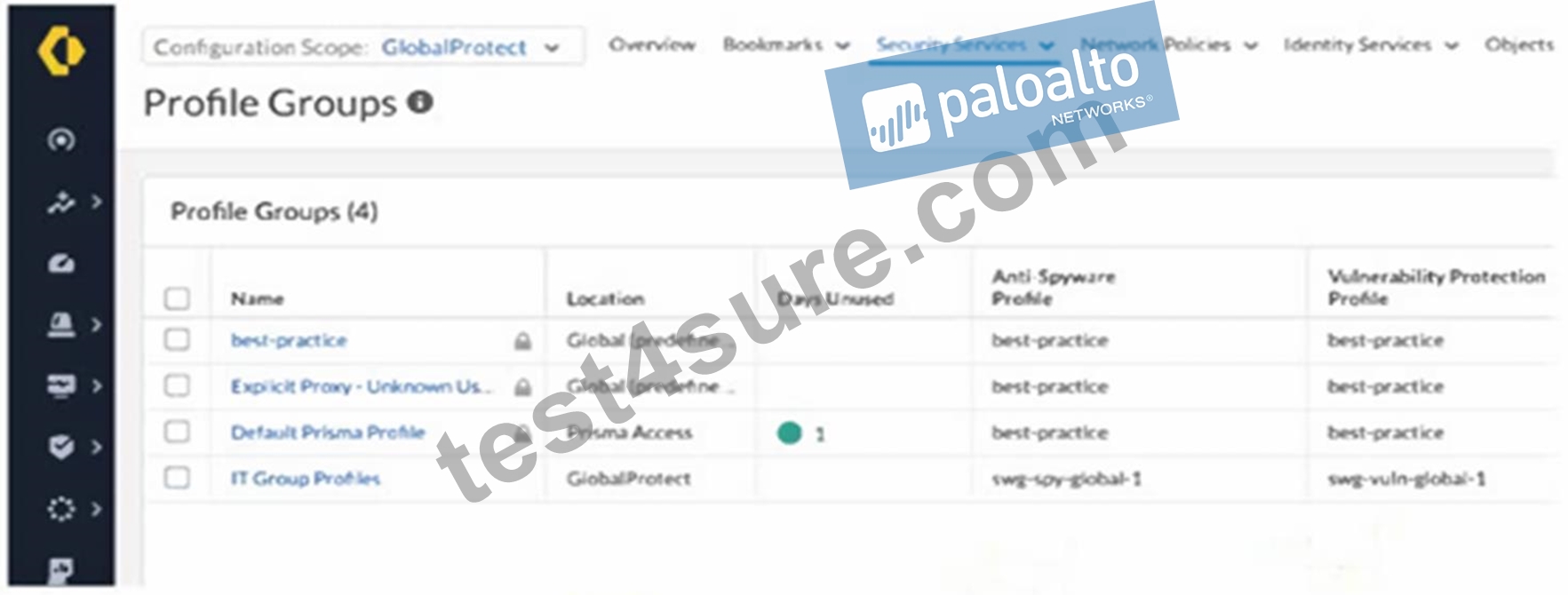
- A. Change the configuration scope to Prisma Access and modify the profile group.
- B. Modify the existing anti-spyware profile, because best-practice profiles cannot be removed from a group.
- C. Request edit access for the GlobalProtect scope.
- D. Create a new profile, because default profile groups cannot be modified.
Answer: D
Explanation:
Palo Alto Networks best practices and the behavior of Strata Cloud Manager (SCM) dictate thatpredefined or default objects, including profile groups like "Default Prisma Profile," cannot be directly modified.
These default objects serve as baseline configurations and are often locked to prevent accidental or unintended changes that could impact the overall security posture.
The intern's experience of the options being greyed out when selecting "Default Prisma Profile" is a direct indication of this immutability of default objects.
Therefore, the correct action is to:
* Create a new Profile Group:The intern should create a new profile group within the appropriate configuration scope (likely GlobalProtect, given the task).
* Configure the new Profile Group:In this new profile group, the intern can select the desired Anti- Spyware Profile (which might be an existing custom profile or a new one they create).
* Modify Security Rules:The security rules currently using the "Default Prisma Profile" in the GlobalProtect folder need to be modified to use this newly created profile group.
Let's analyze why the other options are incorrect based on official documentation:
* A. Request edit access for the GlobalProtect scope.While having the correct scope permissions is necessary for makinganychanges within GlobalProtect, it will not override the inherent immutability of default objects like "Default Prisma Profile." Edit access will allow the intern to create new objects and modify rules, but not directly edit the default profile group.
* B. Change the configuration scope to Prisma Access and modify the profile group.The image shows that "Default Prisma Profile" has a "Location" of "Prisma Access." However, even within the Prisma Access scope, default profile groups are generally not directly editable. The issue is not the scope but the fact that it's a default object.
* D. Modify the existing anti-spyware profile, because best-practice profiles cannot be removed from a group.The question is about changing theprofile group, not the individual Anti-Spyware Profile. While "best-practice" profiles might be part of default groups, the core issue is the inability to modify thedefault groupitself. Creating a new group allows the intern to choose which Anti-Spyware Profile to include.
In summary, the fundamental principle in Palo Alto Networks management is that default objects are typically read-only to ensure a consistent and predictable baseline. To make changes, you need to create custom objects.
NEW QUESTION # 40
Which overlay protocol must a customer premises equipment (CPE) device support when terminating a Partner Interconnect-based Colo-Connect in Prisma Access?
- A. GRE
- B. DTLS
- C. Geneve
- D. IPSec
Answer: D
Explanation:
When terminating aPartner Interconnect-based Colo-ConnectinPrisma Access, theCustomer Premises Equipment (CPE)must supportIPSecas the overlay protocol. Prisma Access establishes secureIPSec tunnels between theColo-Connect infrastructure and the CPE, ensuringencrypted communicationand reliable connectivity.IPSecprovidessecure site-to-cloud integration, enabling customers to extend their private network securely over the Prisma Access infrastructure.
NEW QUESTION # 41
Which feature will fetch user and group information to verify whether a group from the Cloud Identity Engine is present on a security processing node (SPN)?
- A. SASE Health Dashboard
- B. Region Activity Insights
- C. User Activity Insights
- D. Prisma Access Locations
Answer: A
Explanation:
TheSASE Health Dashboardprovides visibility intouser and group synchronizationbetween theCloud Identity Engine and the Security Processing Nodes (SPNs). It allows administrators to verifywhether a group from the Cloud Identity Engine is properly fetched and available on the SPN for policy enforcement.
This feature helps in troubleshooting identity-based access control issues and ensures thatuser group mappings are correctly applied within Prisma Access.
NEW QUESTION # 42
In an Explicit Proxy deployment where no agent can be used on the endpoint, which authentication method is supported with mobile users?
- A. SAML
- B. SSO
- C. LDAP
- D. Kerberos
Answer: A
Explanation:
In anExplicit Proxy deploymentwhereno agentcan be used on the endpoint,SAML (Security Assertion Markup Language)is the supported authentication method formobile users.SAMLallows authentication via anIdentity Provider (IdP)without requiring an agent on the endpoint, making it ideal for web-based authentication incloud and remote access environments. It enablesSingle Sign-On (SSO)and secure authentication without direct integration withLDAP or Kerberos, which typically require an agent or local network presence.
NEW QUESTION # 43
When a review of devices discovered by IoT Security reveals network routers appearing multiple times with different IP addresses, which configuration will address the issue by showing only unique devices?
- A. Create a custom role to merge devices with the same hostname and operating system.
- B. Merge individual devices into a single device with multiple interfaces.
- C. Delete all duplicate devices, keeping only those discovered using their management IP addresses.
- D. Add the duplicate entries to the ignore list in IoT Security.
Answer: B
Explanation:
When network routers appear multiple times with different IP addresses in IoT Security, it is likely because they have multiple interfaces with separate IPs. Merging these entries into a single device with multiple interfaces ensures that the system correctly identifies each router as a unique entity while maintaining visibility across all its interfaces. This approach prevents unnecessary duplicates, improves asset management, and enhances security monitoring.
NEW QUESTION # 44
Which two configurations must be enabled to allow App Acceleration for SaaS applications? (Choose two.)
- A. QoS for user traffic
- B. Acceleration agent for the client machines
- C. Trusted Root CA for the CA certificate
- D. Forward Trust Certificate for the CA certificate
Answer: C,D
Explanation:
To enable App Acceleration for SaaS applications in Prisma Access, the following configurations must be enabled:
Trusted Root CA for the CA certificate ensures that Prisma Access can validate and trust the SaaS application's certificates, allowing seamless inspection and acceleration of traffic without security warnings.
Forward Trust Certificate for the CA certificate enables SSL decryption for SaaS applications, allowing Prisma Access to optimize traffic and apply acceleration techniques while maintaining security policies.
NEW QUESTION # 45
A customer is implementing Prisma Access (Managed by Strata Cloud Manager) to connect mobile users, branch locations, and business-to- business (B2B) partners to their data centers.
The solution must meet these requirements:
The mobile users must have internet filtering, data center connectivity, and remote site connectivity to the branch locations.
The branch locations must have internet filtering and data center connectivity.
The B2B partner connections must only have access to specific data center internally developed applications running on non-standard ports.
The security team must have access to manage the mobile user and access to branch locations.
The network team must have access to manage only the partner access.
Which two options will allow the engineer to support the requirements? (Choose two.)
- A. Enable eBGP for dynamic routing and configure RemoteNetworks.
- B. Enable Remote Networks Advertise Default Route.
- C. Configure Remote Networks and define the branch IP subnets using Static Routes.
- D. Configure the CPE with Static Routes pointing to Prisma Access Infrastructure and Mobile User routes.
Answer: A,C
Explanation:
Enabling eBGP for dynamic routing and configuring Remote Networks ensures seamless connectivity between branch locations, mobile users, and the data center. eBGP allows Prisma Access to dynamically exchange routes with the Customer Premises Equipment (CPE), optimizing path selection without requiring manual updates. Configuring Remote Networks and defining branch IP subnets using static routes ensures controlled and segmented routing, aligning with security policies. This setup provides proper internet filtering, data center connectivity, and restricted access for B2B partners while keeping management responsibilities aligned.
NEW QUESTION # 46
How can a senior engineer use Strata Cloud Manager (SCM) to ensure that junior engineers are able to create compliant policies while preventing the creation of policies that may result in security gaps?
- A. Run a Best Practice Assessment (BPA) at regular intervals and manually revert any policies not meeting company compliance standards.
- B. Use security checks under posture settings and set the action to "deny" for all checks that do not meet the compliance standards.
- C. Configure role-based access controls (RBACs) for all junior engineers to limit them to creating policies in a disabled state, manually review the policies, and enable them using a senior engineer role.
- D. Configure an auto tagging rule in SCM to trigger a Security policy review workflow based on a security rule tag, then instruct junior engineers to use this tag for all new Security policies.
Answer: B
Explanation:
By usingsecurity checks under posture settingsinStrata Cloud Manager (SCM), the senior engineer can enforcepolicy compliance standardsbyautomatically denyingany security policy that does notalign with best practices. This ensures that junior engineers can create policies while preventing configurations that might introduce security gaps. This proactive approacheliminates manual oversightand enforces compliance at the time of policy creation, reducing risk and ensuring consistent security enforcement.
NEW QUESTION # 47
Which policy configuration in Prisma Access Browser (PAB) will protect an organization from malicious BYOD and minimize the impact on the user experience?
- A. One that blocks elements such as screen scrapers
- B. One that blocks file exchange
- C. One that allows access to applications with data masking or watermarking
- D. One for session recording
Answer: C
Explanation:
InPrisma Access Browser (PAB), allowing access to applications while enforcingdata masking or watermarkingprovides security forBYOD (Bring Your Own Device)users without heavily impacting the user experience.Data maskingensures that sensitive information isobscured, reducing the risk of data leakage, whilewatermarkingcan deter unauthorized screenshots or data exfiltration. This approachbalances security and usability, allowing users to work efficiently while protecting corporate data.
NEW QUESTION # 48
Which feature within Strata Cloud Manager (SCM) allows an operations team to view applications, threats, and user insights for branch locations for both NGFW and Prisma Access simultaneously?
- A. Log Viewer
- B. SASE Health Dashboard
- C. Branch Site Monitor
- D. Command Center
Answer: D
Explanation:
TheCommand CenterwithinStrata Cloud Manager (SCM)provides acentralized view of applications, threats, and user insightsacross bothNGFW (Next-Generation Firewall) and Prisma Access simultaneously. This feature enables theoperations teamto monitorbranch locations, analyzesecurity events, and detect anomalies in real time, offering acomprehensive visibility and threat intelligence interfacefor proactive network and security management.
NEW QUESTION # 49
When configuring Remote Browser Isolation (RBI) with Prisma Access (Managed by Strata Cloud Manager), which element is required to define the protected URLs for mobile users?
- A. A Security policy with the target URL categories and set the action to "Isolate"
- B. A DNS Security profile applied to a Security policy with the action of "Isolate" for the target remote browser DNS categories
- C. An RBI profile applied to the URL access management profile
- D. A URL access management profile with site access set to "Isolate" applied to a Security policy
Answer: D
Explanation:
When configuringRemote Browser Isolation (RBI)inPrisma Access (Managed by Strata Cloud Manager) for mobile users, aURL access management profilemust be created with thesite access action set to
"Isolate". This profile is thenapplied to a Security policyto enforce isolation for specific URLs. This ensures thatweb traffic to designated high-risk or untrusted sitesisredirected to a remote, secure browser instance, protecting endpoints from potential web-based threats.
NEW QUESTION # 50
......
Palo Alto Networks SSE-Engineer Exam Syllabus Topics:
| Topic | Details |
|---|---|
| Topic 1 |
|
| Topic 2 |
|
| Topic 3 |
|
| Topic 4 |
|
Tested Material Used To SSE-Engineer: https://freecert.test4sure.com/SSE-Engineer-exam-materials.html