

Actual ISO-9001-Lead-Auditor Exam Recently Updated Questions with Free Demo
Free PECB ISO-9001-Lead-Auditor Exam Questions Self-Assess Preparation
NEW QUESTION # 130
Select one option that must be considered when determining the scope of a QMS to ISO 9001.
- A. External issues of the organisation's context
- B. Business improvement
- C. Performance of business processes
- D. Competence of top management
Answer: A
Explanation:
According to ISO 9001:2015, clause 4.3, the organization is required to determine the scope of its quality management system (QMS) by considering the external and internal issues referred to in clause 4.1. Clause 4.1 requires the organization to determine the external and internal issues that are relevant to its purpose and strategic direction, and that affect its ability to achieve the intended results of its QMS. These issues can include positive and negative factors or conditions for consideration, such as legal, technological, competitive, market, cultural, social, and economic environments, whether international, national, regional, or local. The organization is also required to monitor and review these issues.
Therefore, the correct answer is C, as external issues of the organization's context are one of the factors that must be considered when determining the scope of the QMS. The other options are either not directly related to the scope of the QMS, or are not explicitly mentioned in clause 4.3.
References:
ISO 9001:2015(en), Quality management systems - Requirements, clause 4.1 and 4.3 ISO 9001:2015 - How to determine the scope of your QMS - Advisera, section "Considerations for determining the scope of the QMS in ISO 9001" ISO 9001 Lead Auditor Training Course | IRCA Certified | BSI, section "Learning objectives" ISO 9001 Lead Auditor Course Material | 3FOLD Education Centre, module 4
NEW QUESTION # 131
XYZ Corporation is an organisation that employs 100 people. As audit team leader, you are conducting a certification audit at Stage 1. When reviewing the quality management system (QMS) documentation, you find that quality objectives have been set for every employee in the organisation except top management.
The Quality Manager complains that this has created a lot of resistance to the QMS, and the Chief Executive is asking questions about how much it will cost. He asks for your opinion on whether this is the correct method of setting objectives.
Three months after Stage 1, you return to XYZ Corporation to conduct a Stage 2 certification audit as Audit Team Leader with one other auditor. You find that the Quality Manager has cancelled the previous quality objectives for all employees and replaced them with a single objective for himself. This states that "The Quality Manager will drive multiple improvements in the QMS in the next year". The Quality Manager indicates that this gives him the authority to issue instructions to department managers when quality improvement is needed. He says that this approach has the full backing of senior management. He shows you the latest Quality Improvement Request that was included in the last management review.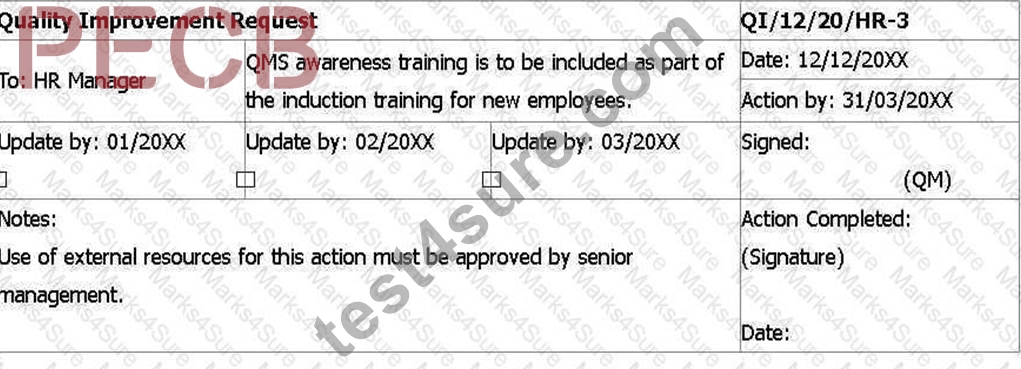
After further auditing, the issues below were found. Select two statements that apply to the term
`nonconformity'.
- A. Quality improvements not aligning with the quality policy.
- B. Decisions on improvement action timescales not involving departmental managers.
- C. Limited knowledge of the content of Quality Improvement Requests by departmental staff.
- D. No quality objectives planned for the top management team
- E. Evaluation of the results of the improvement action not always documented by the Quality Manager.
- F. Top management claim not to be aware of the improvement request (QI/12/20/HR-3) initiated by the Quality Manager.
Answer: A,D
Explanation:
According to the ISO 9001:2015 standard, clause 10.2.1 defines nonconformity as the non-fulfilment of a requirement. A requirement can be related to the quality management system, the products and services, the customer expectations, or the applicable statutory and regulatory requirements. Nonconformities can be detected through various sources, such as audits, inspections, tests, customer complaints, or internal reviews.
Nonconformities must be addressed by taking appropriate actions to correct them and prevent their recurrence.
In this scenario, the auditee has shown several issues that indicate nonconformities in their quality management system. Two statements that apply to the term nonconformity are:
A: No quality objectives planned for the top management team: According to ISO 9001, clause 6.2.1, the organization must establish quality objectives at relevant functions, levels, and processes. The quality objectives must be consistent with the quality policy and the strategic direction of the organization. The top management team is responsible for providing leadership and direction for the quality management system and ensuring its alignment with the organization's purpose and context. Therefore, the absence of quality objectives for the top management team is a nonconformity as it violates the requirement of clause 6.2.1.
E: Quality improvements not aligning with the quality policy: According to ISO 9001, clause 5.2.1, the quality policy is a statement of the organization's intentions and direction regarding quality, as formally expressed by top management. The quality policy must provide a framework for setting quality objectives and be compatible with the context and strategic direction of the organization. The quality policy must also be communicated, understood, and applied within the organization. Therefore, if the quality improvements are not aligned with the quality policy, it is a nonconformity as it violates the requirement of clause 5.2.1.
NEW QUESTION # 132
You are carrying out an audit at an organisation seeking certification to ISO 9001 for the first time. The organisation offers health and safety training to customers. Training courses are offered either as open courses, delivered at a public venue, or online, or as courses that are tailored to meet specific requirements.
The business operates from a single office and those who deliver the training are either full-time employees or subcontractors.
You are interviewing the Training Manager (TM).
You: "What quality objectives apply to the training process?"
TM: "One of the quality objectives we aim for is a 90% minimum exam pass rate for all open training courses." You: "How do you measure this objective?" The Training Manager shows you a record on her computer and you see the following: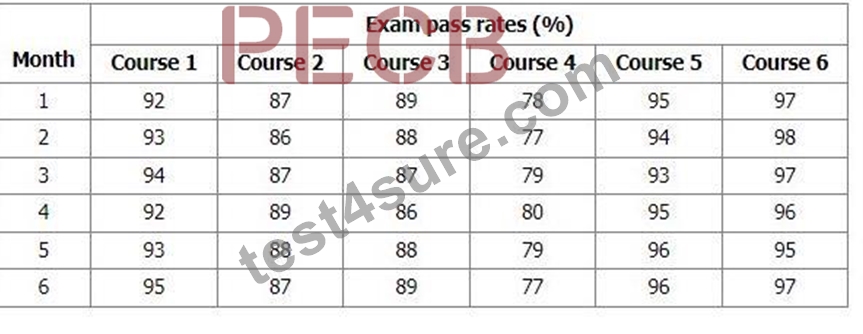
Which two of the following statements are true?
- A. You would check the training of personnel.
- B. You would determine the relative difficulty of each training course by reviewing them.
- C. You would determine how the exam pass rate figures were analysed.
- D. You would raise a nonconformity as a requirement in clause 8.7 has not been fulfilled.
- E. You would raise a nonconformity as a requirement in clause 10.2 has not been fulfilled.
- F. You would determine what corrective action was being taken to address the low pass rates.
Answer: C,F
Explanation:
In this scenario, the organization has set a quality objective of achieving a 90% minimum exam pass rate for all courses. The auditor's task is to assess whether this objective is being monitored effectively and if appropriate actions are taken when the objective is not met.
B: You would determine how the exam pass rate figures were analysed: ISO 9001:2015, particularly Clause
9.1 (Monitoring, measurement, analysis, and evaluation), requires organizations to evaluate performance data.
The auditor should verify how the organization analyses the pass rate data to ensure trends are identified, and corrective actions are planned based on this analysis.
D: You would determine what corrective action was being taken to address the low pass rates: When performance falls short of the objective, as seen with Course 4 (where the pass rate is below 90% in all months), Clause 10.2 (Nonconformity and corrective action) requires organizations to take corrective actions to address issues. The auditor would need to check if corrective actions have been initiated to address consistently low pass rates.
Statements A, C, E, and F do not directly address the monitoring and corrective action required under ISO
9001:2015 in this context.
NEW QUESTION # 133
Put the following steps of a third-party audit into the correct sequence in which they happen.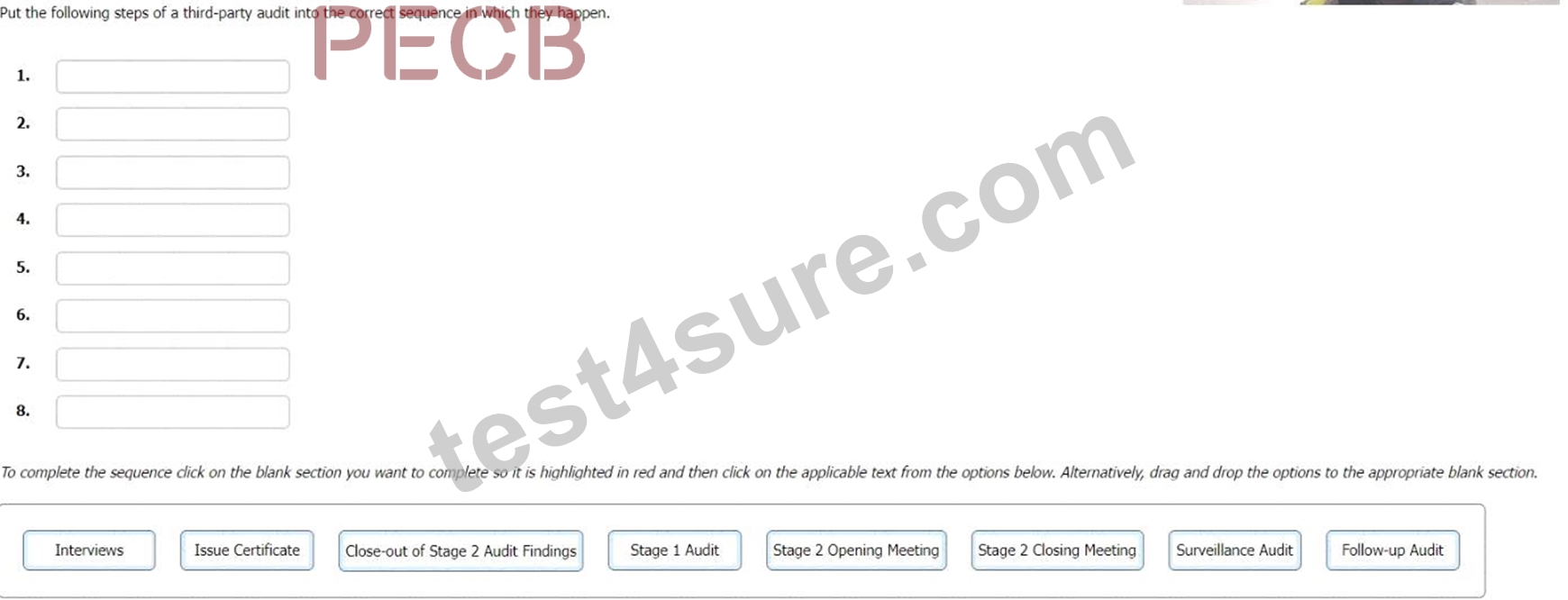
Answer:
Explanation: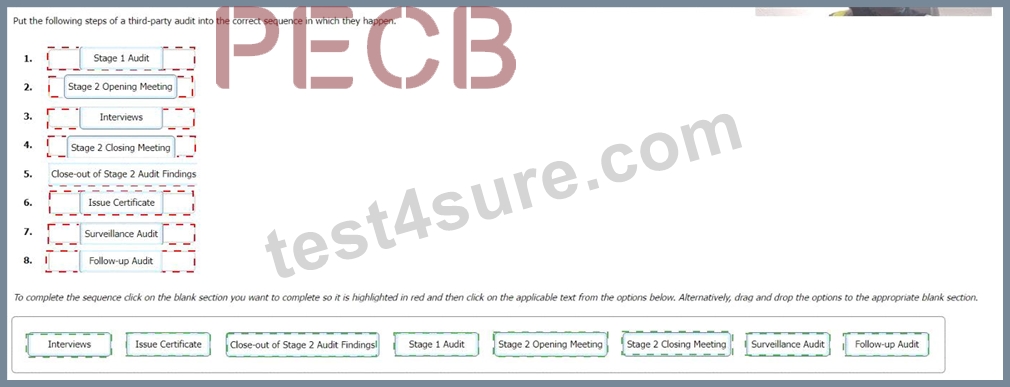
Explanation:
Sequence:
Stage 1 Audit
Stage 2 Opening Meeting
Interviews
Stage 2 Closing Meeting
Close-out of Stage 2 Audit Findings
Issue Certificate
Surveillance Audit
Follow-up Audit
To complete the sequence, you can drag and drop the options to the appropriate blank section.
Here is a brief explanation of each step:
Stage 1 Audit: This is the initial audit that aims to assess the readiness of the organization for the stage 2 audit. It involves reviewing the documentation of the quality management system, evaluating the scope and objectives of the audit, and identifying any major gaps or nonconformities34.
Stage 2 Opening Meeting: This is the meeting that marks the start of the stage 2 audit. It involves confirming the audit plan, the audit criteria, the audit scope, and the audit team. It also provides an opportunity for the auditee to ask any questions or raise any concerns34.
Interviews: This is the main activity of the stage 2 audit, where the audit team collects evidence by interviewing the personnel involved in the quality management system, observing the processes and activities, and examining the records and documents. The audit team uses various techniques, such as sampling, measurement, analysis, and evaluation, to verify the conformity and effectiveness of the quality management system345.
Stage 2 Closing Meeting: This is the meeting that marks the end of the stage 2 audit. It involves presenting the audit findings, the audit conclusions, and the audit report to the auditee. It also provides an opportunity for the auditee to provide feedback, ask questions, or dispute any findings34.
Close-out of Stage 2 Audit Findings: This is the process of verifying that the auditee has taken appropriate corrective actions to address any nonconformities or opportunities for improvement identified during the stage 2 audit. The audit team may request evidence or conduct a follow-up visit to confirm the effectiveness of the corrective actions34.
Issue Certificate: This is the process of issuing a certificate of conformity to the auditee, if the audit team is satisfied that the quality management system meets the requirements of the standard and that there are no major nonconformities or unresolved issues. The certificate is valid for a specified period, usually three years, and is subject to periodic surveillance audits34.
Surveillance Audit: This is the process of conducting periodic audits, usually once a year, to monitor the continued conformity and effectiveness of the quality management system. It involves reviewing the changes, improvements, and performance of the quality management system, and identifying any new nonconformities or opportunities for improvement34.
Follow-up Audit: This is the process of conducting an additional audit, usually in response to a significant change, a complaint, or a major nonconformity, to verify the impact and the corrective actions taken by the auditee. It may result in the suspension, withdrawal, or renewal of the certificate, depending on the outcome of the audit34.
NEW QUESTION # 134
Scenario 3:
Fin-Pro is a financial institution in Austria offering commercial banking, wealth management, and investment services. The company faced a significant loss of customers due to failing to improve service quality as they expanded.
To regain customer confidence, top management implemented a QMS based on ISO 9001. After a year, they contacted ACB, a local certification body, to pursue ISO 9001 certification.
The audit team was led by Emilia, an experienced lead auditor, and included three auditors. After an agreement was reached, ACB sent the audit objectives to the audit team.
The audit team began by gathering information about Fin-Pro's understanding of ISO 9001 requirements.
While reviewing documented information, they noticed missing records of training and awareness sessions. They conducted employee interviews to verify attendance.
The team also reviewed the organizational chart and job descriptions to confirm employee competence.
They observed the company's working environment (social, psychological, and physical conditions).
The audit team analyzed the evidence and prepared an audit report with findings and conclusions.
Which statement below represents the level of responsibility demonstrated by the audit team in scenario 3?
- A. Gross negligence, the audit team has demonstrated a total lack of diligence.
- B. No negligence, the audit team has demonstrated diligence during the audit and followed the best practices.
- C. Ordinary negligence, the audit team has demonstrated lack of diligence.
- D. Willful misconduct, the audit team intentionally disregarded audit procedures.
Answer: B
Explanation:
Comprehensive and Detailed In-Depth Explanation:
ISO 19011:2018 requires auditors to conduct audits professionally and diligently.
Clause References:
* ISO 19011:2018, Clause 4.4 - Professional Care: Auditors must exercise due diligence in conducting audits.
* ISO 9001:2015, Clause 9.2 - Internal Audit: Requires objective and systematic audits to evaluate QMS effectiveness.
Why is the Correct Answer A?
* The audit team followed best practices by gathering verifiable audit evidence through interviews, document reviews, and observations.
* They ensured fair presentation of findings in the final audit report.
* They complied with ISO 9001 and ISO 19011 guidelines for audit procedures.
Why are the Other Options Incorrect?
* B (Ordinary negligence) # No evidence of negligence; the team followed structured audit processes.
* C (Gross negligence) # No indication that the auditors ignored important responsibilities.
* D (Willful misconduct) # The auditors acted professionally and did not intentionally disregard rules.
NEW QUESTION # 135
In the context of a third-party certification audit, match the roles with the following responsibilities: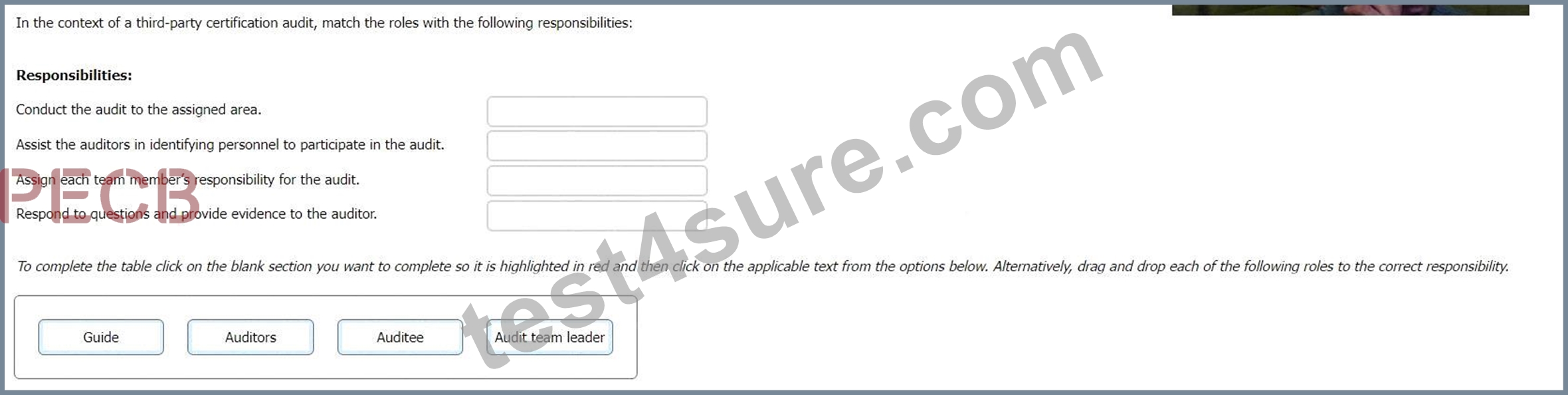
Answer:
Explanation: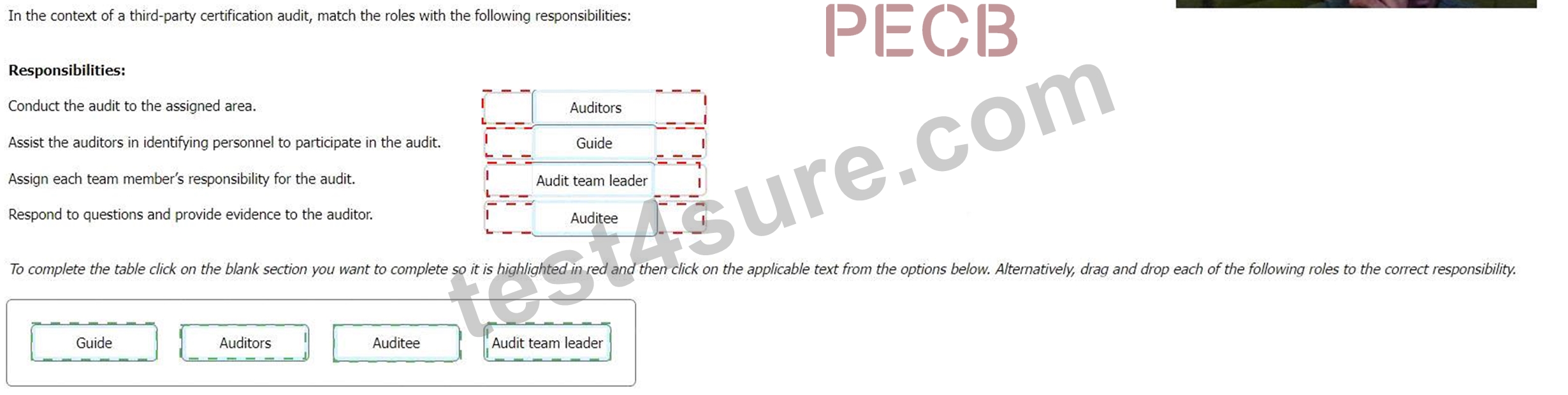
Explanation:
In the context of a third-party certification audit, match the roles with the following responsibilities:
Responsibilities:
Conduct the audit to the assigned area.= Auditors
Assist the auditors in identifying personnel to participate in the audit.= Guide Assign each team member's responsibility for the audit.= Audit team leader Respond to questions and provide evidence to the auditor.= Auditee According to ISO 19011:2018, clause 3, the definitions of the roles are as follows1:
Auditors: persons with the competence to conduct an audit
Guide: person appointed by the auditee to assist the audit team
Auditee: organization being audited
Audit team leader: member of an audit team appointed to manage the audit or an audit team Therefore, the roles can be matched to the responsibilities based on these definitions and the description of the audit process in clause 6 of the standard1.
References: ISO 19011:2018(en), Guidelines for auditing management systems
NEW QUESTION # 136
What are the criteria for reviewing documented information?
- A. Archive, volume, and confidentiality of documented information
- B. Content, format, and the procedure for managing documented information
- C. Language of documented information, internal audit reports, client feedback
Answer: B
Explanation:
Comprehensive and Detailed In-Depth Explanation:According to ISO 9001:2015, Clause 7.5.2 (Creating and Updating Documented Information), the criteria for reviewing documented information include:
* Content - The accuracy and relevance of the information.
* Format - Ensuring readability and proper structuring (e.g., language, versioning).
* Procedure for managing documented information - Ensuring control, access, and updates.
Other options, such as internal audit reports and client feedback, are important for overall QMS evaluation but are not the main criteria for reviewing documented information.
NEW QUESTION # 137
You work for an organisation, 'A', which provides packaged food to the public. You are asked to lead a team (you as the leader and two other auditors) to audit a supplier, 'B', which provides packaging materials to your organisation. It is 4 p.m. and the audit is close to an end; you are having an internal meeting with the team to decide what will be presented to the auditee during the Closing meeting.
The Closing meeting was scheduled
for 5 p.m.
You, as audit team leader, audited top management, the laboratory, and the storage of raw materials.
Auditor 1 audited the two manufacturing lines and dispatch areas.
You to Auditor 1: "What findings would you report?"
Auditor 1: "When reviewing the Dispatch records, I noticed that during the morning two different trucks (Number 011 and 025) delivered the same batch number of the product (Batch 33555). Truck 011 left the plant at 9.15 am and Truck 025 left the plant at
11.30 am. Procedure P-02 Rev.3 says
that trucks should carry a complete batch. The batch number, once on the truck, is captured using a QR device." You: "OK, what do you think?" Auditor 2: "I think that this is a nonconformity." You: "OK. How would you describe the evidence on which the nonconformity will be based"?
Identify which one of the following statements best describes the identified nonconformity.
- A. The batch 33555 was delivered split in two different trucks (011 and 025).
- B. Dispatch personnel do not always carry out its activities in conformance with Procedure P-02 rev 3.
- C. A product delivered to the client was not identified as required in P-02 Rev 3.
- D. Dispatch personnel are not fully aware of the need to conform to written procedures.
Answer: A
Explanation:
According to the definition in ISO 9000, a nonconformity is "non-fulfillment of a requirement". There are three parts to a well-documented nonconformity: the audit evidence to support auditor findings; a record of the requirement against which the nonconformity is detected; and the statement of nonconformity1. In this case, the audit evidence is the dispatch records that show the same batch number of the product being delivered by two different trucks at different times. The requirement is the procedure P-02 Rev.3 that says that trucks should carry a complete batch. The statement of nonconformity is that the batch 33555 was delivered split in two different trucks (011 and 025), which does not conform to the procedure. Therefore, option C best describes the identified nonconformity, as it includes all three parts of a well-documented nonconformity.
Option A is not correct, as it does not state the audit evidence or the requirement. Option B is not correct, as it does not specify the audit evidence or the statement of nonconformity. Option D is not correct, as it does not match the audit evidence or the requirement. References: 1: ISO 9001 Auditing Practices Group Guidance on Nonconformity - Documenting.
NEW QUESTION # 138
In the context of a third-party certification audit, it is very important to have effective communication. Which is not the responsibility of the audit team leader?
- A. If audit objectives are unattainable, reporting the reasons to the accreditation body.
- B. Communicating the progress, any significant findings and any concerns to the auditee and audit client, as appropriate.
- C. Planning formal communication arrangements, so an auditee can communicate with the auditor any time during the audit.
- D. Confirming formal communication channels between the audit team and the auditee during the opening meeting.
Answer: A
NEW QUESTION # 139
The following actions need to be carried out during a third-party audit planning stage. Which two actions correspond to the individual(s) managing the audit program before the involvement of the audit team leader'
- A. Prepare the audit plan
- B. Prepare the checklists
- C. Assign responsibilities within the audit team
- D. Provide the resources needed
- E. Select the audit team members
- F. Review the reports of previous audits
Answer: D,F
Explanation:
In ISO 9001:2015, the responsibility for managing the audit program lies with those overseeing the entire audit process rather than the Audit Team Leader. During the planning stage, before involving the Audit Team Leader, key actions for managing the audit program include:
1. Providing the Resources Needed: According to clause 7.1 (Resources), the audit program manager must ensure that the necessary resources are in place to conduct the audit effectively. This encompasses logistical support, personnel, and other required resources for the audit to proceed smoothly.
2. Reviewing Reports of Previous Audits: As per clause 9.2.2 (Internal Audit), it is essential to consider the results of previous audits to plan effectively for the upcoming audit. This helps identify areas that require particular attention, ensuring continuity and focusing on recurring issues or improvements since the last audit.
These actions ensure that the audit is thoroughly prepared and that there is continuity and focus on any areas that might need closer inspection. The other options, such as preparing the audit plan, assigning responsibilities, preparing checklists, and selecting the audit team members, generally fall under the duties of the Audit Team Leader once they are appointed and engaged in the planning process.
NEW QUESTION # 140
Whistlekleen is a national dry cleaning and laundry company with 50 shops. You are conducting a surveillance audit of the Head Office and are sampling customer complaints. You find that 80% of complaints originate from five shops in the same region. Most of these complaints relate to damage to customer laundry. The Quality Manager tells you that these are the oldest shops in the company. The cleaning equipment needs replacing but the company cannot afford it at the moment. You learn that the shop managers were told to dismiss most of the claims on the basis of the poor quality of the laundered materials.
On raising the matter with senior management, you are told that there are plans to replace the equipment in these shops over the next five years.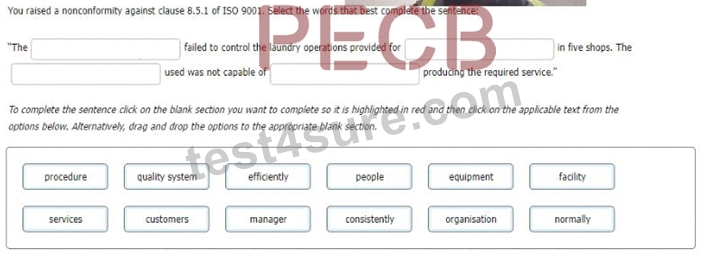
Answer:
Explanation: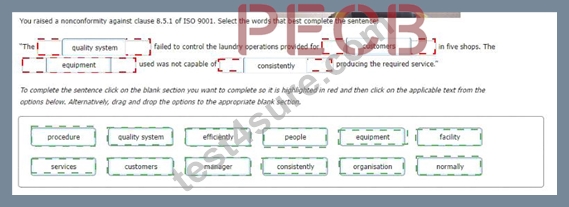
Explanation:
The quality system failed to control the laundry services provided for customers in five shops.
The equipment used was not capable of consistently producing the required service.
NEW QUESTION # 141
Which two of the following statements related to Stage 1 of an initial certification audit against ISO 9001:
2015 are true?
- A. Reviews the processes with high level of risk
- B. Evaluates the conditions of all sites
- C. Verifies the compliance with legal requirements
- D. During the Stage 1 audit, the audit team:
- E. Verifies the degrees of customer satisfaction
- F. Reviews the client's management system documented information
- G. Evaluates the results of the last management review
Answer: A,G
Explanation:
The Stage 1 audit is a readiness review that verifies the organization's ability to conduct the Stage 2 audit. It involves reviewing the documented information, evaluating the site-specific conditions, and having discussions with personnel. The auditor does not verify the degrees of customer satisfaction, the compliance with legal requirements, or the results of the last management review during the Stage 1 audit. These are done during the Stage 2 audit or later in the certification process. References:
ISO 9001 Lead Auditor Reference Materials
ISO 9001 Lead Auditor Candidate Handbook
ISO 9001 Lead Auditor Course Material
ISO 9001 Lead Auditor Training Course IRCA Certified
NEW QUESTION # 142
A small deaning services organisation is about to start work on a hospital dleaning contract for the local Health Trust. You, as auditor, are conducting a Stage 2 audit to ISO 9001 and review the contract with the Service Manager. The contract requires that a cleaning plan is produced. You: "How was the cleaning plan for the contract developed?" Service Manager: "We have a basic template that covers the materials, labour requirements and cleaning methods to be employed. Some of that is specified by the customer." You: "How does the plan deal with locations like the intensive care wards and the operating theatres, which are included in the contract?" Service Manager: "The basic plan covers general wards, but we will do more frequent cleaning in those areas if the hospital requests it." You: "Are you aware of the regulatory requirements for cleaning standards in hospitals?" Service Manager: "No. We depend on the hospital to look after that side of things in the contract." You decide to raise a non-conformity against section 8.2.2.a.1 of ISO 9001. You decide to raise another non-conformity against section 8.2.4 of ISO 9001 when finding that the cleaning plan was amended without the agreement of the Health Trust. A different cleaning chemical was substituted to that specified in the contract. At the follow- up audit, the corrective action proposed was to "obtain a concession from the Health Trust for use of the new chemical." Which one of the following options is the reason why you did not accept this action taken?
- A. The action assumes that the Health Trust will agree to the change.
- B. The substitute chemical has not been used before in the Health Trust.
- C. The process for making changes to the contract has not been addressed.
- D. The substitute chemical may not be as effective as the original.
- E. Staff have not been trained in the use of the new chemical.
Answer: C
Explanation:
* Clause 8.2.4 of ISO 9001:2015 - Changes to Requirements for Products and Services:ISO 9001:
2015 Clause 8.2.4 states that when changes to requirements for products or services are made, they must be communicated and agreed upon with relevant interested parties (in this case, the Health Trust).
The lack of communication and agreement for substituting the cleaning chemical represents a clear violation of this clause.
* Analysis of the Corrective Action Proposed:The organization proposed "obtaining a concession from the Health Trust for the use of the new chemical." This action is reactive and assumes approval from the Health Trust without addressing the systemic issue: the lack of a defined change control process for managing contract changes.
* Option Analysis:
* A. The substitute chemical has not been used before in the Health Trust:Incorrect. While this may be a concern, it is not directly relevant to the root cause of the nonconformity, which is the absence of a process to handle contract changes.
* B. The action assumes that the Health Trust will agree to the change:Incorrect. Although this is true, it is not the primary issue. The nonconformity lies in the lack of a structured approach to obtain agreement, not whether the Health Trust agrees.
* C. Staff have not been trained in the use of the new chemical:Incorrect. This is a separate issue related to staff competence (Clause 7.2), but it is not the main reason why the corrective action is unacceptable under Clause 8.2.4.
* D. The process for making changes to the contract has not been addressed:Correct. The fundamental issue is the organization's failure to follow or establish a change control process for amending contracts, including gaining formal agreement from the Health Trust. The proposed corrective action does not ensure that such issues will be systematically prevented in the future.
* E. The substitute chemical may not be as effective as the original:Incorrect. The effectiveness of the substitute chemical is secondary to the primary issue, which is the lack of a change management process.
* ISO 9001 References Supporting the Correct answer:
* Clause 8.2.4: Requires that changes to product/service requirements be reviewed, communicated, and agreed upon with the customer.
* Clause 10.2 (Nonconformity and Corrective Action): Requires the organization to address the root cause of the nonconformity and take actions to ensure it does not recur. In this case, the root cause is the absence of a change control process.
* Why D is the Best answer:The core issue is that the organization did not have a formalized process for managing and agreeing upon changes to contract requirements. Addressing this process gap is essential to prevent recurrence of similar nonconformities. Merely seeking a concession from the Health Trust is a one-off solution that does not address the systemic issue.
NEW QUESTION # 143
What type of audit evidence are policies and guidelines?
- A. Confirmative evidence.
- B. Documentary evidence.
- C. Technical evidence.
Answer: B
Explanation:
Comprehensive and Detailed In-Depth Explanation:
Policies and guidelines are considered documentary evidence because they are written records that demonstrate how an organization complies with ISO 9001 requirements.
Clause References:
* ISO 19011:2018, Clause 6.4.6 - Audit Evidence:
* Documentary evidence includes manuals, procedures, and policies.
Why is the Correct Answer C?
* Documentary evidence includes written records such as policies, procedures, and documented instructions that support QMS implementation.
* Auditors review policies to verify conformance with ISO 9001.
Why are the Other Options Incorrect?
* A (Confirmative evidence) # Not a recognized category in ISO auditing.
* B (Technical evidence) # Technical evidence refers to measurements, test results, or product data, not policies.
Reference:
ISO 19011:2018, Clause 6.4.6 - Audit Evidence
NEW QUESTION # 144
ABC is a worldwide fast-food organisation. One of the branches, in downtown Cape Town, decided to implement an ISO 9001 quality management system and you are the audit team leader (with two other auditors) that will carry out the certification audits, Stage 2.
ABC receive the orders by phone or internet; some of the employees deliver the ordered food to indicated addresses. The normal menu includes 15 different types of hamburgers; however, in the last two weeks, due to a shortage of a special type of meat, they can only prepare six of the 15 varieties.
During the internal meeting of the audit team, you ask one of the auditors to describe what she has observed. She audited the reception of orders from customers (via phone or internet) and the communication of the orders to the kitchen. She noticed that the menu offering food on the website is still the normal one, with 15 different hamburgers, and during a 30-minute period, she observed many customers reluctantly accepting something other than the hamburger they preferred.
You, as audit team leader, inform the Quality Manager of your concern about the major nonconformity, since you consider this a serious breach of the basic principles of quality that lasted two weeks without action being taken.
Right at the beginning of the Closing meeting, you discuss the nonconformity with the General Manager.
She got quite upset and said she was going to make a complaint to the certification body and left the room; the Quality Manager was the only member of ABC left with the audit team. The Quality Manager said the General Manager would not come back to the meeting.
What would you do? Choose the best from the following options:
- A. Ask the Quality Manager for a break to discuss the issue with the members of the audit team.
- B. Inform the Quality Manager that you consider the meeting closed, and that you will report to the Certification Body for instructions.
- C. Ask the Quality Manager to listen to the nonconformity the auditor will present and continue with the meeting until its closure.
- D. Inform the Quality Manager that the certification process is put on hold and leave the room.
Answer: C
NEW QUESTION # 145
The following are stages of an audit, put them in the order they would be conducted.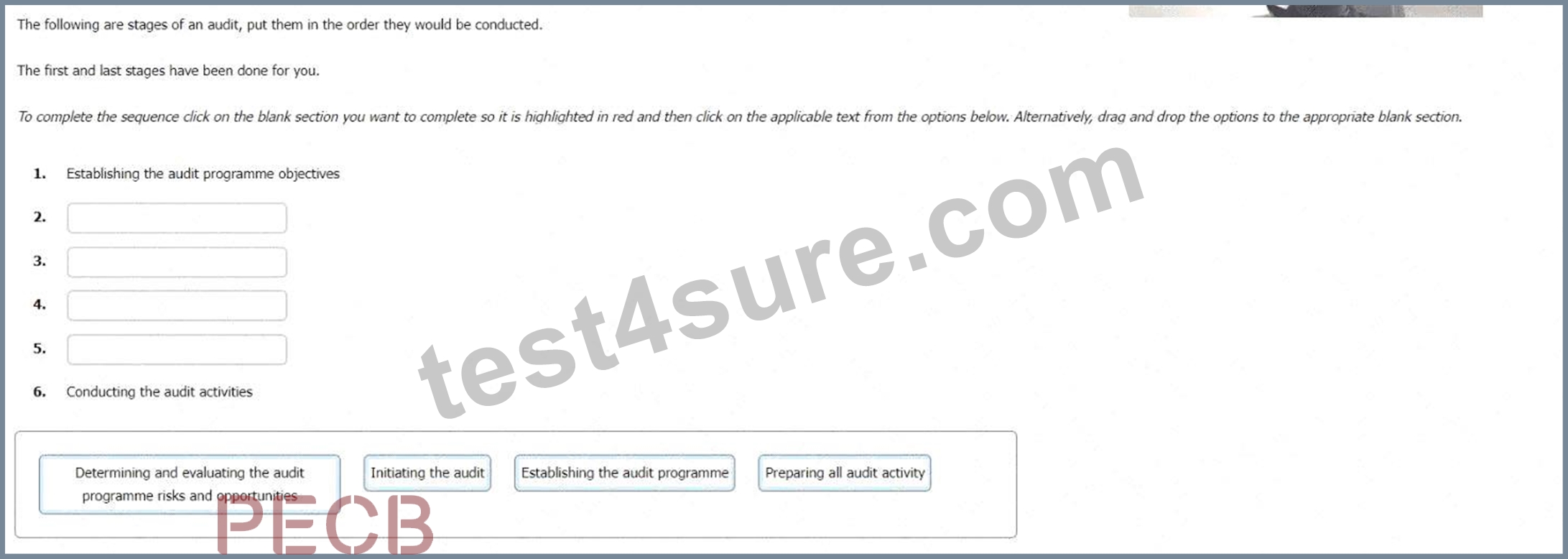
Answer:
Explanation: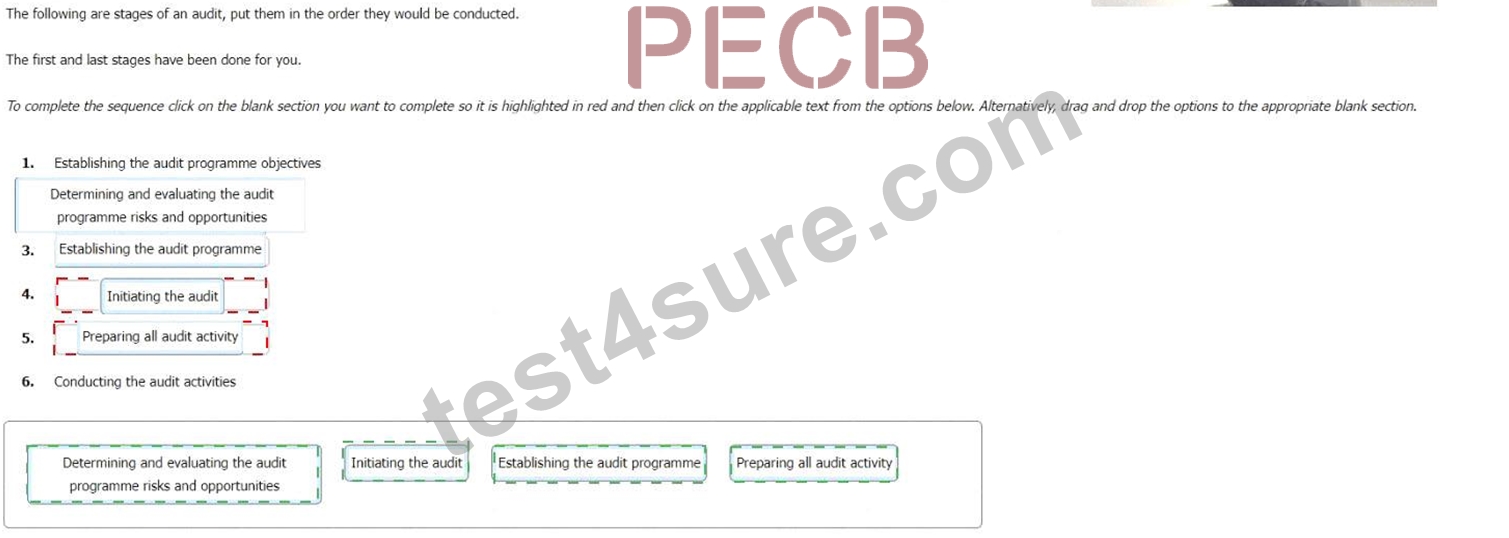
Explanation: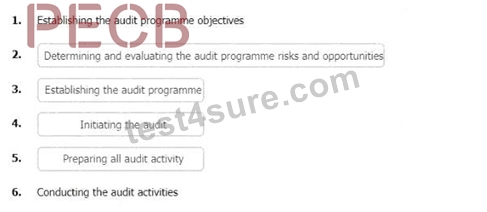
Establishing the audit programme objectives
Determining and evaluating the audit programme risks and opportunities
Establishing the audit programme
Initiating the audit
Preparing all audit activity
Conducting the audit activities
To complete the sequence, you can drag and drop the options to the appropriate blank section.
Here is a brief explanation of each stage:
Establishing the audit programme objectives: This is the first stage of the audit process, where the purpose, scope, and criteria of the audit programme are defined. The audit programme objectives should be aligned with the strategic direction and policies of the organization, and should address the needs and expectations of the interested parties12.
Determining and evaluating the audit programme risks and opportunities: This is the second stage of the audit process, where the factors that can affect the achievement of the audit programme objectives are identified and assessed. The audit programme risks and opportunities should consider the internal and external issues, the requirements and changes of the interested parties, and the results and feedback from previous audits12.
Establishing the audit programme: This is the third stage of the audit process, where the audit programme is designed and implemented. The audit programme should include the audit programme procedures, the audit programme resources, the audit methods and techniques, the audit frequency and schedule, and the audit programme performance indicators12.
Initiating the audit: This is the fourth stage of the audit process, where the audit is prepared and planned. The audit initiation involves selecting the audit team, establishing the contact with the auditee, defining the audit objectives, scope, and criteria, developing the audit plan, and conducting the document review123.
Preparing all audit activity: This is the fifth stage of the audit process, where the audit activities are organized and coordinated. The audit preparation involves assigning the audit tasks, communicating with the auditee and the audit team, arranging the logistics, preparing the working documents, and conducting the opening meeting123.
Conducting the audit activities: This is the sixth and final stage of the audit process, where the audit evidence is collected and evaluated. The audit conduct involves performing the audit activities, such as interviews, observations, document reviews, and tests, documenting the audit findings, preparing the audit conclusions, and conducting the closing meeting123.
I hope this helps you with your ISO 9001 Lead Auditor objectives and content. If you have any further questions, please feel free to ask. # References: 1: ISO 19011:2018 - Guidelines for auditing management systems 2: Audit Process | Flowchart | Summary - Accountinguide 3: What are the Stages of the Auditing Process & Why it is Important ...
NEW QUESTION # 146
You are carrying out an audit at a single-site organisation seeking certification to ISO 9001 for the first time.
The organisation manufactures cosmetics for major retailers.
You are interviewing the Manufacturing Manager (MM).
You: "I would like to begin by looking at the cleaning controls."
MM: "We record the cleaning of the equipment at the end of every batch. This document details the minimum cleaning frequency and the procedures to follow for all areas and each item of equipment. The person who carries out the cleaning puts their initial on the document and records the time and date alongside." Narrative: You sample production records over 3-days and note down evidence of nonconformity as per the table below.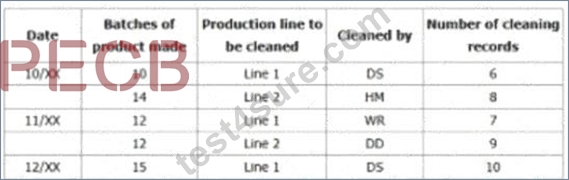
You decide to raise a non-conformity.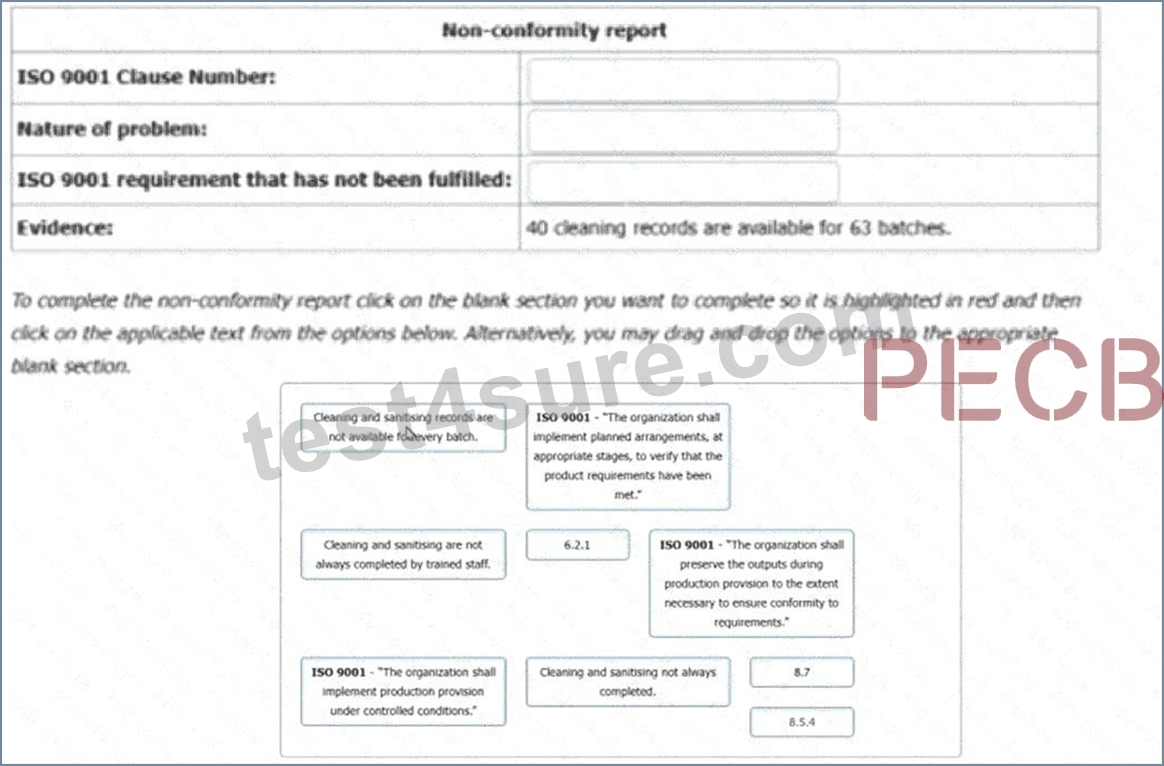
Answer:
Explanation: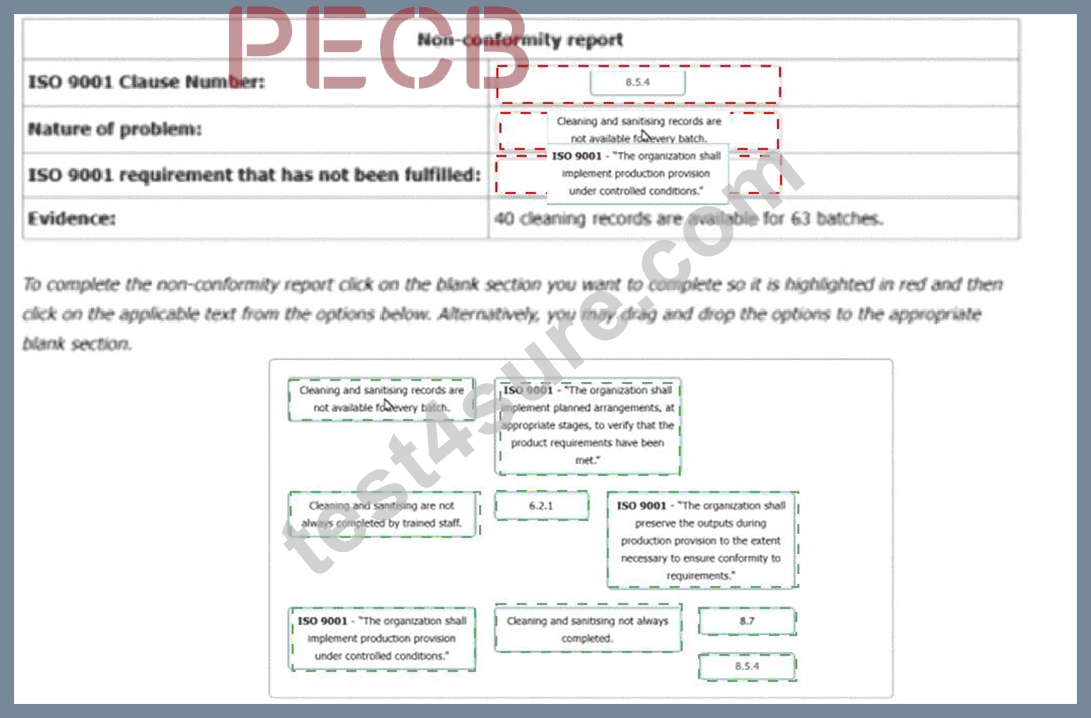
Explanation:
Clause: 8.5.4
Nature of Problem: Cleaning and sanitising records are not available for every batch.
Unfulfilled Requirement: "The organization shall implement production provision under controlled conditions."
NEW QUESTION # 147
Which one of the following options best describes the purpose of a Stage 1 third-party audit?
- A. To learn about the organisation's procurement processes.
- B. To get to know the organisation's customers.
- C. To determine the auditees understanding of ISO 9001.
- D. To introduce the audit team to the client.
Answer: C
Explanation:
The purpose of a Stage 1 third-party audit is to determine an organization's readiness for their Stage 2 Certification Audit. During the Stage 1, the auditor will review the organization's management system documented information, evaluate the site-specific conditions, and have discussions with personnel. The objective is to assess the alignment of the organization's design with ISO 9001 requirements and to identify any areas of concern that could be classified as a nonconformance during the Stage 2 Audit. The auditor will also use the Stage 1 Audit to complete Stage 2 Audit planning, including a review of the allocation of resources and details for the next phase of the audit. Therefore, the option that best describes the purpose of a Stage 1 third-party audit is A, to determine the auditees understanding of ISO 9001. The other options are not correct, as they are not the main focus of a Stage 1 audit:
*B. To get to know the organization's customers: This is not the purpose of a Stage 1 audit, as the auditor is not interested in the specific details of the organization's customers, but rather in the organization's ability to meet customer and applicable statutory and regulatory requirements.
*C. To learn about the organization's procurement processes: This is not the purpose of a Stage 1 audit, as the auditor is not interested in the specific details of the organization's procurement processes, but rather in the organization's ability to control externally provided processes, products and services.
*D. To introduce the audit team to the client: This is not the purpose of a Stage 1 audit, as the auditor is not there to make introductions, but rather to conduct a preliminary examination of the organization's compliance with ISO 9001 standards.
References: What is the difference between Stage 1 and Stage 2 Audits? - ISO Update, The ISO 9001 Audit Process Explained | ISO Explained, What is an ISO Stage 2 Audit? - RiskOptics - Reciprocity
NEW QUESTION # 148
......
PECB ISO-9001-Lead-Auditor Exam Syllabus Topics:
| Topic | Details |
|---|---|
| Topic 1 |
|
| Topic 2 |
|
| Topic 3 |
|
| Topic 4 |
|
| Topic 5 |
|
| Topic 6 |
|
ISO-9001-Lead-Auditor Free Sample Questions to Practice One Year Update: https://freecert.test4sure.com/ISO-9001-Lead-Auditor-exam-materials.html