

Free NSK300 Exam Braindumps - New 2026 Netskope Pratice Exam
Practice Test for NSK300 Certification Real 2026 Mock Exam
Netskope NSK300 Exam Syllabus Topics:
| Topic | Details |
|---|---|
| Topic 1 |
|
| Topic 2 |
|
| Topic 3 |
|
| Topic 4 |
|
| Topic 5 |
|
NEW QUESTION # 22
You want to verify that Google Drive is being tunneled to Netskope by looking in the nsdebuglog file. You are using Chrome and the Netskope Client to steer traffic. In this scenario, what would you expect to see in the log file?
- A.

- B.

- C.

- D.

Answer: C
Explanation:
When verifying that Google Drive traffic is being tunneled to Netskope using Chrome and the Netskope Client, you would expect to see log entries indicating that the traffic is being directed through Netskope's proxy. Specifically, Option A is correct as it shows the process "google drive" being tunneled tonsProxy. The log entry for Option A indicates that a TLS tunneling flow from a local address and process (Google Drive) is being directed to a host (play.googleapis.com) and then to Netskope's proxy (nsProxy).This is consistent with how Netskope tunnels specified traffic for security and policy enforcement1.
The expected log entries are based on the standard operation of Netskope Client and how it steers traffic to Netskope's cloud services, as detailed in Netskope's documentation1.
NEW QUESTION # 23
You created a Real-time Protection policy that blocks all activities to non-corporate S3 buckets, but determine that the policy is too restrictive. Specifically, users are complaining that normal websites have stopped rendering properly.
How would you solve this problem?
- A. Create a Real-time Protection policy to allow the Download activity to the Amazon S3 application
- B. Create a Real-time Protection policy to allow the Browse activity to the Amazon S3 application.
- C. Create a Real-time Protection policy to allow the Download activity to the Cloud Storage category
- D. Create a Real-time Protection policy to allow the Browse activity to the Cloud Storage category
Answer: D
Explanation:
To solve the problem of normal websites not rendering properly due to a Real-time Protection policy that blocks all activities to non-corporate S3 buckets, the best solution is to create a Real-time Protection policy to allow the Browse activity to the Cloud Storage category. This approach will enable users to view content from various cloud storage services, including Amazon S3, without allowing full access to non-corporate S3 buckets. It's a more granular and less restrictive policy that allows necessary browsing activities while still maintaining control over the upload and download activities to non-corporate buckets1.
The Netskope Knowledge Portal provides information on how to configure Real-time Protection policies, including how to set up policies that allow certain activities while blocking others1. Additionally, the Netskope Community Forum offers insights into best practices for policy configuration to avoid overly restrictive rules that can impact normal web browsing
NEW QUESTION # 24
Your CISO asks that you to provide a report with a visual representation of the top 10 applications (by number of objects) and their risk score. As the administrator, you decide to use a Sankey visualization in Advanced Analytics to represent the data in an efficient manner.
In this scenario, which two field types are required to produce a Sankey Tile in your report? {Choose two.)
- A. Pivot Ranks
- B. Period of Type
- C. Measure
- D. Dimension
Answer: C,D
Explanation:
Sankey diagram
Sankey diagram
To produce a Sankey Tile in a report that visually represents the top 10 applications by number of objects and their risk score, you would need:
* Dimension (A): This field type would be used to represent the nodes in the Sankey visualization, which could be the applications in this case1.
* Measure (B): This field type would provide the weight of the links between the nodes, representing the number of objects or the risk score associated with each application1.
These two field types are essential for creating a Sankey visualization as they define the structure and flow of data between different stages or categories within the visualization.
The requirements for creating a Sankey visualization are based on the general principles of data visualization and the specific features of Sankey diagrams, which typically involve dimensions and measures to represent the flow of data1.
NEW QUESTION # 25
You are deploying the Netskope Client to Windows devices. The following command line would be used to install the client MSI file:
In this scenario, what is <token> referring to in the command line?
- A. the Netskope organization ID
- B. a Netskope user identifier
- C. the URL of the IdP used to authenticate the users
- D. a private token given to you by the SCCM administrator
Answer: A
Explanation:
In the context of deploying the Netskope Client to Windows devices, <token> in the command line refers to the Netskope organization ID. This is a unique identifier associated with your organization's account within the Netskope security cloud. It is used during the installation process to ensure that client devices are registered and managed under the correct organizational account, enabling appropriate security policies and configurations to be applied. Reference: The answer can be inferred from general knowledge about installing software clients and isn't directly available on Netskope's official resources.
NEW QUESTION # 26
You are implementing a solution to deploy Netskope for machine traffic in an AWS account across multiple VPCs. You want to deploy the least amount of tunnels while providing connectivity for all VPCs.
How would you accomplish this task?
- A. Use GRE tunnels from the AWS Transit Gateway.
- B. Use GRE tunnels from the AWS Virtual Private Gateway
- C. Use IPsec tunnels from the AWS Virtual Private Gateway.
- D. Use IPsec tunnels from the AWS Transit Gateway.
Answer: D
Explanation:
The best approach to deploy Netskope for machine traffic across multiple VPCs in an AWS account with the least amount of tunnels while providing connectivity for all VPCs is to useIPsec tunnels from the AWS Transit Gateway.This method allows you to use the same Site-to-Site VPN connection to Netskope for multiple VPCs, thus minimizing the number of tunnels required12. The AWS Transit Gateway acts as a network transit hub, enabling you to connect your VPCs and on-premises networks through a central point of management and control.Using IPsec tunnels with the AWS Transit Gateway ensures that all VPCs connected to it utilize the same IPsec tunnel between the transit gateway and Netskope POP1.
Detailed guidance on configuring IPsec VPN tunnels between your AWS Transit Gateway and Netskope POPs can be found in the Netskope Knowledge Portal1.Additionally, the Netskope Community Forum provides insights on setting up IPsec Tunnels for AWS egress traffic, which includes information relevant to deploying Netskope across multiple VPCs2.
NEW QUESTION # 27
Your company just had a new Netskope tenant provisioned and you are asked to create a secure tenant configuration. In this scenario, which two default settings should you change? {Choose two.)
- A. Change Untrusted Root Certificate to Block.
- B. Change Safe Search to Disabled
- C. Change the No SNI setting to Block.
- D. Change "Disallow concurrent logins by an Admin" to Enabled.
Answer: A,D
Explanation:
For a new Netskope tenant provisioned, to create a secure tenant configuration, you should consider changing the following default settings:
* B. Change Untrusted Root Certificate to Block: This setting will ensure that any traffic coming from an untrusted root certificate is blocked, which is a critical security measure to prevent man-in-the-middle attacks and other types of cyber threats1.
* D. Change "Disallow concurrent logins by an Admin" to Enabled: This setting will prevent multiple concurrent logins by the same admin account, which is an important security control to mitigate the risk of unauthorized access.If an admin's credentials are compromised, this setting will help limit the potential damage by ensuring that only one session can be active at a time1.
These changes are part of the recommended security hardening guidelines for Netskope tenants to enhance the overall security posture of the tenant environment.
The recommendations for changing default settings for a secure tenant configuration are based on Netskope' s security hardening guidelines, which provide detailed instructions on how to enhance the security of Netskope products and components deployed in customer environments1.
NEW QUESTION # 28
You are implementing a solution to deploy Netskope for machine traffic in an AWS account across multiple VPCs. You want to deploy the least amount of tunnels while providing connectivity for all VPCs.
How would you accomplish this task?
- A. Use GRE tunnels from the AWS Transit Gateway.
- B. Use GRE tunnels from the AWS Virtual Private Gateway
- C. Use IPsec tunnels from the AWS Virtual Private Gateway.
- D. Use IPsec tunnels from the AWS Transit Gateway.
Answer: D
Explanation:
The best approach to deploy Netskope for machine traffic across multiple VPCs in an AWS account with the least amount of tunnels while providing connectivity for all VPCs is to use IPsec tunnels from the AWS Transit Gateway. This method allows you to use the same Site-to-Site VPN connection to Netskope for multiple VPCs, thus minimizing the number of tunnels required12. The AWS Transit Gateway acts as a network transit hub, enabling you to connect your VPCs and on-premises networks through a central point of management and control. Using IPsec tunnels with the AWS Transit Gateway ensures that all VPCs connected to it utilize the same IPsec tunnel between the transit gateway and Netskope POP1.
NEW QUESTION # 29
You have users connecting to Netskope from around the world You need a way for your NOC to quickly view the status of the tunnels and easily visualize where the tunnels are located Which Netskope monitoring tool would you use in this scenario?
- A. Alerts in Skope IT
- B. Network Steering in Digital Experience Management
- C. Network Events in Skope IT
- D. Web Usage Summary in Advanced Analytics
Answer: B
Explanation:
Network Steering in Digital Experience Management is the appropriate Netskope monitoring tool for this scenario. It allows the Network Operations Center (NOC) to quickly view the status of the tunnels and provides an easy way to visualize the locations of the tunnels. This tool is designed to give a clear overview of network health and performance, which is essential for managing global connectivity and ensuring the reliability of the service.
The use of Network Steering in Digital Experience Management for monitoring tunnel status and location visualization is supported by Netskope's documentation on secure web gateway use cases and best practices for deployment and validation of IPSec/GRE tunnels
NEW QUESTION # 30
You are already using Netskope CSPM to monitor your AWS accounts for compliance. Now you need to allow access from your company-managed devices running the Netskope Client to only Amazon S3 buckets owned by your organization. You must ensure that any current buckets and those created in the future will be allowed Which configuration satisfies these requirements?
- A. Steering: Cloud Apps Only. All Traffic Policy type: Real-time Protection Constraint: Storage. Bucket Does Match -ALLAccounts Action: Allow
- B. Steering: All Web Traffic Policy type: API Data Protection Constraint: Storage, Bucket Does Match *@myorganization.com Action: Allow
- C. Steering: Cloud Apps Only Policy type: Real-time Protection
Constraint: Storage. Bucket Does Not Match *@myorganization.com Action: Block - D. Steering: Cloud Apps Only, All Traffic Policy type: Real-time Protection Constraint: Storage. Bucket Does Not Match -ALLAccounts Action: Block
Answer: A
Explanation:
To allow access from company-managed devices running the Netskope Client to only Amazon S3 buckets owned by the organization, the following configuration satisfies the requirements:
Steering Configuration:
Policy Type: Real-time Protection
Constraint: Storage
Bucket Condition: Bucket Does Match -ALLAccounts
Action: Allow
By configuring the policy to allow traffic from company-managed devices (Netskope Clients) to Amazon S3 buckets, the organization ensures that only buckets owned by the organization are accessible.
The -ALLAccounts condition ensures that both existing and future buckets are allowed.
This configuration aligns with the requirement to allow access to organization-owned buckets while blocking access to other buckets.
Reference:
Netskope Cloud Security
Netskope Solution Brief
Netskope Community
NEW QUESTION # 31
Your client is an NG-SWG customer. They are going to use the Explicit Proxy over Tunnel (EPoT) steering method. They have a specific list of domains that they do not want to steer to the Netskope Cloud.
What would accomplish this task''
- A. Use an SSL decryption policy.
- B. Define exceptions in the Netskope steering configuration
- C. Create a real-time policy with a bypass action.
- D. Define exception domains in the PAC file.
Answer: D
Explanation:
To accomplish the task of not steering specific domains to the Netskope Cloud while using the Explicit Proxy over Tunnel (EPoT) steering method, you woulddefine exception domains in the PAC file (A).This is because the PAC file is used to specify which domains should bypass the proxy and connect directly, thus allowing for granular control over the traffic that is steered to Netskope1.
The use of PAC files for steering exceptions is a standard practice in proxy configurations and is supported by Netskope's EPoT steering method as outlined in their documentation1.
NEW QUESTION # 32
You want to integrate with a third-party DLP engine that requires ICAP. In this scenario, which Netskope platform component must be configured?
- A. Netskope Adapter
- B. Secure Forwarder
- C. On-Premises Log Parser (OPLP)
- D. Netskope Cloud Exchange
Answer: B
Explanation:
To integrate Netskope with a third-party DLP engine using ICAP, you must configure the Netskope Secure Forwarder.
Secure Forwarder is the only Netskope component that supports:
* ICAP communication
* Forwarding inline web traffic to external DLP engines
* Bidirectional ICAP requests/responses (REQMOD/RESPMOD)
This allows Netskope to send inspected content to your on-prem or third-party DLP appliance for additional scanning.
Why the other options are incorrect
* A. On-Premises Log Parser (OPLP)Used for ingesting logs into Netskope - not for ICAP or traffic processing.
* C. Netskope Cloud ExchangeUsed for integrations with SIEM, SOAR, ticketing, threat intel - not for inline DLP.
* D. Netskope AdapterUsed mainly for SSPM/API integrations - not relevant for ICAP or external DLP engines.
NEW QUESTION # 33
Review the exhibit.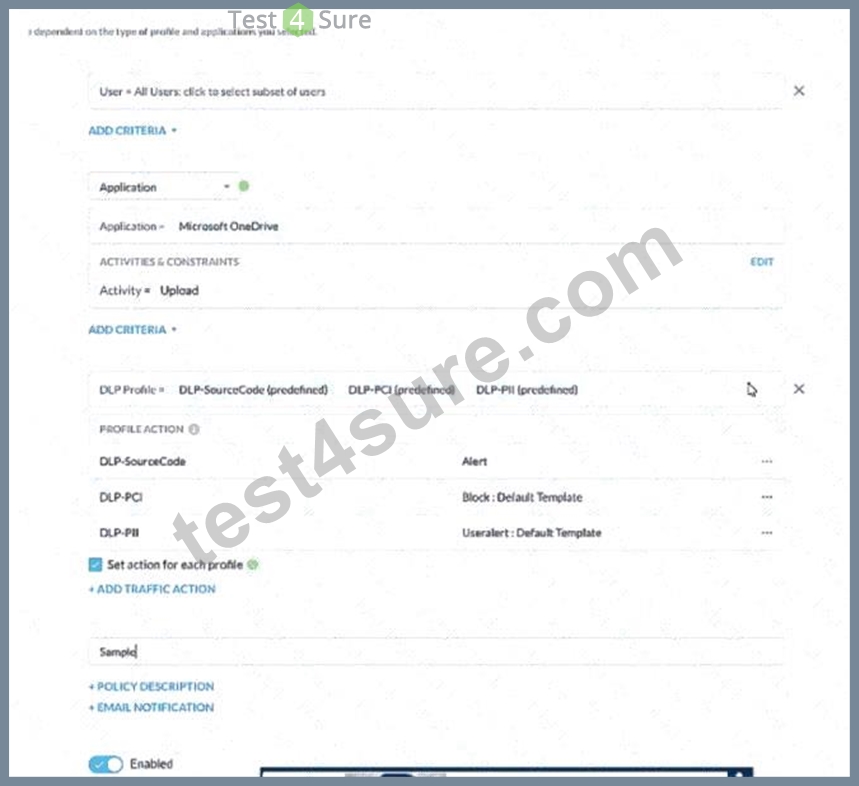
A user has attempted to upload a file to Microsoft OneDrive that contains source code with Pll and PCI data.
Referring to the exhibit, which statement Is correct?
- A. The user will be blocked and a single Incident will be generated referencing the DLP-PCI profile.
- B. The user will be blocked and a single Incident will be generated referencing all of the matching DLP profiles
- C. The user will be alerted and a single incident will be generated referencing the DLP-PII profile.
- D. The user will be blocked and a separate incident will be generated for each of the matching DLP profiles.
Answer: D
NEW QUESTION # 34
You are already using Netskope CSPM to monitor your AWS accounts for compliance. Now you need to allow access from your company-managed devices running the Netskope Client to only Amazon S3 buckets owned by your organization. You must ensure that any current buckets and those created in the future will be allowed Which configuration satisfies these requirements?
- A. Steering: Cloud Apps Only, All Traffic Policy type: Real-time Protection Constraint: Storage. Bucket Does Not Match -ALLAccounts Action: Block
- B. Steering: All Web Traffic Policy type: API Data Protection Constraint: Storage, Bucket Does Match *@myorganization.com Action: Allow
- C. Steering: Cloud Apps Only Policy type: Real-time Protection
Constraint: Storage. Bucket Does Not Match *@myorganization.com Action: Block - D. Steering: Cloud Apps Only. All Traffic Policy type: Real-time Protection Constraint: Storage. Bucket Does Match -ALLAccounts Action: Allow
Answer: A
NEW QUESTION # 35
You are architecting a Netskope steering configuration for devices that are not owned by the organization The users could be either on-premises or off-premises and the architecture requires that traffic destined to the company's instance of Microsoft 365 be steered to Netskope for inspection.
How would you achieve this scenario from a steering perspective?
- A. Use DPoP and Secure Forwarder
- B. Use reverse proxy.
- C. Use explicit proxy and the Netskope Client
- D. Use IPsec and GRE tunnels.
Answer: B
NEW QUESTION # 36
Your customer is currently using Directory Importer with Active Directory (AD) to provision users to Nelskope. They have recently acquired three new companies (A. B. and C) and want to onboard users from the companies onto the NetsKope platform. Information about the companies is shown below.
- Company A uses Active Directory.
-- Company B uses Azure AD.
-- Company C uses Okta Universal Directory.
Which statement is correct in this scenario?
- A. Either Company B or Company C users cannot be provisioned because integration with only one SCIM solution is allowed.
- B. Users from Companies A. B, and C can be provisioned to Netskope by deploying additional AD Importers and integrating more than one SCIM solution.
- C. Company A users cannot be provisioned to Netskope because the customer is already using AD Importer to import users from another Active Directory environment.
- D. Users from Company B and Company C cannot be provisioned because the customer is already using AD Importer.
Answer: B
Explanation:
Users from Companies A, B, and C can indeed be provisioned to Netskope. Company A, which uses Active Directory, can continue to use the existing AD Importer. For Company B that uses Azure AD and Company C that uses Okta Universal Directory, integration with SCIM (System for Cross-domain Identity Management) solutions is possible. Netskope supports provisioning users from multiple directories, including Active Directory and cloud-based identity providers like Azure AD and Okta, by using additional AD Importers and integrating more than one SCIM solution12.
The correct approach for provisioning users from different companies that use various directory services is supported by Netskope's capabilities to integrate with multiple identity providers and directory services, as outlined in their documentation and community resources12.
Netskope supports multiple identity sources at the same time.In this scenario:
Company A (Active Directory):You can deploy additional Directory Importer (DI) instances to connect to separate AD forests or domains. Netskope supports multiple DI connectors.
Company B (Azure AD):Azure AD provisioning uses SCIM, which is fully supported alongside DI.
Company C (Okta Universal Directory):Okta also uses SCIM, and Netskope allows more than one SCIM integration simultaneously.
Therefore, the customer can onboard all three companies without conflict.
Why the other options are incorrect
A). Users from Company B and C cannot be provisioned because customer is already using AD Importer.# Incorrect - SCIM integrations can coexist with Directory Importer.
B). Either Company B or C cannot be provisioned because only one SCIM solution is allowed.# Incorrect
- Netskope supports multiple SCIM connectors.
D). Company A users cannot be provisioned because the customer is already using AD Importer with another AD environment.# Incorrect - Multiple DI instances can be deployed for multiple AD environments.
NEW QUESTION # 37
Your organization's software deployment team did the initial install of the Netskope Client with SCCM. As the Netskope administrator, you will be responsible for all up-to-date upgrades of the client.
Which two actions would be required to accomplish this task9 (Choose two.)
- A. Set the autoupdate-on flag during the original Install.
- B. Set the installmode-IDP flag during the original Install.
- C. In the Client Configuration, set Upgrade Client Automatically to Specific Golden Release.
- D. In the Client Configuration, set Upgrade Client Automatically to Latest Release.
Answer: A,D
Explanation:
To ensure that the Netskope Client is always up-to-date with the latest upgrades, two actions are required. First, in the Client Configuration, the administrator should set the option to Upgrade Client Automatically to Latest Release. This setting ensures that the client will automatically update to the most recent version available. Second, during the original installation of the Netskope Client, the autoupdate-on flag should be set. This flag enables the auto-update feature, allowing the client to receive and apply updates as they are released.
NEW QUESTION # 38
Your client is an NG-SWG customer. They are going to use the Explicit Proxy over Tunnel (EPoT) steering method. They have a specific list of domains that they do not want to steer to the Netskope Cloud.
What would accomplish this task''
- A. Use an SSL decryption policy.
- B. Define exceptions in the Netskope steering configuration
- C. Create a real-time policy with a bypass action.
- D. Define exception domains in the PAC file.
Answer: D
Explanation:
To accomplish the task of not steering specific domains to the Netskope Cloud while using the Explicit Proxy over Tunnel (EPoT) steering method, you would define exception domains in the PAC file (A). This is because the PAC file is used to specify which domains should bypass the proxy and connect directly, thus allowing for granular control over the traffic that is steered to Netskope1.
NEW QUESTION # 39
You are troubleshooting an issue with users who are unable to reach a financial SaaS application when their traffic passes through Netskope. You determine that this is because of IP restrictions in place with the SaaS vendor. You are unable to add Netskope's IP ranges at this time, but need to allow the traffic.
How would you allow this traffic?
- A. Use Cloud Explicit Proxy so the traffic will egress from the corporate data center
- B. Use an IPsec tunnel to forward traffic so it will egress from the corporate data center
- C. Use NPAto implement Source IP anchonng so the traffic will egress from the corporate data center.
- D. Use Explicit Proxy Over Tunnel (EPoT) so the traffic will egress from the corporate data center.
Answer: D
NEW QUESTION # 40
......
Prepare For Realistic NSK300 Dumps PDF - 100% Passing Guarantee: https://freecert.test4sure.com/NSK300-exam-materials.html