

Get Oct-2025 Download Latest & Valid Questions For ISQI CTAL-ATT exam
Ensure Success With Updated Verified CTAL-ATT Exam Dumps
Achieving the CTAL-ATT certification demonstrates that a software testing professional has advanced knowledge and skills in agile testing. ISTQB Advanced Level Agile Technical Tester certification is recognized globally and is highly valued by employers. CTAL-ATT certified professionals have better job prospects and can expect higher salaries compared to non-certified professionals. The CTAL-ATT certification is also a stepping stone for professionals who want to pursue higher-level certifications in software testing.
NEW QUESTION # 52
Refactoring of test cases is needed in agile projects for many reasons.
Which of the following statements about the refactoring of test cases is correct?
- A. Refactoring of test cases is needed because we cannot write and maintain detailed test cases in the short iterations associated with agile. The main benefits include aligning the pace of testing with development and the ability to quickly create new test cases
- B. Refactoring of test cases is done to match and evolve the test cases due to changing functionality. The main benefits include improving the regression test cases and the continued alignment of the tests with the code base and product functionality
- C. Refactoring of test cases is done as a process with the following steps: Identification, Refactor, Re-run, and Identify again. The main benefits include improving the regression test cases and maintaining the alignment of tests with the code base and product functionality
- D. In general, in the agile world refactoring is a way to clean up test cases by making them shorter. The main benefits include the ability to write test cases quickly, being able to test faster using short test cases, and being able to automate them quickly
Answer: B
NEW QUESTION # 53
When test cases are re-run after refactoring, what should always be verified?
- A. That tests that have now been made redundant are removed from the test set
- B. That they provide better logging than before
- C. That the branch coverage is the same or increased
- D. That they provide the same results as before
Answer: D
Explanation:
* Purpose of Test Case Refactoring:
* Refactoring focuses on improving the structure of test cases without changing their behavior.
* Key Verification After Refactoring:
* Tests must produce the same results as before to confirm that refactoring has not altered functionality or introduced defects.
* Analyzing the Options:
* A: Branch coverage may change during refactoring, but consistent results are the primary focus.
* B: Improved logging is desirable but not a critical verification.
* D: Redundant test removal is unrelated to verifying unchanged behavior.
References:Aligned with ISTQB principles emphasizing consistency in test results after refactoring.
NEW QUESTION # 54
Which of the following is a primary goal for refactoring test cases?
- A. To increase the usability of the test cases with the goal of later using them for UAT
- B. To ensure they adequately test the product's potentially changed functionality
- C. To reduce the details and ensure the test case is only targeting high-level functionality
- D. To detect and remove defects from the code being tested
Answer: B
Explanation:
Refactoring test cases in Agile projects is primarily done to ensure that the test cases continue to provide adequate coverage for the product's functionality, which may have evolved or changed. This process involves revising and improving the test cases to adapt to any updates in the product's code or features, thereby maintaining their effectiveness and relevance.
References = The ISTQB Advanced Level Agile Technical Tester documents highlight the importance of refactoring test cases to align with the continuous evolution of the product in an Agile environment123.
NEW QUESTION # 55
Which option correctly slates a recommended guideline for formulating 8DD scenarios0 SELECT ONE OPTION
- A. The When steps should describe the specific technical actions that a user performs
- B. Dependencies between scenarios should be documented.
- C. The scenario should use the third person to describe the initial slate and the interactions from the perspective of the user.
- D. The scenario should describe a general behavior that the system supports from the perspective of a specific user
Answer: D
Explanation:
In Behavior-Driven Development (BDD), scenarios are formulated to describe the general behavior of the system from the perspective of a specific user. This helps in understanding the user's needs and how the system should respond. It's important for scenarios to be clear and understandable to all stakeholders, including non-technical ones, which is why they are often written in simple language describing the behavior rather than the technical actions.
NEW QUESTION # 56
You have been asked to supply the list of keywords for a keyword-driven test automation script that will be used to test the following story:
As a customer, I want to be able to add and delete items from my shopping cart, so that I can buy the right number of items and still get free shipping on some of the items.
The automation will add and delete items from a customer's shopping cart and will then verify that the total shipping cost is correct. The test automation library has a large set of keywords that have been coded to support this e-commerce site. Which of the following is the smallest set of keywords that contains the ones needed to support testing this story?
- A. Add Item, View Cart, Compute Shipping
- B. Login, Add Item, Delete Item, Checkout, Compute Cart Total, Compute Shipping, Complete Order
- C. Login, Add Item, Delete Item, View Cart, Compute Shipping
- D. Login, Add Item, Checkout, Compute Cart Total, Compute Shipping, Complete Order
Answer: C
Explanation:
* Keyword-Driven Testing:This approach requires a focused set of keywords tailored to the actions described in the user story.
* Story Actions:
* The ability to add and delete items from the cart.
* Viewing the cart to confirm changes.
* Calculating shipping costs.
* Smallest Set of Keywords:
* Login: To simulate a user session.
* Add Item and Delete Item: For cart modifications.
* View Cart: To verify cart contents.
* Compute Shipping: To check shipping costs.
* Conclusion:Option D includes the minimum keywords required to meet the story's needs.
NEW QUESTION # 57
You have been asked to supply the list of keywords for a keyword-driven test automation script that will be used to test the following story As a customer I want to be able to add and delete items from my shopping carl, so that I can buy the right number of items and still get free shipping on some of the items The automation will add and delete items from a customer's shopping carl and will then verify that the total shipping cost is correct The test automation library has a large set of keywords that have been coded to support this ecommerce site Which of the following is the smallest set of keywords that contains the ones needed to support testing this story?
- A. Login Add Item, Delete Item Checkout, Compute Cart Total, Compute Shipping Complete Order
- B. Login Add Item Delete Item View Cart Compute Shipping
- C. Add Item View Cart Compute Shipping
- D. Login Add Item Checkout Compute Carl Total Compute Shipping, Complete Order
Answer: B
NEW QUESTION # 58
From these results, what can you conclude about the TDD process?
- A. The developers are not running the tests prior to releasing the code
- B. The story needs to be enhanced to include the capabilities that are causing errors
- C. The tests are insufficient and need to include more options
- D. The tests cannot be passing
Answer: C
Explanation:
* Analyzing the TDD Process:
* The provided test cases only cover two inputs: "smith" and "x," and these pass successfully.
* Real-world inputs such as longer names ("Steinbrenner") or edge cases (blank inputs) are not tested, resulting in errors and crashes.
* Insufficient Tests:
* The developers have not accounted for all possible input scenarios, such as names exceeding 30 characters or invalid inputs.
* Expanding the tests to cover such cases would align the implementation with the acceptance criteria.
* Analyzing the Options:
* A: The tests are running but are inadequate in scope.
* B: The tests are likely passing for the covered cases but fail to address uncovered scenarios.
* D: The story already includes relevant details; the issue lies with test case insufficiency.
References:Aligned with ISTQB guidance on the importance of comprehensive test coverage in TDD.
NEW QUESTION # 59
You have been asked to supply the data file for a data-driven test automation script that will be used to test the following story:
As a customer I want to be told how many items I need to purchase, so I can receive free shipping You have been told the automation will verify whether or not the free shipping message is displayed. Which of the following columns should appear in your data file to support the automated testing of this story?
- A. customer name # items, price of items, total shipping cost
- B. item ID quantity purchased free shipping (y/n), item shipping cost total shipping cost
- C. item ID quantity purchased free shipping (y/n)
- D. quantity purchased, free shipping (y/n), total shipping cost
Answer: C
Explanation:
For the user story in question, the data file for the data-driven test automation script should include columns that directly relate to the criteria for free shipping. The column 'item ID' is necessary to identify the specific items being purchased. 'Quantity purchased' is required to determine if the number of items meets the threshold for free shipping. The 'free shipping (y/n)' column is essential to verify if the free shipping message displays correctly based on the quantity purchased. This setup aligns with the principles of data-driven testing where inputs and expected outcomes are clearly defined to validate the functionality being tested.
References = The ISTQB Advanced Level Agile Technical Tester syllabus and materials emphasize the importance of creating data files that support the automated testing of user stories. The data file should contain columns that are relevant to the story's acceptance criteria and enable the automation to verify the correct behavior of the system12.
NEW QUESTION # 60
You are testing a new feature in the current iteration. The feature is supposed to take the input of a name and return the number of characters in the name. This information is used by another feature that will determine the size needed on a form. The acceptance criteria state the following
1) a name of up to 30 characters should be accepted
2) standard error processing should be in place to limit user errors
The developers are using TDD and you have asked to see their tests. This is what they gave you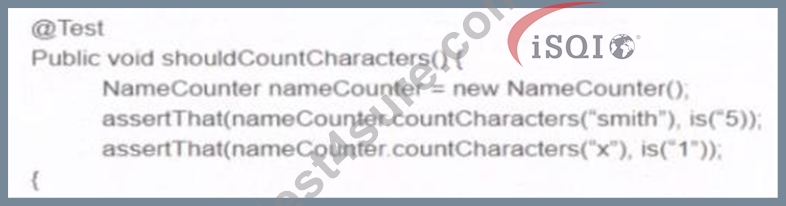
When yourun your manual tests you are finding that when you use the following inputs you get the associated results:
From these results what can you conclude about the TDD process?
- A. The developers are not running the tests prior to releasing the code
- B. The story needs to be enhanced to include the capabilities that are causing errors
- C. The tests are insufficient and need to include more options
- D. The tests cannot be passing
Answer: C
NEW QUESTION # 61
Whose perspective should be used when a user story is created?
- A. Stakeholder paying for the project
- B. User acceptance tester
- C. Automated user software
- D. End user
Answer: D
Explanation:
When creating a user story, it is essential to consider the perspective of the end user. This is because user stories are meant to capture the requirements and experiences of the actual users who will interact with the system or product. The ISTQB Advanced Level Agile Technical Tester syllabus emphasizes the importance of analyzing user stories and epics using requirements engineering techniques, which include creating and evaluating testable acceptance criteria from the end user's perspective. This approach ensures that the developed features will meet the real needs and expectations of the users, leading to a more user-centered and valuable product.
References = ISTQB Advanced Level Agile Technical Tester documents and Training resources12.
NEW QUESTION # 62
Why is it important to refactor test cases to make them easier to understand?
- A. Because users will apply them as use cases for UAT and need to be able to determine the mam path and alternate paths
- B. Because the observable behavior of the test case will change and the product owner needs to be able to clearly see what the behavior should be
- C. Because developers need to use them for performance testing
- D. Because they will be used as the code-under-test changes, so they need to be easy for other testers to understand and modify
Answer: B
NEW QUESTION # 63
An increased proportion of automated test coverage often leads to a greater degree of manual testing that follows reactive strategies, because:
- A. If the proportion of automated tests increases, manual tests focus on the riskiest areas which are identified reactively
- B. Reactive strategies consider the current context and status of the project and the system under test. To be able to adopt to this status most flexible a greater degree of manual testing is necessary
- C. Many of the tests that can be prepared upfront, will be automated which enables the testers to spend more time for execution of manual tests
- D. An increase of the proportion of automated test increases test coverage, and the uncovered areas are to be tested reactively
Answer: B
Explanation:
The increase in automated test coverage allows for more frequent and extensive testing of the software, which in turn provides more up-to-date information about the current state of the system. This enables testers to apply reactive strategies effectively, as they can focus manual testing efforts on areas that are most likely to be affected by recent changes or that are identified as high-risk. Reactive strategies are adaptive and context-dependent, making them well-suited for the dynamic and iterative nature of Agile projects.
References = The ISTQB Advanced Level Agile Technical Tester syllabus and study materials emphasize the importance of integrating automated testing within the Agile process to support continuous integration and delivery. It also highlights the need for manual testing to complement automated tests by focusing on areas that require human judgment and exploratory testing skills12.
NEW QUESTION # 64
You have been given the following story
As a shopper
I want to scan my membership card
So that I get all the discounts I'm entitled to receive
Which of the following is the correct use of BDD to design test scenarios?
- A. Given that I have scanned my card
I expect to receive my discounts
And an itemized list of what I bought - B. Given that a card is scanned
Then discounts should be applied
When the customer checks out - C. As a store clerk
I want to scan a customer's card
So that their total includes their discounts - D. Given that the shopper scans their card
When they checkout
Then they should receive alt the quantity discounts for everything they have purchased
Answer: D
Explanation:
The correct use of Behavior-Driven Development (BDD) to design test scenarios involves specifying the behavior in a given-when-then format. This format helps to clarify the conditions under which a particular outcome should occur. Option A follows this structure correctly:
* Given that the shopper scans their card (the precondition),
* When they checkout (the action),
* Then they should receive all the quantity discounts for everything they have purchased (the expected outcome).
This scenario clearly outlines the behavior of the system in response to the user's actions, which is central to BDD.
References = The ISTQB Advanced Level Agile Technical Tester syllabus emphasizes the importance of creating testable acceptance criteria for a given user story using requirements engineering and test techniques, which include the application of BDD in the context of a given user story12.
NEW QUESTION # 65
You are planning an exploratory test session for the current sprint which includes the following user stories:
User Story AA-008
As a booked customer of Alpha Airways
I want to access an open flight reservation
So that I can update the booking details
User Story AA-012
As a booking clerk for Alpha Airways
I want to access a customer's flight reservation
So that i can view their reservation details
what three things should be considered when creating the session's test charter?
a)What are the user roles specified in the two user stories?
b)What level of coverage and efficiency was should be achieved by the session' c)Will the session fit within a 60 to 120 minutes time box' d)Do Will the findings from the exploratory sessions need to be documented?
e)What actions are performed by the user roles according to the acceptance criteria for these user stories' f)Should the exploratory session be automated' g)Has the Definition of Done been met for both user stories' SELECT ONE OPTION
- A. c.f.g
- B. a, b, d
- C. a, c.e
- D. d. e.f
Answer: C
Explanation:
When creating a test charter for an exploratory test session, it's important to consider the following: a) The user roles specified in the user stories are crucial as they determine the perspective from which the testing will be conducted. c) Ensuring the session fits within a 60 to 120 minutes time box is important for maintaining focus and efficiency. e) Understanding the actions performed by the user roles according to the acceptance criteria is essential for defining the scope of the testing.
These considerations are aligned with the ISTQB guidelines for Agile Technical Testing, which emphasize the importance of understanding user roles, maintaining efficient testing sessions, and ensuring that the acceptance criteria are met through the actions performed during testing12.
References = The ISTQB Advanced Level Agile Technical Tester documents and training resources provide guidance on creating test charters and conducting exploratory testing sessions. They highlight the importance of focusing on user roles, session time management, and the actions required to meet the acceptance criteria12. Additionally, resources available at Software Testing Help offer practical insights into the application of these principles in real-world testing scenarios34.
NEW QUESTION # 66
You are developing a test automation suite for an agile project and want to include as much coverage as possible. Unfortunately, one of the critical web services (e-commerce checkout) is not scheduled for completion until the later iterations. Which of the following would be a good option to allow you to progress with your end-to-end test automation without creating too much extra work?
- A. Have the automation create a stub to replace the service for each execution and destroy the stub after execution is complete
- B. Use a service from a legacy product and integrate it with the system to allow use by the test automation
- C. Write the missing web service yourself and then hand over that code to the developers for further refinement
- D. Use a service virtualization tool to create a virtualized service to be used by the test automation
Answer: D
Explanation:
* Service Virtualization in Agile:Virtualized services are ideal for simulating unavailable components, enabling comprehensive testing without waiting for the actual service to be developed.
* Minimizing Extra Work:Using a service virtualization tool reduces the need for manual creation and maintenance of stubs or other temporary solutions.
* Analysis of Options:
* A is impractical, as testers should not develop production services.
* B is less efficient than service virtualization and requires ongoing setup/teardown.
* C provides an efficient and reusable solution.
* D risks misalignment with the new system.
* Conclusion:Option C is the best approach for agile test automation progress.
NEW QUESTION # 67
The following epic has been written:
As a vehicle driver
I want to find an available space In a car park
So that I can pay in advance to reserve that space
This epic will be used to develop user stories for a new National Car Parking application Both public and private car park owners will be able to utilise the system, allowing drivers of all kinds to guarantee an available car parking space on arrival at their chosen car park, according to the kind of vehicle that they may drive There will be multiple stakeholders including different car park owners, different user groups including disabled drivers and different vehicle types such as car. van and motorbike.
From this epic, multiple user stories will be written. The following acceptance criteria have been written for the epic, and will be applicable to all user stories (each user story will also have its own acceptance cntena):
1.End-to-end response time for any individual request submitted by a user must not exceed 5 seconds
2.All correspondence with stakeholders must be via email and text message
3.The application must be accessible on most mobile technology
4.A user cannot submit a form unless all mandatory fields are entered
5.Payment method can be made using the most popular electronic options
Applying the INVEST technique to this epic, including its acceptance criteria, which of the following statements is correct?
SELECT ONE OPTION
- A. The Independent and Small criteria of INVEST have not been satisfied
- B. The Testable and Valuable criteria of INVEST have not been satisfied
- C. The Testable and Small criteria of INVEST have not been satisfied
- D. The invest criteria have all been satisfied by this epic
Answer: A
Explanation:
The epic described is broad and encompasses a system that involves multiple stakeholders and vehicle types, indicating that it is not a small piece of work that can be completed in a short iteration. This violates the
'Small' criterion of INVEST, which states that stories should be the smallest piece of work that delivers useful functionality to fit within an iteration12. Additionally, the epic's acceptance criteria apply to all user stories derived from it, suggesting that the stories are not independent of each other, as changes to one could affect the others. This goes against the 'Independent' criterion, which emphasizes that stories should be self-contained to avoid delays caused by dependencies12.
References = The INVEST criteria are a set of guidelines used to evaluate the quality of user stories and epics in Agile development. They ensure that the stories are well-defined and suitable for Agile practices, focusing on creating value through independent, negotiable, valuable, estimable, small, and testable stories123.
NEW QUESTION # 68
Which of the following is an example of how continuous testing facilitates continuous delivery?
- A. Automated testing conducted in the delivery environment helps validate that the delivery has been successful
- B. Automated testing removes the need to report defects so the code can move more quickly toward production
- C. Continuous testing is the process that delivers the code to the test environment
- D. Continuous testing supports continuous delivery to production by constantly regression testing the software in the production environment so problems are identified quickly
Answer: A
Explanation:
Continuous testing facilitates continuous delivery by ensuring that every change made to the codebase is tested automatically and immediately, which helps in identifying defects as early as possible. Automated testing in the delivery environment is crucial as it validates the success of the delivery process by ensuring that the software operates as expected in the production-like environment before the actual release.
References = The ISTQB Advanced Level Agile Technical Tester certification highlights the importance of technical testing skills in Agile development, including test automation approaches and continuous deployment and delivery1234.
NEW QUESTION # 69
Whose perspective should be used when a user story is created?
- A. Stakeholder paying for the project
- B. User acceptance tester
- C. Automated user software
- D. End user
Answer: D
NEW QUESTION # 70
Which statement correctly describes continuous testing'
SELECT ONE OPTION
- A. Each modification made to the system triggers the tests that cover that change to be executed automatically.
- B. Each new build of the system triggers a pre-defined set of tests to be executed automatically.
- C. Each new build of the system triggers deployment into a testing environment.
- D. Each modification made to the system is automatically tested and then automatically made implemented in live
Answer: B
Explanation:
Continuous testing in Agile involves automatically executing a pre-defined set of tests with every new build of the system. This practice is part of continuous integration and delivery, ensuring that new changes are verified quickly and frequently, which is essential for Agile's fast-paced and iterative development cycles. References = The ISTQB Advanced Level Agile Technical Tester syllabus emphasizes the importance of continuous testing in Agile projects, highlighting techniques such as test automation, continuous deployment, and delivery as fundamental to the Agile approach123.
NEW QUESTION # 71
......
Exam Materials for You to Prepare & Pass CTAL-ATT Exam: https://freecert.test4sure.com/CTAL-ATT-exam-materials.html