

[Jun-2026] Integration-Architect PDF Dumps Extremely Quick Way Of Preparation
Download Integration-Architect Dumps (2026) - Free PDF Exam Demo
Salesforce Integration-Architect Exam, also known as the Salesforce Certified Integration Architect Exam, is a highly specialized certification that focuses on the design and implementation of complex integration solutions using the Salesforce platform. Salesforce Certified Integration Architect certification is designed for professionals who have a deep understanding of integration patterns, best practices, and technologies.
NEW QUESTION # 54
Northern Trail Outfitters (NTO) has an integration set up between a Salesforce org and a quoting system.
NTO would like to show a notification to allsales representatives that use Salesforceanytime the quoting system will be taken down for maintenance.
Which Salesforce API should an Integration Architect use to fulfill this requirement?
- A. Streaming API
- B. Tooling API
- C. REST API
- D. Connect REST API
Answer: A
Explanation:
Streaming API is the best option for sending real-time notifications of changes to Salesforce data. Streaming API uses a publish-subscribe model to push relevant data to subscribers without polling. Streaming API supports PushTopic events, whichare based on SOQL queries that define the data changes to listen for. The affiliate company can subscribe to a PushTopic event on the NTO Salesforce org and receive notifications whenever the data that matches the query changes. This way, the affiliate company can be informed of any updates to the opportunities in the NTO Salesforce instance.
NEW QUESTION # 55
An enterprise customer that has more than 10 million customers have the following systems and conditions in their landscape:
- A. Salesforce CRM (CRM)- Customer information, Sales and Support information is maintained in CRM.
- B. Enterprise Document Management System (DMS) Billsmailed to customers are maintained in the Document Management system.
- C. Enterprise Billing System (EBS) - All customer's monthly billing is generated by this system.
Answer: A,B
Explanation:
The integration consultant should consider the following authorization and authentication needs while integrating the DMS and ESB with Salesforce:
Users should be authorized to view information specific to the customer they are servicing without a need to search for customer. This means that the integration should provide a seamless and contextual access to the customer billing information and generated bills from the DMS and ESB, based on the customer record or case that the user is working on in Salesforce.
Consider Enterprise security needs for access to DMS and ESB. This means that the integration should comply with the security policies and standards of the Enterprise, such as encryption, auditing, logging, monitoring, etc.
Users should be authenticated into DMS and ESB without having to enter username and password. This means that the integration should use a single sign-on (SSO) mechanism that allows users to access multiple systems with one login credential, such as OAuth or SAML.
References: [Authorization Through Connected Apps and OAuth 2.0], [Single Sign-On for Desktopand Mobile Applications using SAML and OAuth]
NEW QUESTION # 56
Universal Containers (UC) is a leading provider of managementtraining globally, UC requested students course registration data generated from the Salesforce student community to be synced with the learning management system (LMS). Any update to the course registration data needs to be reflected in the LMS.
Which integration mechanism should be used to meet the requirement?
- A. Streaming API
- B. Change Data Capture (CDC)
- C. Platform Event
- D. Outbound Message
Answer: B
Explanation:
Change Data Capture (CDC) is the best option to meet the requirement. CDC is a type of streaming event that notifies subscribers of changes to Salesforce records, such as creation, update, delete, and undelete operations.
By subscribing to CDC events for the course registration data, the LMS can receive real-time updates and sync with Salesforce. Streaming API is another type of streaming event that notifies subscribers of changes to Salesforce records that match a SOQL query. However, Streaming API has some limitations, such as not supporting all SOQL features and not capturing delete and undelete operations. Platform Event is a type of streaming event that delivers custom notifications within the Salesforce platform or from external sources.
Platform Event is not suitable for this requirement because it is not tied to Salesforce records and requires custom logic to publish and subscribe. Outbound Message is a workflow action that sends SOAP messages with field values to designated endpoints. Outbound Message is not suitable for this requirement because it does not support complex data types, such as sObjects or collections.
NEW QUESTION # 57
When user clicks Check Preferences as part of a Lightning flow in Salesforce, preferences from an externally hosted RESTful service are to be checked in real-time. The RESTful service has OpenAPI 2.0 JSON definitions, responding in data types of Boolean and string values.
Which integration pattern and mechanism should be selected to meet the conditions?
- A. Request-Reply: Enhanced External Services invokes a REST API.
- B. Data Virtualization: Salesforce Connect map data external REST data in external objects.
- C. Fire and Forget: Process-driven platform events publishes events on Salesforce Event Bus.
- D. Remote Call-In: Salesforce REST API with REST Composite Resources.
Answer: A
NEW QUESTION # 58
A company that is a leading provider of courses and training delivers courses using third party trainers. The trainer for the company has to be verified from 10 different training accreditation verification agencies before providing training for the company. Each training accreditation agency has its own response time, which could take days to confirm a trainer.
The company decided to automate the trainer accreditation verification process by integrating to the agencies' web services.
What is the recommended approach to automate this process?
- A. Create a trigger on the trainer record to make a Callout to each verification agencies, write business logic to consolidate the verification then update the trainer status to verified".
- B. Use salesforce external service to make the call out, Salesforce external service should check the verification agencies until the result is verified, then update the trainer status to "verified".
- C. Make an apex callout using @future annotation to make the call out to all different agencies. The response should update the trainer status to "verified".
- D. Use middleware to handle the call out to the 10 different verification services, the middleware will handle the business logic of consolidating the verification result from t 10 services, then make a call-in to salesforce and update the verification status to "verified".
Answer: D
Explanation:
Explanation
Answer D is valid because using middleware to handle the call out to the 10 different verification services is a scalable and reliable solution that can handle the complexity and variability of the integration. The middleware can orchestrate the calls to the different web services, consolidate the verification results, and handle any errors or retries. The middleware can then make a call-in to Salesforce and update the verification status to "verified" using an API or a platform event12 Answer A is not valid because using Salesforce external service to make the call out to the 10 different verification services is not a feasible or efficient solution. Salesforce external service is a feature that allows invoking an external service from a flow and mapping its inputs and outputs to flow variables.
However, this feature requires configuring an Apex action, a named credential, and an external service definition for each web service, which is not a low code solution. Moreover, this feature does not support checking the verification agencies until the result is verified, as it only invokes the external service once per flow interview3 Answer B is not valid because creating a trigger on the trainer record to make a callout to each verification agency is not a recommended or robust solution. Triggers are Apex code that execute before or after database events, such as insert, update, or delete. However, triggers cannot make callouts directly, as they are part of a database transaction and must complete quickly. To make a callout from a trigger, an asynchronous process such as a future method or a queueable job must be used, which adds complexity and overhead to the integration. Moreover, triggers have limits on the number of callouts and asynchronous calls they can make per transaction, which may affect the scalability and reliability of the integration.
Answer C is not valid because making an Apex callout using @future annotation to make the call out to all different agencies is not a suitable or reliable solution. The @future annotation allows marking a method for execution at a later time when system resources become available. However, this annotation has several limitations and drawbacks, such as:
Future methods cannot return values, so they cannot update the trainer status to "verified" directly.
Future methods have limits on the number of callouts and future calls they can make per execution, which may affect the scalability and reliability of the integration.
Future methods run in their own thread and do not share any static variables or state with other methods, which makes it difficult to consolidate the verification results from different agencies.
Future methods are not guaranteed to execute at a specific time or order, which may affect the timeliness and accuracy of the integration.
1: Orchestration Pattern 2: Remote Process Invocation-Request and Reply 3: External Services : Apex Developer Guide: Triggers : Apex Developer Guide: Using Future Methods
NEW QUESTION # 59
A customer is evaluating the Platform Events solution and would like help in comparing/contrasting it with Outbound Messaging for real-time/near-real time needs. They expect 3,000 customers to view messages in Salesforce. What should be evaluated and highlighted when deciding between the solutions?12
- A. In both Platform Events and Outbound Messaging, the event messages are retried by and delivered in sequence, and 3only once. Sales4force ensures there is no duplicate message delivery.
- B. Both Platform Events and Outbound Messaging are highly scalable. However, unlike Outbound Messaging, only Platform Events have Event Delivery and Event Publishing limits to be considered.
- C. Message sequence is possible in Outbound Messaging, but not guaranteed with Platform Events. Both offer very high reliability. Fault handling and recovery are fully handled by Salesforce.
Answer: B
Explanation:
When comparing Platform Events and Outbound Messaging for a near-real-time architecture, a Salesforce Platform Integration Architect must evaluate fundamental differences in their delivery models and governance. While both provide declarative, asynchronous "Fire-and-Forget" capabilities, their technical constraints differ significantly, particularly regarding scalability and platform limits.
The key architectural highlight in this scenario is that Platform Events operate on a specialized event bus with specific Event Publishing and Event Delivery limits. Unlike Outbound Messaging, which is governed by more general daily outbound call limits (often tied to user licenses), Platform Events have a dedicated allocation for the number of events that can be published per hour and delivered in a 24-hour period to external clients via the Pub/Sub API or CometD. For example, the number of concurrent subscribers to a Platform Event channel is typically capped at 2,000 for standard configurations. Since the customer expects
3,000 customers to view these messages, this limit is a critical evaluation point; the architecture would need to account for this gap, perhaps by using middleware to fan out messages to the larger audience.
In contrast, Outbound Messaging does not have an "Event Delivery" limit in the same sense. It is a point-to- point SOAP-based push mechanism where Salesforce manages retries for up to 24 hours if the receiving endpoint is unavailable. However, it is less flexible for multi-consumer scenarios because it requires a separate configuration for every unique destination.
Regarding the other options: Option A is incorrect because neither system strictly guarantees "exactly-once" delivery without the possibility of duplicates; in fact, Outbound Messaging may deliver a message more than once if it doesn't receive a timely acknowledgment. Option B is incorrect because Platform Events do not have built-in "fault recovery" handled by Salesforce in the same way as Outbound Messaging's automatic retry queue; with Platform Events, it is the subscriber's responsibility to use a Replay ID to retrieve missed events within the 72-hour retention window. Therefore, highlighting the unique delivery and publishing limits is the most vital step for the architect.
NEW QUESTION # 60
Northern Trail Outfitters uses a custom Java application to display code coverage and test results for all of their enterprise applicationsand is planning to include Salesforce as well.
Which Salesforce API should an Integration Architect use to meet the requirement?
- A. Metadata API
- B. Analytics REST API
- C. SOAP API
- D. Tooling API
Answer: D
Explanation:
Explanation
Option D is correct because Tooling API is the Salesforce API that can be used to retrieve code coverage and test results for Apex classes and triggers. Tooling API provides REST and SOAP interfaces to access metadata about code, execute tests, and get test results12 Option A is incorrect because SOAP API is a Salesforce API that can be used to create, retrieve, update, or delete records, but not to get code coverage and test results. SOAP API uses a WSDL file to define the parameters for accessing data through the API3 Option B is incorrect because Analytics REST API is a Salesforce API that can be used to access data from reports and dashboards, but not from code coverage and test results. Analytics REST API provides a programmatic way to interact with analytics features such as lenses, datasets, and dashboards4 Option C is incorrect because Metadata API is a Salesforce API that can be used to retrieve, deploy, create, update, or delete customization information, such as custom object definitions and page layouts, but not code coverage and test results. Metadata API is mainly used for development tools or backup tools5 References: 1: Introducing Tooling API 2: Tooling API Examples 3: SOAP API Developer Guide 4: Analytics REST API Developer Guide 5: Metadata API Developer Guide
NEW QUESTION # 61
A new Salesforce program has the following high level abstract requirement: Business processes executed on Salesforce require data updates between the internal systems and Salesforce Which three relevant details should a Salesforce Integration Architect seek to specifically solve for Integration architecture needs of the program?
Which three relevant details should a Salesforce Integration Architect seek to specifically solve for Integration architecture needs of the program?
Choose 3 answers
- A. Integration Style Process based, Data based, Virtual integration. E Core functional and non-functional requirements for User Experience design, Encryption needs, Community, and license choices.
- B. Source and Target system, Directionality, data volume & transformation complexity long with any middleware that can be leveraged.
- C. Integration skills, SME availability and Program Governance details.
- D. Timing aspects - real-time/near real-time (synchronous or asynchronous), batch; update frequency.
Answer: A,B,D
Explanation:
Explanation
The correct answer is A, C, and D. These are three relevant details that a Salesforce Integration Architect should seek to specifically solve for Integration architecture needs of the program. These details can help the Integration Architect to understand the scope, requirements, and constraints of the integration solution, and to choose the appropriate tools, methods, and patterns. The details are:
Source and Target system, Directionality, data volume & transformation complexity along with any middleware that can be leveraged. This detail can help the Integration Architect to identify the systems involved in the integration, the direction of data flow, the amount and complexity of data to be exchanged, and the middleware or platform capabilities that can facilitate the integration.
Timing aspects - real-time/near real-time (synchronous or asynchronous), batch; update frequency. This detail can help the Integration Architect to determine the latency, reliability, and scalability requirements of the integration solution, and to choose the suitable integration protocols and techniques.
Integration Style - Process based, Data based, Virtual integration. This detail can help the Integration Architect to select the appropriate integration style that matches the business needs and objectives.
Process based integration focuses on orchestrating business processes across systems, data based integration focuses on synchronizing data across systems, and virtual integration focuses on providing a unified view of data across systems.
References: Certification - Integration Architect - Trailhead, [Integration Patterns and Practices]
NEW QUESTION # 62
Northern Trail Outfitters is creating a distributable Salesforce package. The package needs to call into a custom Apex REST endpoint in the central org. The security team wants to ensure a specific integration account is used in the central org that they will authorize after installation of the package. Which item should an architect recommend to secure the integration?
- A. Create a connected app in the central org and add the callback URL for each org in the package it is installed in to redirect after a successful authentication.
- B. Contact Salesforce Support and create a case to temporarily enable API access for managed packages.
- C. Use an encrypted field to store the password.
Answer: A
Explanation:
To securely integrate a distributed package with a central "Hub" org, the architect should utilize the OAuth
2.0 Web Server Flow. In this model, a Connected App is created in the central org to act as the identity and access provider.1 A critical component of this setup is the Callback URL (Redirect URI). When a user in the "Subscriber" org (where the packag2e is installed) initiates the connection, Salesforce redirects them to the central org to authorize the access. After successful authentication, the central org needs the correct callback URL to return the authorization code to the specific subscriber org.
Using this flow satisfies the security team's requirement for a specific integration account. The administrator in the central org can pre-authorize specific profiles or permission sets to use the Connected App, ensuring that only the designated integration user's credentials are used to fulfill requests. Option A is a security "anti- pattern" (storing passwords in fields), and Option C is unnecessary as API access is a standard feature. This OAuth-based approach provides a secure, revocable, and standardized way to manage cross-org communication in a multi-tenant environment.
NEW QUESTION # 63
A company's cloud-based single page application consolidates data local to the application with data from on- premise and Third-party systems. The diagram below typifies the application's combined use of synchronous and asynchronous calls. The company wants to use the average response time of its application's user interface as a basis for certain alerts. For this purpose, the following occurs:
* Log every call start and finish date and time to a central analytics data store.
* Compute response time uniformly as the difference between the start and finish date and time (A to H in the diagram).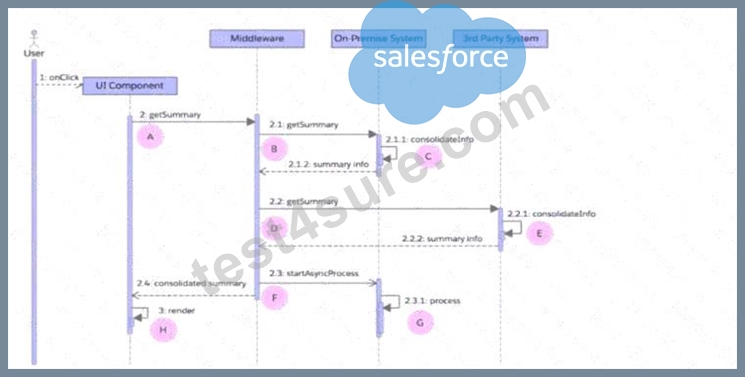
Which computation represents the end-to-end response time from the user's perspective?
- A. Sum of A to F
- B. Sum of A and H
- C. Sum of A to H
Answer: B
NEW QUESTION # 64
Northern Trail Outfitters (NTO) use Salesforce to track leads, opportunities, and to capture order details.
However, Salesforce isn't the system that holds or processes orders. After the order details are captured in Salesforce, an order must be created in the remote system, which manages the orders life cylce. The Integration Architect for the project is recommending a remote system that will subscribe to the platform event defined in Salesforce.
Which integration pattern should be used for this business use case?
- A. Request and Reply
- B. Remote Call In
- C. Batch Data Synchronization
- D. Fire and Forget
Answer: D
Explanation:
Explanation
The Fire and Forget pattern is suitable for this business use case because it allows sending a message from Salesforce to the remote system without waiting for a response or acknowledgement. This reduces the latency and complexity of the integration and enables asynchronous processing of the orders in the remote system. The platform event defined in Salesforce can be used to publish the order details to the remote system, which can subscribe to the event and create the order accordingly1
NEW QUESTION # 65
Northern Trail Outfitters (NTO) use Salesforce to track leads, opportunities, and to capture order details. However, Salesforce isn't the system that holds or processes orders. After the order details are captured in Salesforce, an order must be created in the remote system, which manages the orders lifecylce. The Integration Architect for the project is recommending a remote system that will subscribe to the platform event defined in Salesforce.
Which integration pattern should be used for this business use case?
- A. Request and Reply
- B. Remote Call In
- C. Batch Data Synchronization
- D. Fire and Forget
Answer: D
NEW QUESTION # 66
An enterprise customer is planning to implement Salesforce to support case management.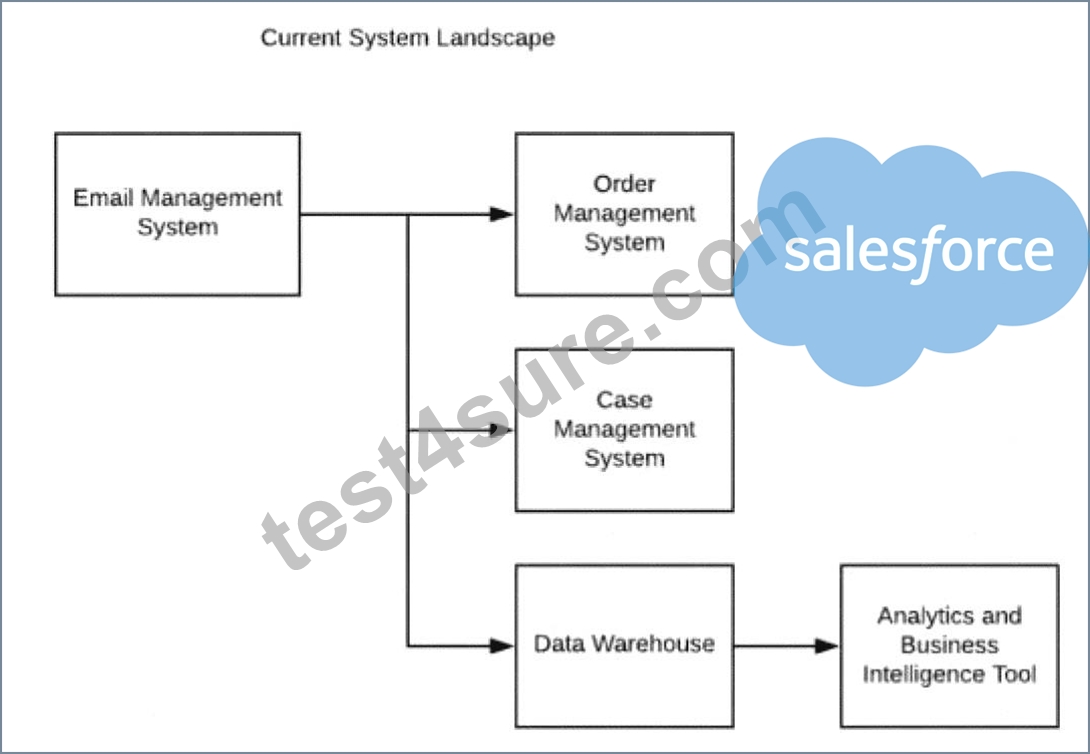
Below is their current system landscape diagram. Considering Salesforce capabilities, what should the integration architect evaluate when integrating Salesforce with the current system landscape?
- A. Integrate Salesforce with Order Management System, Data Warehouse and Case Management System.
- B. Integrate Salesforce with Email Management System, Order Management System and Case Management System.
- C. Integrate Salesforce with Data Warehouse, Order Management and Email Management System.
Answer: C
Explanation:
An Integration Architect's primary responsibility when evaluating a landscape for a new Salesforce implementation is to identify the system of record for each business process and determine which legacy systems will be replaced by Salesforce. In this scenario, the customer is implementing Salesforce specifically to support case management.
According to the provided landscape diagram, the Case Management System currently exists as a standalone entity. Since Salesforce Service Cloud provides native, best-in-class case management capabilities, this legacy system is the primary candidate for retirement. Retiring the legacy Case Management system avoids data fragmentation and ensures that Salesforce serves as the single source of truth for support interactions.
However, for Salesforce to function effectively as a new case management hub, it must integrate with the remaining surrounding systems:
* Email Management System: This system likely handles inbound customer communications. An architect must evaluate integrating this with Salesforce (via Email-to-Case or a specialized connector) so that incoming emails automatically generate or update cases.
* Order Management System (OMS): Support agents often need to view order history or status to resolve customer inquiries. Integrating Salesforce with the OMS allows for a 360-degree view, enabling agents to see relevant order data directly within the Salesforce case console.
* Data Warehouse: For long-term reporting, trend analysis, and a unified customer profile, case data from Salesforce needs to be pushed to the Data Warehouse. This ensures that the Analytics and Business Intelligence Tool downstream can report on support metrics alongside other enterprise data.
Therefore, the architect should evaluate integrations with the Data Warehouse, Order Management, and Email Management System. Option B and C are incorrect because they suggest integrating with the "Case Management System," which is the very system being superseded by Salesforce's native capabilities. By focusing on the integration of these three supporting systems, the architect ensures a seamless transition where Salesforce is fully enriched with the necessary external data to drive support excellence.
NEW QUESTION # 67
An architect decided to use Platform Events for integratingSalesforce with an external system for a company.
Which three things should an architect consider when proposing this type of integration mechanism?
Choose 3 answers
- A. To publish an event, the integration user in salesforce needs create permission on the event entity.
- B. To subscribe to an event, the integration user in salesforce needs read access to theevent entity.
- C. Error handling must be performed by the remote service because the event is effectively handed off to the remote system for further processing.
- D. Salesforce needs to be able to store information about the external system in order toknow which event to send out.
- E. External system needs to have the same uptime in order to be able to keep up with Salesforce Platform Events.
Answer: A,B,C
Explanation:
Platform Events are a type of event-driven architecture that allows you to publish and subscribe to events in Salesforce and external systems. To subscribe to an event, the integration user in Salesforce needs read access to the event entity, which defines the schema and properties of the event message. To publish an event, the integration user in Salesforce needs create permission on the event entity, which is a special type of sObject that can be inserted into the platform event queue. Error handling must be performed by the remote service because the event is effectively handed off to the remote system for further processing. Salesforce does not guarantee the delivery or acknowledgment of the event by the external system. The external system should implement its own logic to handle errors, such as retrying failed events, logging errors, or sending notifications. References: Certification - IntegrationArchitect - Trailhead, [Platform Events Developer Guide]
NEW QUESTION # 68
A Salesforce customer is planning to roll out Salesforce for all their Sales and Service staff.
Senior Management has requested that monitoring is to be in pla for Operations to notify any degradation in Salesforce performance.
How should an integration consultant implement monitoring?
- A. Identify critical business processes and establish automation to monitor performance against established benchmarks.
- B. Use Salesforce limits API to capture current API usage and configure alerts for monitoring.
- C. Use APIEVENT to track all user initiated API calls through SOAP, REST or BULK APIs.
- D. Request Salesforce to monitor the Salesforce instance and notify when there is degradation in performance.
Answer: A
NEW QUESTION # 69
A business requires automating the check and updating of the phone number type classification (mobile vs.
landline) for all incoming calls delivered to its phone sales agents. The following conditions exist:
* At peak, the call center can receive up to 100,000 calls per day.
* The phone number type classification is a service provided by an external service API.
* Business is flexible with timing and frequency to check and update the records (throughout the night or every 6-12 hours is sufficient).
A Remote-Call-In pattern and/or Batch Synchronization (Replication via ETL: System -> Salesforce) are determined to work with a middleware hosted on customer premise. In order to implement these patterns and mechanisms, which component should an integration architect recommend?
- A. Remote Site Settings configured in Salesforce to authenticate the middleware
- B. ConnectedApp configured in Salesforce to authenticate the middleware
- C. An API Gateway that authenticates requests from Salesforce into the middleware (ETL/ESB)
Answer: B
Explanation:
In this scenario, the architecture involves a Remote-Call-In pattern or Batch Synchronization, where an external system (the middleware or ETL tool) initiates communication with Salesforce to update records. For any external system to securely access Salesforce APIs and perform these updates, it must be authenticated and authorized.
The Connected App is the foundational framework that allows an external application to integrate with Salesforce using APIs and standard protocols, such as OAuth 2.0 and SAML. By configuring a Connected App, the architect can define which permissions (Scopes) the middleware has, such as the ability to access data via the REST or Bulk API. This is the correct choice because the middleware needs to "log in" to Salesforce to push the phone classification data back into the Account or Contact records.
Option B, an API Gateway, is typically used to manage and secure requests going out of an organization to external services, or to provide a facade for on-premise APIs; it does not handle the inbound authentication into Salesforce itself. Option C, Remote Site Settings, is a configuration used solely to permit Salesforce to make outbound calls to a specific external URL (for example, if Salesforce were calling the phone classification service directly via Apex).
Given that the business is flexible with timing (allowing for nightly or 12-hour syncs) and handles 100,000 calls, a Batch Synchronization pattern via an ETL tool is highly efficient. The ETL tool will authenticate against the Connected App using a secure OAuth flow (such as the JWT Bearer Flow for server-to-server integration), retrieve the new phone numbers, call the external classification API, and then bulk-update the Salesforce records. This setup ensures a secure, scalable, and manageable integration that respects Salesforce's security architecture while meeting the high-volume data requirements of the call center.
NEW QUESTION # 70
Northern Trail Outfitters submits orders to the manufacturing system web service. Recently, the system has experienced outages that keep service unavailable for several days. Which solution should an integration architect recommend to handle errors during these types of service outages?1718
- A. Use Outbound Messaging to automatically retry failed service calls.
- B. Use Platform Event replayId and custom scheduled Apex process to retrieve missed events.
- C. Use middleware queuing and buffering to insulate Salesforce from1920 system outages.
Answer: C
Explanation:
When a target system experiences prolonged outages (lasting "several days"), point-to-point integrations built directly within Salesforce are prone to failure because they lack the persistence required for long-term retries.
The architecturally sound recommendation is to utilize middleware queuing and buffering to "insulate" Salesforce from the target system's instability.
In this architecture, Salesforce sends the order to a middleware layer (such as an ESB or iPaaS). The middleware immediately acknowledges receipt of the message, freeing up Salesforce resources. If the manufacturing system is offline, the middleware stores the order in a persistent Message Queue. Unlike Salesforce Outbound Messaging (Option B), which only retries for up to 24 hours, enterprise middleware can be configured to hold messages for days or even weeks.
Middleware also provides sophisticated Quality of Service (QoS) features, such as "Dead Letter Queues" for manual intervention and customized retry schedules (e.g., retrying every hour instead of every few minutes).
This decoupling ensures that Salesforce users can continue to create and "send" orders without seeing technical errors, even while the backend manufacturing system is down. Once the manufacturing service is restored, the middleware "drains" the queue, delivering all buffered orders in the correct sequence. This strategy provides the highest level of reliability and resilience for mission-critical business processes.
NEW QUESTION # 71
Northern Trail Outfitters (NTO) is looking to integrate three external systems that run nightly data enrichment processes in Salesforce. NTO has both of the following security and strict auditing requirements:
1. The external systems must follow the principle of least privilege, and
2. The activities of the eternal systems must be available for audit.
What should an Integration Architect recommend as a solution for these integrations?
- A. A unique integration user for each external system integration.
- B. A shared integration user for the three external system integrations.
- C. A Connected App for each external system integration.
- D. A shared Connected App for the three external system integrations.
Answer: C
Explanation:
Explanation
Using a Connected App for each external system integration is a good solution because it can provide security, auditing, and monitoring features for each integration. A Connected App is an application that can connect to Salesforce using APIs and OAuth as an authentication protocol. A Connected App can also enforce policies such as IP restrictions, login hours, and session timeout for each integration. Using a shared integration user for the three external system integrations is not a good solution because it violates the principle of least privilege, as well as makes it difficult to audit the activities of each system. Using a shared Connected App for the three external system integrations is also not a good solution because it does not allow for granular control and visibility of each integration. Using a unique integration user for each external system integration is not enough to meet the security and auditing requirements, as it does not provide any mechanism for authentication, authorization, or encryption. Reference: Salesforce Integration Architecture Designer Resource Guide, page 20-21
NEW QUESTION # 72
An integration architect has received a request to prevent employees that leave the company from accessing data in Salesforce after they are deactivated in the company's HR system.
What should the integration architect determine before recommending a solution?
- A. Data access prevention requirements, integration requirements, and system constraints
- B. Inbound integration requirements, then identify frequency
- C. Data access prevention requirements, then identify frequency
Answer: C
NEW QUESTION # 73
A company needs to integrate a legacy on premise application that can only support SOAP API. After the Integration Architect has evaluated the requirements and volume, they determined that the Fire and Forget integration pattern will be most appropriate for sending data from Salesforce to the external application and getting response back in a strongly typed format.
Which integration capabilities should be used to integrate the two systems?
- A. Platform Events for Salesforce to Legacy Systemdirection and SOAP API using Enterprise WSDL for the communication back from legacy system to salesforce.
- B. Outbound Message for Salesforce to Legacy System direction and SOAP API using Enterprise WSDL for the communication back from legacy system to salesforce.
- C. Platform Events for Salesforce to Legacy System direction and SOAP API using Partner WSDL for the communication back from legacy system to salesforce.
- D. Outbound Message for Salesforce to Legacy System direction and SOAP API using Partner WSDL for the communication back from legacy system to salesforce.
Answer: B
Explanation:
Outbound Message is a SOAP-based notification service that sends information about changes in Salesforce to a specified endpoint. It is a type of Remote Process Invocation-Fire and Forget integration pattern, which means that Salesforce does not wait for a response from the external system. Outbound Message can be configured using workflow rules or process builder, and it can include a subset of fields of the object that triggered the message. Outbound Message requires the external system to expose a SOAP web service that conforms to the WSDL generated by Salesforce1.
SOAP API is a way to access Salesforce dataand functionality using SOAP (Simple Object Access Protocol), which is a standard XML-based protocol for exchanging structured data over the web. SOAP API can be used for both inbound and outbound integration, and it supports two types of WSDL (Web Service Description Language) files: Enterprise and Partner. Enterprise WSDL is a strongly typedWSDL file that is specific to an organization's Salesforce configuration. It can be used when the client application knows the objects and fields it needs to accessat compile time. Partner WSDL is a loosely typed WSDL file that is generic for any organization. It can be used when the client application needs to access data dynamically at run time2.
Therefore, the correct answer is A, because Outbound Message is suitable for Fire and Forget integration from Salesforce to the legacy system, and SOAP API using Enterprise WSDL is suitable for getting response back in a strongly typed format from the legacy system to Salesforce.
References: 1: Remote Process Invocation-Fire and Forget | Integration Patterns and Practices | Salesforce Developers 2: SOAP API Developer Guide | SOAP API Basics | Salesforce Developers
NEW QUESTION # 74
Which three considerations should an Integration Architect consider when recommending Platform Event as a Integration solution?
Choose 3 answers
- A. Inability to create a Lightning record page for platform events.
- B. Subscribe to an AssetToken Event streamto monitor OAuth2.0 authentication activity. C
- C. You can use Event Monitoring to track user activity, such as logins and running reports.
- D. When you delete an event definition, it's permanently removed and can't be restored.
- E. Inability to query event messages using SOQL
Answer: A,D,E
Explanation:
These are three considerations that an Integration Architect should consider when recommending Platform Event as an Integration solution. Platform Events are a type of event-driven architecture thatallows you to publish and subscribe to custom events in Salesforce and external systems. Platform Events have some limitations and features that an Integration Architect should be aware of, such as:
Inability to query event messages using SOQL. Platform Events are not stored in Salesforce database, but in an event bus that retains them for 24 hours. You cannot use SOQL to query event messages, but you can use the EventLogFile object or the Event Monitoring feature to access them.
Inability to create a Lightning record page for platform events. Platform Events are not standard or custom objects, but a special type of sObject that can be inserted into the event bus. You cannot create a Lightning record page for platform events, but you can use Apex triggers, Lightning web components, or CometD clients to subscribe to them.
When you delete an event definition, it's permanently removed and can't be restored. An event definition is a metadata type that defines the schema and properties of a platform event message.You can create or modify event definitions in Salesforce Setup or using Metadata API. However, if you delete an event definition, it's permanently removed from your org and can't be restored. You also lose access to any event messages that use that eventdefinition.
References: Certification - Integration Architect - Trailhead, [Platform Events Developer Guide]
NEW QUESTION # 75
The director of customer service at Northern Trail Outfitters (NTO) wants tocapture and trend specific business events that occur in Salesforce in real time. The metrics will be accessed in an ad-hoc manner using an external analytics system. The events that are of interest are:
A customer has initiated a product exchange via a Case A customer service rep clicks on the "Authorize Exchange Product" menu item on the Case A customer has initiated a subscription cancellation via a Case A customer service rep clicks on the "Initiate Refund" menu item on the Case Which two solutions willmeet these business requirements?
Choose 2 answers
- A. Case after insert Trigger that executes a callout.
- B. Case Workflow Rule that sends an Outbound Message.
- C. Custom Apex controller that publishes a Platform Event.
- D. Case after insert Trigger that publishes a Platform Event.
Answer: B,D
Explanation:
Outbound Messaging and Platform Events are both suitable solutions for capturing and sending business events from Salesforce to an external system in real time. Outbound Messaging allows you to specify workflow rules that send SOAP messages with field values to designated endpoints1. Platform Events are secure and scalable messages that contain data and can be published and subscribed to using various APIs2. A trigger or a custom Apex controller can be used to publish platform events from Salesforce34. A callout is not a suitable solution because it is a synchronous request that may fail or timeout, and it also consumes API limits. A contract-first Outbound Messaging interface is not a valid option because Outbound Messaging uses a predefined WSDL that cannot be customized
NEW QUESTION # 76
A new Salesforce program has the following high-level abstract requirement: Business processes executed on Salesforce require data updates between their Internal systems and Salesforce.
Which relevant detail should an integration architect seek to specifically solve for integration architecture needs of the program?
- A. Core functional and non-functional requirements for User Experience design, Encryption needs, Community and license choices
- B. Integration skills, SME availability, and Program Governance details
- C. Timing aspects, real-time/near real-time (synchronous or asynchronous), batch and update frequency
Answer: C
Explanation:
Explanation
Timing aspects, real-time/near real-time (synchronous or asynchronous), batch and update frequency are relevant details that an integration architect should seek to specifically solve for integration architecture needs of the program. These details help to determine the appropriate integration pattern, technology, and solution for the business requirements. Core functional and non-functional requirements for User Experience design, Encryption needs, Community and license choices are important for the overall program design, but not specific to the integration architecture needs. Integration skills, SME availability, and Program Governance details are also important for the program execution, but not specific to the integration architecture needs.
NEW QUESTION # 77
When user clicks Check Preferences as part of a Lightning flow in Salesforce, preferences from an externally hosted RESTful service are to be checked in real-time. The RESTful service has OpenAPI 2.0 JSON definitions, responding in data types of Boolean and string values.
Which integration pattern and mechanism should be selected to meet the conditions?
- A. Request-Reply: Enhanced External Services invokes a REST API.
- B. Data Virtualization: Salesforce Connect map data external REST data in external objects.
- C. Fire and Forget: Process-driven platform events publishes events on Salesforce Event Bus.
- D. Remote Call-In: Salesforce REST API with REST Composite Resources.
Answer: A
Explanation:
Explanation
The correct answer is C, Request-Reply: Enhanced External Services invokes a REST API. This is because Enhanced External Services allows you to register an external web service that has an OpenAPI 2.0 specification and use it as an invocable action in a Lightning flow. This way, you can check the preferences from the external service in real-time and get the response in Boolean and string values. The other options are not suitable for this scenario because:
A, Fire and Forget: Process-driven platform events publishes events on Salesforce Event Bus, is a pattern that is used for asynchronous integration, where the sender does not expect a response from the receiver. This is not suitable for checking preferences in real-time.
B, Remote Call-In: Salesforce REST API with REST Composite Resources, is a pattern that is used for integrating external applications with Salesforce by calling the Salesforce REST API. This is not suitable for invoking an external service from a Lightning flow.
D, Data Virtualization: Salesforce Connect map data external REST data in external objects, is a pattern that is used for accessing external data without copying or synchronizing it to Salesforce. This is not suitable for checking preferences in real-time or using them in a Lightning flow.
References:
Enhanced External Services
Get Started with External Services
Registering external services in salesforce
NEW QUESTION # 78
......
Enhance your career with Integration-Architect PDF Dumps - True Salesforce Exam Questions: https://freecert.test4sure.com/Integration-Architect-exam-materials.html