

[Nov 14, 2025] 100% Pass Guarantee for 2V0-11.25 Dumps with Actual Exam Questions
Today Updated 2V0-11.25 Exam Dumps Actual Questions
VMware 2V0-11.25 Exam Syllabus Topics:
| Topic | Details |
|---|---|
| Topic 1 |
|
| Topic 2 |
|
| Topic 3 |
|
| Topic 4 |
|
| Topic 5 |
|
NEW QUESTION # 76
An administrator needs to configure an ESXi host and create a host profile to ensure consistent configuration across multiple hosts in a cluster.
Which three steps are necessary to achieve this? (Choose three.)
- A. Remediate the non-compliant hosts to ensure they match the host profile.
- B. Extract the host profile from the configured reference host.
- C. Manually configure each host to match the reference host settings.
- D. Apply the host profile to all hosts in the cluster.
- E. Configure the desired settings on a reference ESXi host.
Answer: A,B,E
Explanation:
First, configure the desired settings on a reference ESXi host. This host will be used as the template for creating a consistent configuration across the cluster.
After configuring the reference host, extract the host profile from it. This captures the configuration of the reference host as a host profile.
Remediation is necessary to ensure that other hosts in the cluster align with the reference host's configuration. The host profile can be applied, and remediation will correct any non-compliant settings on other hosts.
NEW QUESTION # 77
An organization is integrating VMware vCenter with Active Directory (AD) to streamline user authentication.
As part of this process, the administrator needs to add AD as an identity source in vCenter.
Which three steps must be performed to successfully add AD as an identity source? (Choose three.)
- A. Navigate to the vCenter Single Sign-On configuration in the vSphere Client.
- B. Select 'Add Identity Source' and choose 'Active Directory (Integrated Windows Authentication)'.
- C. Reboot the vCenter Server to apply the identity source settings.
- D. Configure DNS settings on all ESXi hosts to point to the AD DNS servers.
- E. Enter the Domain Name and the credentials of an AD user with domain join privileges
Answer: A,B,E
Explanation:
When adding AD as an identity source, you need to enter the Domain Name and provide the credentials of an AD user with domain join privileges to authenticate and add the domain.
In the vSphere Client, you need to select 'Add Identity Source' and choose the appropriate method for AD integration, which is typically 'Active Directory (Integrated Windows Authentication)'.
The process to add AD as an identity source is performed under the vCenter Single Sign-On (SSO) configuration in the vSphere Client.
NEW QUESTION # 78
An administrator is troubleshooting a high CPU usage issue in a VMware Cloud Foundation environment running IaaS Control Plane. Several namespaces are reporting degraded performance.
What two steps should the administrator take to diagnose and potentially resolve the issue? (Choose two.)
- A. Reboot the supervisor cluster to clear any temporary issues.
- B. Reconfigure the DRS settings to be more aggressive in load balancing.
- C. Upgrade the vSphere version to the latest release.
- D. Check the resource limits and reservations set on the Kubernetes namespaces.
- E. Review the CPU usage of the ESXi hosts to identify any that are overcommitted.
Answer: D,E
Explanation:
The administrator should review the CPU usage of the ESXi hosts to identify if any hosts are overcommitted. Overcommitted hosts can lead to performance degradation across workloads.
Checking the resource limits and reservations on Kubernetes namespaces is crucial. If the resource limits are too low or improperly configured, it could cause degraded performance for workloads running in those namespaces.
NEW QUESTION # 79
An administrator successfully removed a host from a VMware vSphere cluster and decommissioned it in SDDC Manager.
What must be done before the host can be recommissioned and added back to the SDDC Manager inventory?
- A. From the host console, use the /sbin/qenerate-certifcates command to qenerate a new self-siqned certificate.
- B. Reinstall ESXi on the host.
- C. Loq in to the host console and select "Reset System Configuration" from the ESXi DCUI.
- D. Manually uninstall the NSX VIBs on the host.
Answer: C
Explanation:
Before the host can be recommissioned and added back to the SDDC Manager inventory, you must reset the system configuration. This can be done from the ESXi Direct Console User Interface (DCUI) by selecting the "Reset System Configuration" option. This will remove any previous configuration and allow the host to be re-added to the environment.
NEW QUESTION # 80
When commissioning new hosts in VMware Cloud Foundation, which three parameters must be provided?
(Choose three.)
- A. Username
- B. Hardware Type
- C. Network Pool Name
- D. ESXi Version
- E. SSO Domain Name
- F. Storage Type
Answer: A,E,F
Explanation:
Storage Type: The storage type needs to be specified during the commissioning of new hosts in VMware Cloud Foundation, as it is important for the configuration of storage resources for the hosts.
SSO Domain Name: The Single Sign-On (SSO) domain is an essential parameter to associate the hosts with the existing authentication domain.
Username: The administrator needs to provide a username with appropriate permissions to configure the hosts during the commissioning process.
NEW QUESTION # 81
What are the steps to apply software updates in a VMware Cloud Foundation deployment using the VMware Async Patch CLI Tool?
- A. Download the patch bundle, upload the bundle to SDDC Manager, and then apply the patch.
- B. Upload the patch bundle to SDDC Manager, download the confirmation, and then apply the patch.
- C. Download the patch bundle, apply the patch directly, and then upload the confirmation to SDDC Manager.
- D. Apply the patch directly in the VMware SDDC Manager UI from the Software Depot.
Answer: A
Explanation:
To apply software updates in a VMware Cloud Foundation deployment using the VMware Async Patch CLI Tool, the process involves downloading the patch bundle, uploading it to SDDC Manager, and then using the appropriate commands or tools to apply the patch. This ensures that the patch is properly staged in the environment and applied to the necessary components.
NEW QUESTION # 82
Following an internal security audit of the new VMware Cloud Foundation (VCF) instance, the following audit finding was documented for priority remediation:
All users from the custom administrators group could access the Direct Console User Interface (DCUI) on all ESXi hosts within the workload domain. RISK=High, IMPACT=High The company IT security policy around accessing ESXi servers states the following:
Users within the custom administrators group must access ESXi host configurations from within vCenter Server or the vSphere Web Client only.
Only users within the restricted administrators group must be allowed direct access to ESXi hosts.
Which two actions should the administrator perform on each of the hosts within the workload domain to remediate the security finding? (Choose two.)
- A. Add the custom administrators group to the DCUI.Access advanced system setting.
- B. Add the restricted administrators group to the DCUI.Access advanced system setting.
- C. Disable SSH and the ESXi Shell.
- D. Enable Normal Lockdown Mode.
- E. Enable Strict Lockdown Mode.
Answer: B,D
Explanation:
Comprehensive and Detailed Explanation From Exact Extract:
From the VMware vSphere Security Guide and official documentation for Lockdown Mode:
C . Add the restricted administrators group to the DCUI.Access advanced system setting.
Exact Extract:
"You can add users or groups to the DCUI.Access advanced system setting to allow them to access the Direct Console User Interface (DCUI) even when the host is in lockdown mode. Ensure that only the authorized group (restricted administrators group) is included in this setting, and remove any other groups that should not have DCUI access." E . Enable Normal Lockdown Mode.
Exact Extract:
"When Normal Lockdown Mode is enabled, only users and groups in the DCUI.Access list can log in to the Direct Console User Interface (DCUI) of the host. All other local or direct access is denied unless explicitly permitted in the DCUI.Access list. This mode allows vCenter-controlled access for all other administrative operations, which matches the company's security policy requirements." Why Not the Other Options?
A: Disabling SSH and ESXi Shell is best practice but is not directly related to DCUI or lockdown mode.
B: Adding the custom administrators group would violate the stated security policy.
D: Strict Lockdown Mode prevents all DCUI access except for the root user, which is more restrictive than what the policy requires. The policy permits a specific group to have DCUI access, which is supported in Normal Lockdown Mode, not Strict.
Summary:
To meet the security policy and remediate the audit finding, the administrator must add only the restricted administrators group to the DCUI.Access setting (C) and enable Normal Lockdown Mode (E) on each ESXi host.
This configuration ensures that only members of the restricted administrators group can directly access the DCUI, and all other users (including those from the custom administrators group) must access the host through vCenter Server or the vSphere Web Client, fully aligning with the official VMware documentation and security best practices.
NEW QUESTION # 83
A VMware Cloud Foundation administrator notices that the SDDC Manager dashboard shows an alert indicating that one of the ESXi hosts in their workload domain is in a Not Responding state.
What is the first troubleshooting step that should be performed to resolve this issue?
- A. Reboot the ESXi host from the SDDC Manager interface.
- B. Upgrade the ESXi host to the latest version.
- C. Remove and re-add the ESXi host to the workload domain.
- D. Check the network connectivity between the ESXi host and the SDDC Manager.
Answer: D
Explanation:
When an ESXi host is in a "Not Responding" state in VMware Cloud Foundation, the first step in troubleshooting is to check the network connectivity between the ESXi host and the SDDC Manager.
Network issues (e.g., misconfigured VLANs, firewall settings, or network outages) are often the primary cause of communication problems between SDDC Manager and the ESXi host.
NEW QUESTION # 84
What is the primary benefit of creating a VM template in VMware vCenter?
- A. It simplifies the process of taking snapshots of VMs.
- B. It enables direct physical access to the underlying hardware.
- C. It provides enhanced network security for VMs.
- D. It accelerates the deployment of VMs with predefined configurations.
Answer: D
Explanation:
The primary benefit of creating a VM template in VMware vCenter is that it allows for the rapid deployment of virtual machines (VMs) with predefined configurations, including the operating system, installed applications, and other settings. This accelerates the process of provisioning VMs, ensuring consistency and saving time during deployment.
NEW QUESTION # 85
What are three prerequisites for deploying an NSX Edge cluster in a VMware Cloud Foundation (VCF) solution? (Choose three.)
- A. Verify that the NSX host overlay VLAN and NSX Edge overlay VLAN are routed to each other.
- B. Set upvSAN storage policies for the Edge VMs.
- C. Install Aria Operations and enable Edge Cluster monitoring.
- D. Configure BGP as a dynamic routing protocol on the physical switches.
- E. Use separate VLAN IDs and subnets forthe NSX host overlay and NSX Edge overlay networks.
- F. Create DNS entries for the NSX Edge nodes.
Answer: A,E,F
Explanation:
The NSX host overlay VLAN and NSX Edge overlay VLAN must be routed to each other so Edge nodes can establish overlay tunnels with transport nodes.
DNS A records for each NSX Edge node are required for name resolution during deployment and operation.
NSX requires distinct VLAN IDs and subnets for the host overlay network (transport nodes) and the Edge overlay network to segregate traffic and avoid IP space conflicts.
https://techdocs.broadcom.com/us/en/vmware-cis/vcf/vcf-5-2-and-earlier/5-2/map-for-administering-vcf-5-2
/deploying-nsx-edge-clusters-admin/prerequisites-for-an-nsx-edge-cluster-admin.html
NEW QUESTION # 86
It looks likeIt you seems are like referencing you're a set of information working or credentials required for setting with up or configuring a VMware VMware Ar Ariaia Suite Suite Lifecycle Lifecycle appliance ( setupprevious orly configuration known. as The vReal question seemsize to involve identifying Suite Lifecycle the Manager necessary) information or in credentials a needed VMware for Cloud a Foundation successful ( deploymentVC.F The) environment.correctFrom answer your, based provided on list your, list the, correct is answers for this:
- A. The FQDN of the Aria Suite Lifecycle appliance
- B. A free IP address on the VMware NSX Tier 0
- C. The FQDN of the Aria Suite Lifecycle cluster
- D. The password for the root account
- E. The password for the vcfadmin@local account
- F. The password for the admin@local account
- G. A free IP Address within the cross-region virtual network segment
Answer: A,C,D,E
Explanation:
The fully qualified domain name (FQDN) of the Aria Suite Lifecycle appliance and cluster are necessary for proper configuration and integration within the VMware Cloud Foundation environment.
The password for the root account is required to authenticate and provide administrative access to the environment.
The password for the vcfadmin@local account is needed to perform administrative tasks related to VMware Cloud Foundation (VCF).
NEW QUESTION # 87
What is the recommended method for managing IP address allocation for VMware ESXi hosts in a VMware Cloud Foundation environment?
- A. Dynamic IP addresses assigned via DHCP and without any reservations
- B. Static IP addresses assigned manually
- C. Static IP address assigned using VMware NSX IP Pools
- D. Dynamic IP addresses assigned via DHCP with reservations
Answer: C
Explanation:
In a VMware Cloud Foundation environment, it is recommended to use static IP addresses that are managed via VMware NSX IP Pools. This method ensures consistency, scalability, and centralized management of IP addresses, which is essential for large environments. NSX IP Pools allow for efficient IP address allocation and management.
NEW QUESTION # 88
An administrator needs to perform lifecycle management for their VMware Cloud Foundation (VCF) components, including upgrading SDDC Manager.
Which three steps should be followed to upgrade VCF? (Choose three.)
- A. Perform a pre-checkto ensure that all components are compatible with the new version.
- B. Disable DRS and HA on all clusters before initiating the upgrade.
- C. Manually download the update bundles with a secure browser from the VMware website.
- D. Use the SDDC Manager Ul to initiate the upgrade process.
- E. Backup all VMware Cloud Foundation components before starting the upgrade.
Answer: A,D,E
Explanation:
Running a compatibility pre-check validates that vCenter, ESXi, NSX, and other components meet the requirements for the target VCF version.
Backing up SDDC Manager, vCenter, NSX, and other critical components ensures you can roll back if the upgrade encounters issues.
The SDDC Manager UI provides an orchestrated upgrade workflow, downloading and applying the required bundles in the correct order.
NEW QUESTION # 89
When setting up a new port group on a Virtual Distributed Switch (VDS), what role does configuring a VLAN ID play in network management and traffic isolation?
- A. To configure storage replication settings for virtual machines connected to the port group
- B. To improve the performance of virtual machines by distributing network traffic across multiple uplinks
- C. To enable the automatic assignment of IP addresses to virtual machines in the port group
- D. To logically segment network traffic by assigning the port group to a specific VLAN, ensuring that traffic is isolated
Answer: D
Explanation:
Assigning a VLAN ID to a VDS port group ensures that all traffic on that port group is tagged for and confined to the specified VLAN, providing logical segmentation and isolation of network traffic.
NEW QUESTION # 90
An administrator needs to ensure that all ESXi hosts in a cluster have a consistent configuration.
Which three steps are necessary to achieve this? (Choose three.)
- A. Detach the host profile from all hosts in the cluster.
- B. Attach the host profile to all hosts in the cluster.
- C. Extract the host profile from the configured reference host.
- D. Configure the desired settings on an ESXi host.
- E. Manually configure each host to match the reference host settings.
- F. Right-click the host profile from the reference host and select duplicate host profile.
Answer: B,C,D
Explanation:
You extract a host profile from the reference host that has the desired configuration.
Before extraction, you configure the reference ESXi host with the settings you want standardized.
You attach the extracted host profile to all other hosts in the cluster to enforce a consistent configuration.
NEW QUESTION # 91
An administrator is tasked with enabling Workload Management (vSphere Supervisor) on a VMware Cloud Foundation (VCF) workload domain using the SDDC Manager UI.
Which three are prerequisites for enabling Workload Management? (Choose three.)
- A. Verify at least one NSX Edge cluster is deployed and available.
- B. Verify that the vSphere Distributed Switch is configured with sufficient port groups.
- C. Verify that the cluster is running vSAN.
- D. Verify all hosts within the selected Sphere clusters have the proper vSphere with Tanzu licensing to support Workload Management.
- E. Verify at least one Content Library is available.
Answer: A,B,D
Explanation:
Comprehensive and Detailed Explanation From Exact Extract:
The official documentation for enabling Workload Management (vSphere Supervisor) on a VCF workload domain requires the following prerequisites:
Verify that the vSphere Distributed Switch is configured with sufficient port groups (A): The vSphere Distributed Switch must have the appropriate port groups created and configured to support the networking requirements of the Supervisor Cluster.
Verify all hosts within the selected Sphere clusters have the proper vSphere with Tanzu licensing to support Workload Management (C): All ESXi hosts in the target cluster must have vSphere with Tanzu licensing to enable and use Workload Management features.
Verify at least one NSX Edge cluster is deployed and available (D): NSX Edge cluster is necessary to provide network services, including load balancing and routing, which are required for the Supervisor Cluster.
A content library is not a prerequisite for enabling Workload Management, and while vSAN is commonly used, it is not a strict requirement for all configurations of Supervisor Clusters.
NEW QUESTION # 92
During a routine check, an administrator observes that several VMs are reporting high memory usage in VMware Aria Operations. They need to verify if the high memory usage is due to memory contention.
What actions should be taken in VMware Aria Operations to verify this?
- A. Review the CPU ready time.
B Look al the network throughput - B. Analyze the storage I/O performance.
- C. Check the memory usage and ballooning metrics.
Answer: C
Explanation:
To verify if high memory usage is due to memory contention, the administrator should check the memory usage and ballooning metrics in VMware Aria Operations. Ballooning occurs when the hypervisor reclaims memory from a virtual machine due to memory contention, and monitoring these metrics can help identify whether the VMs are experiencing memory pressure or being forced to swap memory.
NEW QUESTION # 93
The administrator of a VMware Cloud Foundation environment notices that log data from multiple components, including vSphere, NSX, and vSAN, is not being collected in Aria Operations for Logs.
What two steps should the administrator perform to resolve this issue? (Choose two.)
- A. Check the network connectivity between the Aria Operations for Logs server and the VMware Cloud Foundation components.
- B. Verify that the Aria Operations for Logs license is still valid and active.
- C. Increase the storage capacity of the Aria Operations for Logs server to accommodate more log data.
- D. Reconfigure the log level settings on all vSphere components to ensure detailed logging.
- E. Ensure that the syslog configuration on each component is pointing to the correct Aria Operations for Logs server.
Answer: A,E
Explanation:
If Aria Operations for Logs cannot reach the vSphere, NSX, or vSAN components over the network, no logs will be collected-so validating connectivity (firewalls, routing, DNS) is essential.
Each component's syslog settings must point to the correct Aria Operations for Logs endpoint; if they're misconfigured, logs won't be forwarded.
NEW QUESTION # 94
Which feature of VMware Lifecycle Manager allows an administrator to manage the lifecycle of ESXi hosts by applying a consistent image across the hosts in a cluster?
- A. vSphere Auto Deploy
- B. Host Profiles
- C. Lifecycle Manager Images
- D. Update Manager Baselines
Answer: C
Explanation:
VMware Lifecycle Manager (vLCM) enables administrators to manage the lifecycle of ESXi hosts by applying a consistent image across the hosts in a cluster. These images include the ESXi version, firmware, drivers, and settings, ensuring consistency and simplifying updates and patches across all hosts in a cluster.
NEW QUESTION # 95
Arrange the steps in the correct order to resolve host connectivity issues.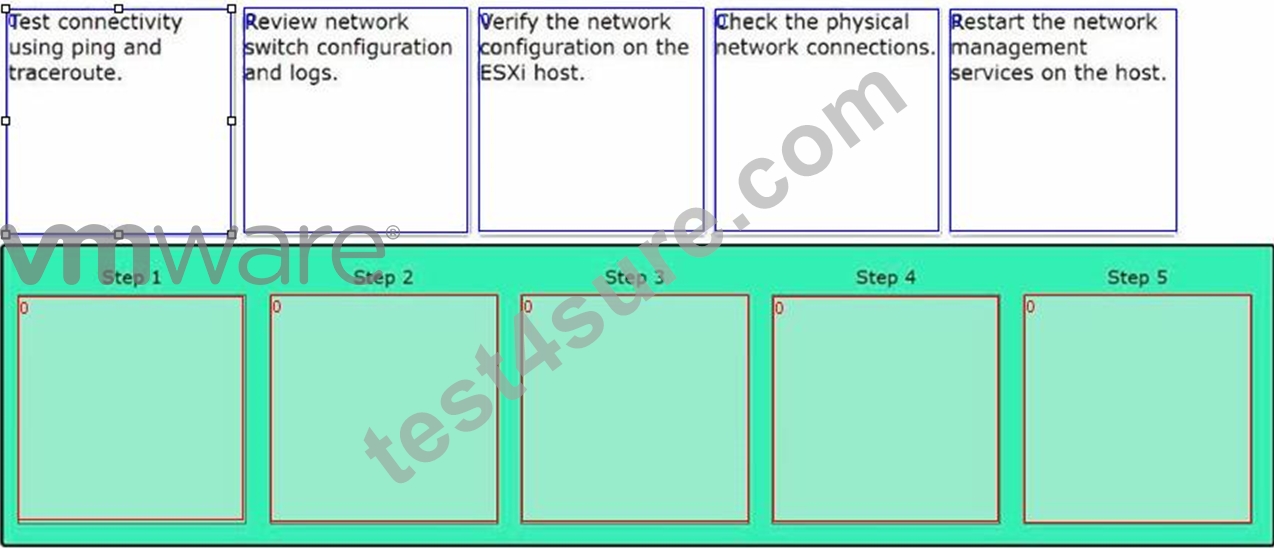
Answer:
Explanation: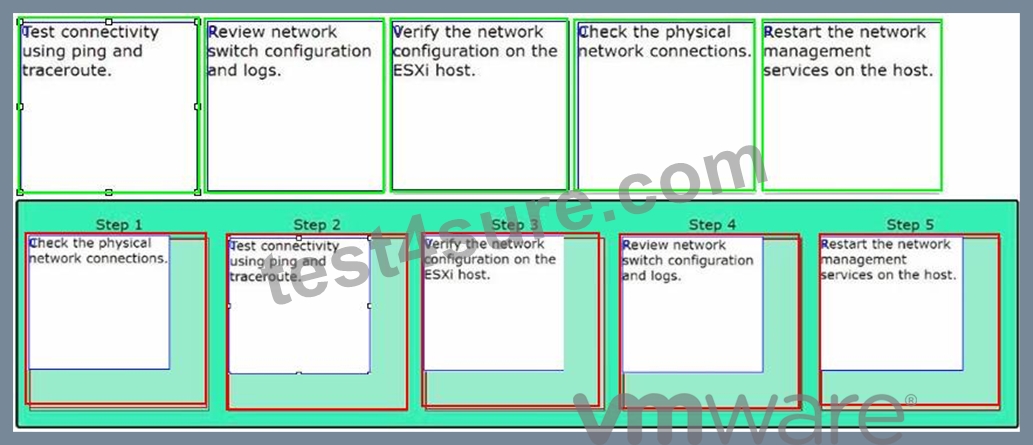
NEW QUESTION # 96
What is the primary benefit of using VMware vCenter Content Libraries?
- A. They facilitate the creation of virtual networks.
- B. They allow for the automation of VM snapshots.
- C. They provide enhanced security for vCenter Server.
- D. They enable centralized management and distribution of VM templates, ISO images, and scripts.
Answer: D
Explanation:
VMware vCenter Content Libraries provide a centralized location for storing and managing virtual machine templates, ISO images, and scripts, making it easier to distribute these resources across multiple vCenter instances. This helps streamline the deployment process, ensuring consistency and reducing the overhead of managing these resources manually.
NEW QUESTION # 97
What is the primary benefit of using HCX Replication Assisted vMotion (RAV) for VM migration?
- A. It ensures zero downtime to the VM(s).
- B. It provides the fastest migration method by powering off the VM(s) before initiating the migration.
- C. It requires no configuration changes to the VM(s) within the destination environment.
- D. It performs a test migration to ensure compatibility.
Answer: A
Explanation:
Comprehensive and Detailed Explanation From Exact Extract:
According to the VMware HCX User Guide and the VMware Cloud Foundation 5.2 Documentation, HCX Replication Assisted vMotion (RAV) is designed to provide a seamless migration of VMs across environments with no downtime to the workload.
Exact Extract from the VMware HCX User Guide:
"HCX Replication Assisted vMotion (RAV) provides zero-downtime migration for virtual machines, combining the benefits of vMotion with replication technologies. This allows VMs to continue running without disruption during the migration process, ensuring uninterrupted service for business-critical workloads." (VMware HCX User Guide - VM Mobility Methods) Why Not the Other Options?
A: RAV does not eliminate all configuration changes; network and other settings may still need updates depending on environments.
B: RAV does not perform a test migration; test migration is a feature of other migration methods.
D: RAV is not a cold migration method; it avoids powering off the VMs and maintains their availability throughout.
Summary:
The primary benefit of using HCX Replication Assisted vMotion (RAV) for VM migration is that it ensures zero downtime to the VM(s) (C), as stated in the official VMware documentation.
NEW QUESTION # 98
An administrator is unable to log in to the SDDC Manager UI on their local workstation. After entering the correct URL, the login page does not load and the administrator is unable to enter their credentials in order to view the SDDC Manager inventory. They confirm that the SDDC Manager appliance responds to a ping command from their local workstation against both its FQDN and IP address.
After checking the VM console of the SDDC Manager appliance in the management vCenter UI, they determine that the operating system is online and they can log in to it with the relevant administrator level accounts.
What two actions could the administrator take whilst logged in to the SDDC Manager VM via the VM console to help identify the root cause of the UI not loading? (Choose two.)
- A. Verify that there is free disk space remaining using the command df -h.
- B. Verify that port 80 is open and listening for connections using the command netstat.
- C. Perform a restart of the network adapter using the command systemctl restart.
- D. Verify the health of the SDDC Manager services using the command sos --get-vcf-services-summary.
- E. Perform a restart of the services using the command systemctl restart.
Answer: A,D
Explanation:
Comprehensive and Detailed Explanation From Exact Extract:
According to the VMware Cloud Foundation 5.2 Administration Guide and troubleshooting documentation, when the SDDC Manager UI does not load even though the appliance is reachable and online, administrators should check both the health of services and the system resources. Here's the detailed reasoning and exact documentation extracts:
Option C: Verify the health of the SDDC Manager services using the command sos --get-vcf-services-summary.
Official documentation states:
"You can check the status of SDDC Manager services by running the sos command on the SDDC Manager VM. This command provides a summary of all SDDC Manager services and their current state. If any service is stopped or unhealthy, this may prevent the UI from loading." Reference:
Option E: Verify that there is free disk space remaining using the command df -h.
Official documentation specifies:
"If the SDDC Manager appliance runs out of disk space, the UI and related services may become unresponsive. Use the df -h command to check for available disk space on the appliance." Why Not the Other Options?
Option A: Port 80 is not used for the SDDC Manager UI; the UI listens on port 443 (HTTPS).
Option B and D: Restarting the network adapter or services without first identifying the root cause is not a recommended troubleshooting step according to the official documentation.
Summary:
The administrator should check the SDDC Manager services health (C) and ensure there is free disk space (E) on the appliance, as recommended by the VMware official documentation for troubleshooting UI access issues in VMware Cloud Foundation 5.2.
NEW QUESTION # 99
Which two operations can be completed in the SDDC Manager UI on an NSX Edge cluster after it has been deployed into a workload domain? (Choose two.)
- A. Expand
- B. Redeploy
- C. Sync
- D. Shrink
- E. Delete
Answer: A,D
Explanation:
Comprehensive and Detailed Explanation From Exact Extract:
After an NSX Edge cluster is deployed into a workload domain, SDDC Manager provides built in operations to adjust the cluster size. According to the VMware Cloud Foundation 5.2 documentation:
"After you create an NSX Edge cluster, you can use SDDC Manager to expand or shrink it by adding or deleting NSX Edge nodes." Breakdown of options:
B).Expand - You can add one or more Edge nodes to increase the cluster size.
E .Shrink - You can remove Edge nodes to decrease the cluster size.
These two actions are the only supported cluster scaling operations available in SDDC Manager post-deployment. Other operations-such as Redeploy, Sync, or Delete-are not available via the UI for a deployed Edge cluster and are either manual or unsupported in that context.
Summary:
Selected choices B and E match the documented capability to scale an NSX Edge cluster via SDDC Manager.
No other operations (A, C, D) are supported for an existing Edge cluster through the UI.
NEW QUESTION # 100
......
2V0-11.25 exam dumps with real VMware questions and answers: https://freecert.test4sure.com/2V0-11.25-exam-materials.html