

[2023] QSDA2022 PDF Questions - Perfect Prospect To Go With Test4Sure Practice Exam
Qlik QSDA2022 Pdf Questions - Outstanding Practice To your Exam
Qlik QSDA2022 exam is a comprehensive test that requires a deep understanding of the Qlik Sense platform. Candidates are expected to have hands-on experience in working with Qlik Sense and be familiar with the best practices of data architecture. QSDA2022 exam consists of multiple-choice questions that assess the candidate's knowledge of Qlik Sense features and functions.
NEW QUESTION # 26
Refer to the exhibit.
A data architect is loading the tables and a synth key is generated.
How should the data architect resolve the synthetic key?
- A. Create a composite key using OrdertD and LineNo
- B. Remove the LineNo field from both tables and use the AutoNumberfunction on the OrderlC field
- C. Create a composite key using OrderlD and LineNo. and remove OrderlD and LineNo from Shipments
- D. Remove the LineNo field from Shipments and use the AutoNumber function on the
Answer: C
NEW QUESTION # 27
A data architect needs to upload data from ten different sources, but only if there are any changes after the last reload When data is updated, a new file is placed into a folder mapped to E A439926003 The data connection points to this folder.
The data architect plans a script which will:
1. Verify that the file exists
2. If the file exists, upload it Otherwise, skip to the next piece of code The script will repeat this subroutine for each source. When the script ends, all uploaded files will be removed with a batch procedure.
Which option should the data architectuse to meet these requirements?
- A. FilePath, FOR EACH, Peek, Drop
- B. FileExists, FOR EACH, IF
- C. FileSize, IF, THEN, END IF
- D. FilePath, IF, THEN. Drop
Answer: C
NEW QUESTION # 28
A dataarchitect needs to load data from two different databases Additional data will be added from a folder that contains QVDs. text files, and Excel files.
What is the minimum number of data connections required?
- A. Two
- B. Four
- C. Five
- D. Three
Answer: D
NEW QUESTION # 29
A data architect needs to develop multiple apps for various departments.
More departments are requesting apps over time The company uses specific requirementsfor the number interpretation variables (e.g., ThousandSep, DecimalSep) found at the beginning of a LOAD script.
The data architect wants to reduce duplicate scripts but does not want to copy and paste the number interpretation variables each time new appis created. The data architect prefers to use the least amount of script in Qlik Sense.
How should the data architect meet these requirements?
- A. Create an Excel file with the number interpretation variables and use a FOR Next loop to load the variables into Qlik Sense
- B. Create an Excel file with the number interpretation variables and apply the variables to the app using a mapping table
- C. Save the script for the number interpretation variables in a text file and INLUDE function to insert the variables
- D. Save the script for the number interpretation variables in a text file and use the CALL function to insert the variables.
Answer: C
Explanation:
Explanation
This method involves saving the script for the number interpretation variables in a separate text file, and then using theINCLUDE function to insert the variables into each new app script that is created. This reduces the need to copy and paste the number interpretation variables each time a new app is created and allows the data architect to use the least amount of script in Qlik Sense.
The INCLUDE function is a script statement that allows you to insert the contents of one script file into another script file. This can be used to insert common scripts, such as the number interpretation variables, into multiple app scripts.
NEW QUESTION # 30 
Refer to the exhibit
A data architect develops an app for Coffee4all, a coffee company with stores located throughout Europe The script runs successfully, but the Stores table does not have any values.
What should the data architect do?
- A. Use where exists (ID)
- B. Use where exists (ID, StorelD)
- C. Use Concatenate before loading the Stores table
Answer: A
NEW QUESTION # 31
Refer to the exhibit.
This table contains information about the number of admissions and discharges of patients in a hospital. The values can be positive or negative. The data architect needs to create an extra column that contains the number of patients that are currently in the hospital.
Which script should the data architect use ?
A)
B)
C)
D)
- A. Option A
- B. Option D
- C. Option B
- D. Option C
Answer: A
NEW QUESTION # 32
Refer to the exhibits.
While debugging an app, a developer loads data from an application layer QVD file.
In the process of separating a concatenated key into two parts, some split results are missing data What should the data architect do?
- A. In the SUBFIELD function, replace the '_' with a '|' or '_' character.
While debugging an app, a developer loads data from an application layer QVD file.
In theprocess of separating a concatenated key into two parts, some split results are missing data What should the data architect do? - B. Instruct the developer of the QVD file to correct the generation of the ConcatKeyAlpha field
- C. Utilize a combination of LEFT(), MID(), and RIGHTO functions to capture the key components
- D. Utilize a combination of LEFT(), MID(), and RIGHT() functions to capture the key components
- E. In the SUBFIELDfunction, replace the '- with a '|' or '-' character
- F. Wrap an IF() function around the SUBFIELD() functions to check and adapt to null values
- G. Wrap an IF() function around the SUBFIELDQ functions to check and adapt to null values character
- H. Instruct the developer of the QVD file to correct the generation of the ConcatKeyAlpha field
Answer: E
NEW QUESTION # 33
A data architect needs to upload different data sources. To properly handle null values, the data architect decides to set all of these values to "Missing Value".
Which syntax should the data architect use?
- A. NullAsValue*; Set NullValues = 'Missing Value';
- B. NullasNull *;
Set NullValues = 'Missing Value'; - C. NullasNull *;
Set NullValue = 'Missing Value'; - D. NullAsValue*;
Set NullValue = 'Missing Value';
Answer: A
Explanation:
Explanation
This syntax will set all null values to "Missing Value" in the data sources. The other options are not valid syntax and will not achieve the desired result.
NEW QUESTION # 34
A data architect needs to create an app to analyze 30-day re-admissions at a hospital.
* The medical record system does NOT calculate re-admission data
* The business rule to follow: if a patient is admitted to a hospital within 30 days after being discharged from a previous hospital stay, that event should be captured in the app with a flag called "30-day Re-admission"
* Data being used from the patient record includes hospital account ID, patient ID, admission dater and discharge date Which action should the data architect perform first to meet these requirements?
- A. Order patient records by patient ID and admission date
- B. Sequence patient records by hospital account ID and patient ID using the Peek function
- C. Calculate the days since previous discharge using admission date and discharge date
- D. Sequence patient records by patient ID using the Peek function
Answer: A
NEW QUESTION # 35 
The Section Access security table for an app is shown. User ABC\PPP opens a Qlik Sense app with a table using the field called LEVEL on one of the table columns.
What is the result?
- A. The table is displayed without the LEVELcolumn.
- B. The user gets an "incomplete visualization" error
- C. The user gets a "Field not found" error.
- D. The table is removed from the user interface.
Answer: B
NEW QUESTION # 36
Refer to the exhibit.
A data architect loads sales data and creates a table which shows only customers who made purchases in 2018 and 2019. The data architect applies the following set analysis expression on the sales measure.
Count<{<Year={'2 018'}, CustomerID=P({<Year={'2019*}>})>} Customer ID)
Which option shows the resulting table after the expression is applied?
A)
B)
C)
D)
- A. Option A
- B. Option B
- C. Option D
- D. Option C
Answer: C
NEW QUESTION # 37
Refer to the exhibits.
A business analyst needs to see the currency conversion provided by a third party process, and only contains a record when the rate changes in a chart. The currency conversion rate data is An existing master calendar exists in the data model that contains a full set of dates.
Which technique should the data architect use to meet this requirement?
- A. Use ITERNO and AUTOGENERATE to create a new calendar from max and min dates of the currency conversion table
- B. Utilize INTERVALMATCH to load the currency conversion rate between dates theconversation changed INNER JOIN the resultant table back into the master calendar
- C. Leverage a FOR loop between the start date and end date of the master calendar Use the MATCH function to add the currency conversion rates to the master calendar
- D. OUTER JOIN the calendar with the currency conversion table
ORDER BY the date and use the PEEK function to fill in blank values
Answer: D
NEW QUESTION # 38
Refer to the exhibit.
A business analyst reports that the 'CompanyAge' field does NOT display for users The data architect examines the LOAD script and wants to place the breakpoint in the script to check the field name.
Which line number should the data architect use?
- A. 251 because the field name appears in the Variable panel of the debugger
- B. 251 because the field name appears in the Output panel of the debugger
- C. 242 because field name appears in the output Panel of the debugger
- D. 251 because the field name appears in the Qlik Log files
Answer: B
NEW QUESTION # 39
Refer to the exhibits.
Some business users created an app by using the Add data functionality and loading two Excel files Orders and Customers.
The app is used to analyze the number of orders by customer. When the users create a bar chart to review the figures, the data shown is incorrect.
What should the data architect do to resolve this issue?
- A. Open the data load editor and apply a NOCONCATENATE function in the LOAD statement on the Orders table
- B. Open the data load editor and use JOIN instead of concatenate to combine Orders and Customers by CustomerlD
- C. Open the data manager, split the Customers table, and JOIN Orders and Customers on the CustomerlD field
- D. Open the data manager, split the Customers table, and associate both tables on CustomerlD field
Answer: B
NEW QUESTION # 40
A table is generated resulting from the following script
When the data architect selects a date, some, but NOT all, orders for that date are shown How should the data architect modify the script to show all orders for the selected date?
A)
B)
C)
D)
- A. Option C
- B. Option A
- C. Option D
- D. Option B
Answer: A
NEW QUESTION # 41
Refer to the exhibit.

Refer to the exhibits.
While using an app, the users report that some Sales Reps do NOT have personal details, like Division or Address Number A data architect has been called in to investigate.
The data architect uses the data model viewer to determine the relationship between the SalesRepMaster and CustomerMaster tables.
What is the cause of the issue?
- A. 40.7% of the Sales Rep have CustomerMaster information
- B. 59.3% of the Sales Rep have CustomerMaster information
- C. Density is 100% while Total Distinct and Present Distinct are NOT the same
- D. 26 values for Sales Rep are null in CustomerMaster
Answer: C
Explanation:
Explanation
When using the data model viewer to investigate the relationship between the SalesRepMaster and CustomerMaster tables, the data architect would look at the density of the relationship. Density is a measure of how well the key fields of a table match the key fields of another table. A density of 100% means that all key fields in one table have a match in the other table.
When the density is 100% but the total distinct and present distinct values for the key fields of the related tables do not match, it means that some of the key fields in one table do not have a match in the other table, this is the cause of the issue.
NEW QUESTION # 42
A company decides to migrate all apps from QlikView to Qlik Sense. After converting an apps: there are several unconverted objects What should the data architect do?
- A. Save the unconverted objects as master items
- B. Re-create the unconverted objects
- C. Remove the set analysis statements from the unconverted objects
- D. Save the unconverted objects as extensions and import them into Qlik Sense
Answer: B
Explanation:
Explanation
After migrating an app from QlikView to Qlik Sense, there may be some unconverted objects. In this case, the data architect should re-create the unconverted objects in order to ensure that the app works properly in Qlik Sense. The other options will not work, as saving the unconverted objects as extensions or master items will not ensure that the app works properly, and removing set analysis statements will not help either.
qlik-sense-certification-exam-study-guide-en.pdf
https://www.qlik.com/us/-/media/files/training/global-us/qlik-sense-certification-exam-study-guide-en.pdf?la=en Talk to Experts Tuesday - Migrating from QlikView to Qlik Sense FAQ
https://community.qlik.com/t5/Support-Knowledge-Base/Talk-to-Experts-Tuesday-Migrating-from-QlikView-to Certifications & Qualifications | Qlik
https://www.qlik.com/us/services/training/certifications-and-qualifications
NEW QUESTION # 43
A data architect of an organization that has implemented Qlik Sense on Windows needs to load large amounts of data from a database that is continuously updated New records are added, and existing records get updated and deleted. Each record has a LastModified field.
All existing records are exported into aQVD file. The data architect wants to load the records into Qlik Sense efficiently.
Which steps should the data architect take to meet these requirements?
- A. 1 Load the existing data from the QVD
2. Load the new and updated data from the database without the rows that have just been loaded from the QVD and concatenate with data from the QVD
3. Load all records from the key field from the database and use an INNER JOIN on the previous table - B. 1. Load the existing data from the QVD
2. Load new andupdated data from the database Concatenate with the table loaded from the QVD.
3. Create a separate table for the deleted rows and use a WHERE NOT EXISTS to remove these records - C. 1. Use a partial LOAD to load new and updated data from the database.
2.Load the existing data from the QVD without the updated rows that have just been loaded from the database and concatenate with the new and updated records
3. Use the PEEK function to remove the deleted rows - D. 1 Load the new and updated data fromthe database.
2. Load the existing data from the QVD without the updated rows that have just been loaded from the database and concatenate with the new and updated records.
3. Load all records from the key field from the database and use an INNER JOIN onthe previous table.
Answer: D
NEW QUESTION # 44
A data architect executes the following script:
Whatwill be the result of Table A?
A)
B)
C)
D)
- A. Option A
- B. Option B
- C. Option D
- D. Option C
Answer: C
NEW QUESTION # 45
A data architect needs to load Table_A from an Excel file and sort the data by Field_2.
Which script should the data architect use?
A)
B)
C)
D)
- A. Option A
- B. Option B
- C. Option D
- D. Option C
Answer: C
NEW QUESTION # 46
Refer to the exhibit.
What are the values of the variables vLoadStart and vLoadComplete after the script executes?
- A. vLoadStart; 'NOW{)'
vLoadComplete: current system date and time when the script ended - B. vLoadStart: system date when the app was opened vLoadComplete 'now()'
- C. vLoadStart: current system date and time when the script started vLoadComplete: 'now()'
- D. vLoadStart: system date when the app was opened vLoadComplete: current system date and time when the script ended
Answer: C
Explanation:
Explanation
vLoadStart variable is assigned the current system date and time when the script starts, and vLoadComplete variable is assigned the current system date and time when the script ends.
NEW QUESTION # 47
A global retailer has a large database in which millions of sales transactions are added per hour.
Each regional sales manager should only see details for customers in their region. After filtering based on criteria such as region, gender,and income level, sales managers should be able to see the most current detailed transactions.
What should a data architect do to meet these requirements?
- A. Use section access and include aservice account in the table
- B. Use section access to restrict sales manager access by region
- C. Use On-Demand App Generation (ODAG) and section access
- D. Create an app for each sales manager with Qlik GeoAnalytics
Answer: B
NEW QUESTION # 48 
Refer to the exhibit.
A data architect is loading two tables: Orders and Product. The Product table includes attributes and values for each ProductID such as Colour, Price, Category, and Description.
The business analyst can filter by the value of these attributes. For performance reasons, the Data Model will use two tables.
Which solution should the data architect apply in the Data Load Editor to build the ProductDetails table?
For performance reasons, the Data Model will use two tables a Load Editor to build the ProductDetails table?
- A. Use a For loop to apply a Generic load to the Product table and concatenate the generic tables together
- B. Use a For loop to concatenate all of the Products table and apply a Generic Load to the final concatenate table
- C. Use a Generic Loadin the Product table and a For loop to left join each Generic table
Answer: C
NEW QUESTION # 49 
A company has different departments.
Executive and Sales should always be the first values in a Department filter pane.
Which script must the data architect use to meet this requirement?
- A.
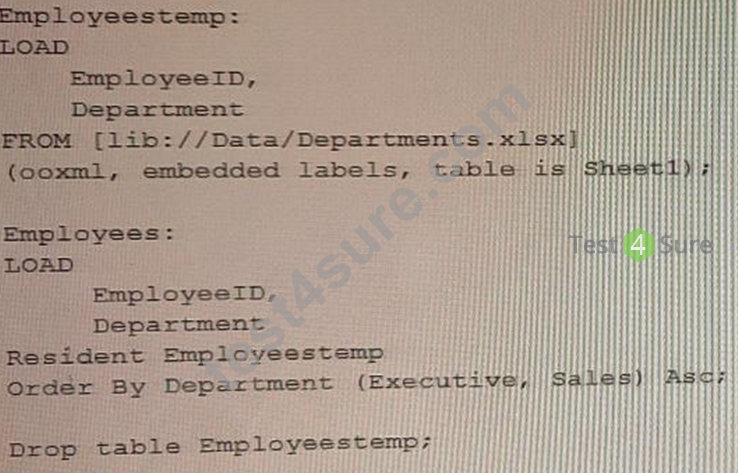
- B.

- C.

- D.

Answer: C
NEW QUESTION # 50
......
The QSDA2022 (Qlik Sense Data Architect Certification Exam - 2022) is a certification exam that gauges the knowledge and skills of data architects who will be using Qlik Sense to create and manage data models, user interfaces, and data connections. QSDA2022 exam is designed to give candidates a comprehensive understanding of the key concepts, features, and functionalities of the Qlik platform, as well as the ability to deploy them effectively in real-world scenarios.
Qlik QSDA2022 (Qlik Sense Data Architect Certification Exam - 2022) Certification Exam is a globally recognized certification that validates a professional's knowledge and skills in Qlik Sense data architecture. Qlik Sense Data Architect Certification Exam - 2022 certification exam is designed for individuals who are keen on advancing their careers as data architects, consultants, and analysts. QSDA2022 exam is intended to test the candidate's abilities in designing, building, and managing data models in Qlik Sense, as well as their proficiency in data integration and transformation.
Online Questions - Outstanding Practice To your QSDA2022 Exam: https://freecert.test4sure.com/QSDA2022-exam-materials.html