

2025 Updated Verified Databricks-Certified-Professional-Data-Engineer Downloadable Printable Exam Dumps
The Ultimate Databricks Databricks-Certified-Professional-Data-Engineer Dumps PDF Review
Databricks Certified Professional Data Engineer exam consists of a set of performance-based tasks that test the candidate's ability to apply their knowledge and skills to real-world scenarios. Databricks-Certified-Professional-Data-Engineer exam is conducted online and can be taken from anywhere in the world. Databricks-Certified-Professional-Data-Engineer exam is timed and candidates have to complete the tasks within the given time frame. Databricks-Certified-Professional-Data-Engineer exam is designed in such a way that it assesses the candidate's ability to work with Databricks Unified Analytics Platform and solve complex data engineering problems.
NEW QUESTION # 15
A DLT pipeline includes the following streaming tables:
Raw_lot ingest raw device measurement data from a heart rate tracking device.
Bgm_stats incrementally computes user statistics based on BPM measurements from raw_lot.
How can the data engineer configure this pipeline to be able to retain manually deleted or updated records in the raw_iot table while recomputing the downstream table when a pipeline update is run?
- A. Set the pipelines, reset, allowed property to false on bpm_stats
- B. Set the skipChangeCommits flag to true on bpm_stats
- C. Set the pipelines, reset, allowed property to false on raw_iot
- D. Set the SkipChangeCommits flag to true raw_lot
Answer: C
Explanation:
In Databricks Lakehouse, to retain manually deleted or updated records in theraw_iottable while recomputing downstream tables when a pipeline update is run, the propertypipelines.reset.allowedshould be set tofalse.
This property prevents the system from resetting the state of the table, which includes the removal of the history of changes, during a pipeline update. By keeping this property as false, any changes to theraw_iot table, including manual deletes or updates, are retained, and recomputation of downstream tables, such as bpm_stats, can occur with the full history of data changes intact.
References:
* Databricks documentation on DLT pipelines: https://docs.databricks.com/data-engineering/delta-live- tables/delta-live-tables-overview.html
NEW QUESTION # 16
An external object storage container has been mounted to the location/mnt/finance_eda_bucket.
The following logic was executed to create a database for the finance team:
After the database was successfully created and permissions configured, a member of the finance team runs the following code:
If all users on the finance team are members of thefinancegroup, which statement describes how thetx_sales table will be created?
- A. A logical table will persist the physical plan to the Hive Metastore in the Databricks control plane.
- B. An external table will be created in the storage container mounted to /mnt/finance eda bucket.
- C. A managed table will be created in the DBFS root storage container.
- D. A logical table will persist the query plan to the Hive Metastore in the Databricks control plane.
- E. An managed table will be created in the storage container mounted to /mnt/finance eda bucket.
Answer: B
Explanation:
Explanation
The code uses the CREATE TABLE USING DELTA command to create a Delta Lake table from an existing Parquet file stored in an external object storage container mounted to /mnt/finance_eda_bucket. The code also uses the LOCATION keyword to specify the path to the Parquet file as
/mnt/finance_eda_bucket/tx_sales.parquet. By using the LOCATION keyword, the code creates an external table, which is a table that is stored outside of the default warehouse directory and whose metadata is not managed by Databricks. An external table can be created from an existing directory in a cloud storage system, such as DBFS or S3, that contains data files in a supported format, such as Parquet or CSV. Verified References: [Databricks Certified Data Engineer Professional], under "Delta Lake" section; Databricks Documentation, under "Create an external table" section.
NEW QUESTION # 17
A Delta Lake table representing metadata about content from user has the following schema:
Based on the above schema, which column is a good candidate for partitioning the Delta Table?
- A. Date
- B. Post_time
- C. Post_id
- D. User_id
Answer: A
Explanation:
Partitioning a Delta Lake table improves query performance by organizing data into partitions based on the values of a column. In the given schema, the date column is a good candidate for partitioning for several reasons:
* Time-Based Queries: If queries frequently filter or group by date, partitioning by the date column can significantly improve performance by limiting the amount of data scanned.
* Granularity: The date column likely has a granularity that leads to a reasonable number of partitions (not too many and not too few). This balance is important for optimizing both read and write performance.
* Data Skew: Other columns like post_id or user_id might lead to uneven partition sizes (data skew), which can negatively impact performance.
Partitioning by post_time could also be considered, but typically date is preferred due to its more manageable granularity.
References:
* Delta Lake Documentation on Table Partitioning: Optimizing Layout with Partitioning
NEW QUESTION # 18
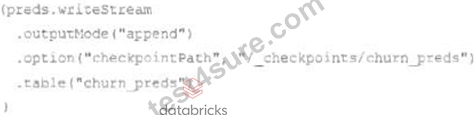
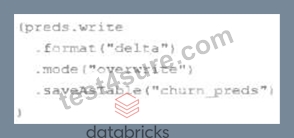
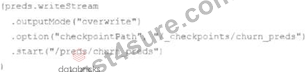
The data science team has created and logged a production model using MLflow. The following code correctly imports and applies the production model to output the predictions as a new DataFrame namedpredswith the schema "customer_id LONG, predictions DOUBLE, date DATE".
The data science team would like predictions saved to a Delta Lake table with the ability to compare all predictions across time. Churn predictions will be made at most once per day.
Which code block accomplishes this task while minimizing potential compute costs?
- A. preds.write.format("delta").save("/preds/churn_preds")
- B.
- C. preds.write.mode("append").saveAsTable("churn_preds")
- D.
- E.
Answer: C
NEW QUESTION # 19
A data engineer needs to create a database called customer360 at the loca-tion /customer/customer360. The
data engineer is unsure if one of their colleagues has already created the database.
Which of the following commands should the data engineer run to complete this task?
- A. CREATE DATABASE customer360 DELTA LOCATION '/customer/customer360';
- B. CREATE DATABASE IF NOT EXISTS customer360 DELTA LOCATION '/customer/customer360';
- C. CREATE DATABASE IF NOT EXISTS customer360 LOCATION '/customer/customer360';
- D. CREATE DATABASE IF NOT EXISTS customer360;
- E. CREATE DATABASE customer360 LOCATION '/customer/customer360';
Answer: C
NEW QUESTION # 20
A junior data engineer is migrating a workload from a relational database system to the Databricks Lakehouse.
The source system uses a star schema, leveraging foreign key constrains and multi-table inserts to validate records on write.
Which consideration will impact the decisions made by the engineer while migrating this workload?
- A. Committing to multiple tables simultaneously requires taking out multiple table locks and can lead to a state of deadlock.
- B. Databricks only allows foreign key constraints on hashed identifiers, which avoid collisions in highly-parallel writes.
- C. All Delta Lake transactions are ACID compliance against a single table, and Databricks does not enforce foreign key constraints.
- D. Foreign keys must reference a primary key field; multi-table inserts must leverage Delta Lake's upsert functionality.
Answer: C
Explanation:
In Databricks and Delta Lake, transactions are indeed ACID-compliant, but this compliance is limited to single table transactions. Delta Lake does not inherently enforce foreign key constraints, which are a staple in relational database systems for maintaining referential integrity between tables. This means that when migrating workloads from a relational database system to Databricks Lakehouse, engineers need to reconsider how to maintain data integrity and relationships that were previously enforced by foreign key constraints.
Unlike traditional relational databases where foreign key constraints help in maintaining the consistency across tables, in Databricks Lakehouse, the data engineer has to manage data consistency and integrity at the application level or through careful design of ETL processes.References:
* Databricks Documentation on Delta Lake: Delta Lake Guide
* Databricks Documentation on ACID Transactions in Delta Lake: ACID Transactions in Delta Lake
NEW QUESTION # 21
A Delta Lake table was created with the below query: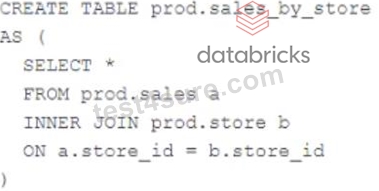
Consider the following query:
DROP TABLE prod.sales_by_store -
If this statement is executed by a workspace admin, which result will occur?
- A. Nothing will occur until a COMMIT command is executed.
- B. The table will be removed from the catalog but the data will remain in storage.
- C. The table will be removed from the catalog and the data will be deleted.
- D. Data will be marked as deleted but still recoverable with Time Travel.
- E. An error will occur because Delta Lake prevents the deletion of production data.
Answer: C
Explanation:
When a table is dropped in Delta Lake, the table is removed from the catalog and the data is deleted. This is because Delta Lake is a transactional storage layer that provides ACID guarantees. When a table is dropped, the transaction log is updated to reflect the deletion of the table and the data is deleted from the underlying storage. Reference:
https://docs.databricks.com/delta/quick-start.html#drop-a-table
https://docs.databricks.com/delta/delta-batch.html#drop-table
NEW QUESTION # 22
The data engineering team has configured a Databricks SQL query and alert to monitor the values in a Delta Lake table. The recent_sensor_recordings table contains an identifying sensor_id alongside the timestamp and temperature for the most recent 5 minutes of recordings.
The below query is used to create the alert:
The query is set to refresh each minute and always completes in less than 10 seconds. The alert is set to trigger when mean (temperature) > 120. Notifications are triggered to be sent at most every 1 minute.
If this alert raises notifications for 3 consecutive minutes and then stops, which statement must be true?
- A. The total average temperature across all sensors exceeded 120 on three consecutive executions of the query
- B. The average temperature recordings for at least one sensor exceeded 120 on three consecutive executions of the query
- C. The recent_sensor_recordingstable was unresponsive for three consecutive runs of the query
- D. The maximum temperature recording for at least one sensor exceeded 120 on three consecutive executions of the query
- E. The source query failed to update properly for three consecutive minutes and then restarted
Answer: B
Explanation:
This is the correct answer because the query is using a GROUP BY clause on the sensor_id column, which means it will calculate the mean temperature for each sensor separately. The alert will trigger when the mean temperature for any sensor is greater than 120, which means at least one sensor had an average temperature above 120 for three consecutive minutes. The alert will stop when the mean temperature for all sensors drops below 120. Verified References: [Databricks Certified Data Engineer Professional], under "SQL Analytics" section; Databricks Documentation, under "Alerts" section.
NEW QUESTION # 23
What is the purpose of the bronze layer in a Multi-hop Medallion architecture?
- A. Powers ML applications
- B. Reduces data storage by compressing the data
- C. Copy of raw data, easy to query and ingest data for downstream processes.
- D. Contain aggregated data that is to be consumed into Silver
- E. Data quality checks, corrupt data quarantined
Answer: C
Explanation:
Explanation
The answer is, copy of raw data, easy to query and ingest data for downstream processes, Medallion Architecture - Databricks Here are the typical role of Bronze Layer in a medallion architecture.
Bronze Layer:
1. Raw copy of ingested data
2. Replaces traditional data lake
3. Provides efficient storage and querying of full, unprocessed history of data
4. No schema is applied at this layer
Exam focus: Please review the below image and understand the role of each layer(bronze, silver, gold) in medallion architecture, you will see varying questions targeting each layer and its purpose.
Sorry I had to add the watermark some people in Udemy are copying my content.
NEW QUESTION # 24
A junior member of the data engineering team is exploring the language interoperability of Databricks notebooks. The intended outcome of the below code is to register a view of all sales that occurred in countries on the continent of Africa that appear in thegeo_lookuptable.
Before executing the code, runningSHOWTABLESon the current database indicates the database contains only two tables:geo_lookupandsales.
Which statement correctly describes the outcome of executing these command cells in order in an interactive notebook?
- A. Both commands will succeed. Executing show tables will show that countries at and sales at have been registered as views.
- B. Both commands will fail. No new variables, tables, or views will be created.
- C. Cmd 1 will succeed. Cmd 2 will search all accessible databases for a table or view named countries af: if this entity exists, Cmd 2 will succeed.
- D. Cmd 1 will succeed and Cmd 2 will fail, countries at will be a Python variable containing a list of strings.
- E. Cmd 1 will succeed and Cmd 2 will fail, countries at will be a Python variable representing a PySpark DataFrame.
Answer: D
Explanation:
This is the correct answer because Cmd 1 is written in Python and uses a list comprehension to extract the country names from the geo_lookup table and store them in a Python variable named countries af. This variable will contain a list of strings, not a PySpark DataFrame or a SQL view. Cmd 2 is written in SQL and tries to create a view named sales af by selecting from the sales table where city is in countries af. However, this command will fail because countries af is not a valid SQL entity and cannot be used in a SQL query. To fix this, a better approach would be to use spark.sql() to execute a SQL query in Python and pass the countries af variable as a parameter. Verified References: [Databricks Certified Data Engineer Professional], under
"Language Interoperability" section; Databricks Documentation, under "Mix languages" section.
NEW QUESTION # 25
The DevOps team has configured a production workload as a collection of notebooks scheduled to run daily using the Jobs UI. A new data engineering hire is onboarding to the team and has requested access to one of these notebooks to review the production logic.
What are the maximum notebook permissions that can be granted to the user without allowing accidental changes to production code or data?
- A. Can Read
- B. No permissions
- C. Can Run
- D. Can Edit
- E. Can Manage
Answer: A
Explanation:
This is the correct answer because it is the maximum notebook permissions that can be granted to the user without allowing accidental changes to production code or data. Notebook permissions are used to control access to notebooks in Databricks workspaces. There are four types of notebook permissions: Can Manage, Can Edit, Can Run, and Can Read. Can Manage allows full control over the notebook, including editing, running, deleting, exporting, and changing permissions. Can Edit allows modifying and running the notebook, but not changing permissions or deleting it. Can Run allows executing commands in an existing cluster attached to the notebook, but not modifying or exporting it. Can Read allows viewing the notebook content, but not running or modifying it. In this case, granting Can Read permission to the user will allow them to review the production logic in the notebook without allowing them to make any changes to it or run any commands that may affect production data. Verified References: [Databricks Certified Data Engineer Professional], under "Databricks Workspace" section; Databricks Documentation, under "Notebook permissions" section.
NEW QUESTION # 26
The Databricks workspace administrator has configured interactive clusters for each of the data engineering groups. To control costs, clusters are set to terminate after 30 minutes of inactivity. Each user should be able to execute workloads against their assigned clusters at any time of the day.
Assuming users have been added to a workspace but not granted any permissions, which of the following describes the minimal permissions a user would need to start and attach to an already configured cluster.
- A. "Can Manage" privileges on the required cluster
- B. "Can Restart" privileges on the required cluster
- C. Cluster creation allowed. "Can Restart" privileges on the required cluster
- D. Workspace Admin privileges, cluster creation allowed. "Can Attach To" privileges on the required cluster
- E. Cluster creation allowed. "Can Attach To" privileges on the required cluster
Answer: B
Explanation:
Explanation
https://learn.microsoft.com/en-us/azure/databricks/security/auth-authz/access-control/cluster-acl
https://docs.databricks.com/en/security/auth-authz/access-control/cluster-acl.html
NEW QUESTION # 27
A junior data engineer has configured a workload that posts the following JSON to the Databricks REST API endpoint2.0/jobs/create.
Assuming that all configurations and referenced resources are available, which statement describes the result of executing this workload three times?
- A. Three new jobs named "Ingest new data" will be defined in the workspace, but no jobs will be executed.
- B. Three new jobs named "Ingest new data" will be defined in the workspace, and they will each run once daily.
- C. The logic defined in the referenced notebook will be executed three times on the referenced existing all purpose cluster.
- D. The logic defined in the referenced notebook will be executed three times on new clusters with the configurations of the provided cluster ID.
- E. One new job named "Ingest new data" will be defined in the workspace, but it will not be executed.
Answer: C
Explanation:
This is the correct answer because the JSON posted to the Databricks REST API endpoint 2.0/jobs/create defines a new job with a name, an existing cluster id, and a notebook task. However, it does not specify any schedule or trigger for the job execution. Therefore, three new jobs with the same name and configuration will be created in the workspace, but none of them will be executed until they are manually triggered or scheduled.
Verified References: [Databricks Certified Data Engineer Professional], under "Monitoring & Logging" section; [Databricks Documentation], under "Jobs API - Create" section.
NEW QUESTION # 28
The data engineering team is migrating an enterprise system with thousands of tables and views into the Lakehouse. They plan to implement the target architecture using a series of bronze, silver, and gold tables. Bronze tables will almost exclusively be used by production data engineering workloads, while silver tables will be used to support both data engineering and machine learning workloads. Gold tables will largely serve business intelligence and reporting purposes. While personal identifying information (PII) exists in all tiers of data, pseudonymization and anonymization rules are in place for all data at the silver and gold levels.
The organization is interested in reducing security concerns while maximizing the ability to collaborate across diverse teams.
Which statement exemplifies best practices for implementing this system?
- A. Working in the default Databricks database provides the greatest security when working with managed tables, as these will be created in the DBFS root.
- B. Isolating tables in separate databases based on data quality tiers allows for easy permissions management through database ACLs and allows physical separation of default storage locations for managed tables.
- C. Because databases on Databricks are merely a logical construct, choices around database organization do not impact security or discoverability in the Lakehouse.
- D. Because all tables must live in the same storage containers used for the database they're created in, organizations should be prepared to create between dozens and thousands of databases depending on their data isolation requirements.
- E. Storinq all production tables in a single database provides a unified view of all data assets available throughout the Lakehouse, simplifying discoverability by granting all users view privileges on this database.
Answer: B
Explanation:
This is the correct answer because it exemplifies best practices for implementing this system. By isolating tables in separate databases based on data quality tiers, such as bronze, silver, and gold, the data engineering team can achieve several benefits. First, they can easily manage permissions for different users and groups through database ACLs, which allow granting or revoking access to databases, tables, or views. Second, they can physically separate the default storage locations for managed tables in each database, which can improve performance and reduce costs. Third, they can provide a clear and consistent naming convention for the tables in each database, which can improve discoverability and usability. Verified Reference: [Databricks Certified Data Engineer Professional], under "Lakehouse" section; Databricks Documentation, under "Database object privileges" section.
NEW QUESTION # 29
A junior data engineer on your team has implemented the following code block.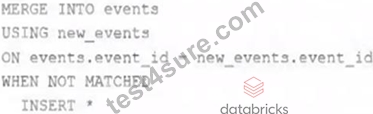
The viewnew_eventscontains a batch of records with the same schema as theeventsDelta table.
Theevent_idfield serves as a unique key for this table.
When this query is executed, what will happen with new records that have the sameevent_idas an existing record?
- A. They are inserted.
- B. They are updated.
- C. They are deleted.
- D. They are ignored.
- E. They are merged.
Answer: D
Explanation:
Explanation
This is the correct answer because it describes what will happen with new records that have the same event_id as an existing record when the query is executed. The query uses the INSERT INTO command to append new records from the view new_events to the table events. However, the INSERT INTO command does not check for duplicate values in the primary key column (event_id) and does not perform any update or delete operations on existing records. Therefore, if there are new records that have the same event_id as an existing record, they will be ignored and not inserted into the table events. Verified References: [Databricks Certified Data Engineer Professional], under "Delta Lake" section; Databricks Documentation, under "Append data using INSERT INTO" section.
NEW QUESTION # 30
To reduce storage and compute costs, the data engineering team has been tasked with curating a series of aggregate tables leveraged by business intelligence dashboards, customer-facing applications, production machine learning models, and ad hoc analytical queries.
The data engineering team has been made aware of new requirements from a customer-facing application, which is the only downstream workload they manage entirely. As a result, an aggregate tableused by numerous teams across the organization will need to have a number of fields renamed, and additional fields will also be added.
Which of the solutions addresses the situation while minimally interrupting other teams in the organization without increasing the number of tables that need to be managed?
- A. Configure a new table with all the requisite fields and new names and use this as the source for the customer-facing application; create a view that maintains the original data schema and table name by aliasing select fields from the new table.
- B. Create a new table with the required schema and new fields and use Delta Lake's deep clone functionality to sync up changes committed to one table to the corresponding table.
- C. Add a table comment warning all users that the table schema and field names will be changing on a given date; overwrite the table in place to the specifications of the customer-facing application.
- D. Replace the current table definition with a logical view defined with the query logic currently writing the aggregate table; create a new table to power the customer-facing application.
- E. Send all users notice that the schema for the table will be changing; include in the communication the logic necessary to revert the new table schema to match historic queries.
Answer: A
Explanation:
This is the correct answer because it addresses the situation while minimally interrupting other teams in the organization without increasing the number of tables that need to be managed. The situation is that an aggregate table used by numerous teams across the organization will need to have a number of fields renamed, and additional fields will also be added, due to new requirements from a customer-facing application. By configuring a new table with all the requisite fields and new names and using this as the source for the customer-facing application, the data engineering team can meet the new requirements without affecting other teams that rely on the existing table schema and name. By creating a view that maintains the original data schema and table name by aliasing select fields from the new table, the data engineering team can also avoid duplicating data or creating additional tables that need to be managed. Verified References:
[Databricks Certified Data Engineer Professional], under "Lakehouse" section; Databricks Documentation, under "CREATE VIEW" section.
NEW QUESTION # 31
A data engineer is designing a data pipeline. The source system generates files in a shared directory that is also
used by other processes. As a result, the files should be kept as is and will accumulate in the directory. The
data engineer needs to identify which files are new since the previous run in the pipeline, and set up the
pipeline to only ingest those new files with each run.
Which of the following tools can the data engineer use to solve this problem?
- A. Databricks SQL
- B. Auto Loader
- C. Data Explorer
- D. Unity Catalog
- E. Delta Lake
Answer: B
NEW QUESTION # 32
The data engineering team maintains the following code:
Assuming that this code produces logically correct results and the data in the source table has been de-duplicated and validated, which statement describes what will occur when this code is executed?
- A. A batch job will update the gold_customer_lifetime_sales_summary table, replacing only those rows that have different values than the current version of the table, using customer_id as the primary key.
- B. An incremental job will detect if new rows have been written to the silver_customer_sales table; if new rows are detected, all aggregates will be recalculated and used to overwrite the gold_customer_lifetime_sales_summary table.
- C. The gold_customer_lifetime_sales_summary table will be overwritten by aggregated values calculated from all records in the silver_customer_sales table as a batch job.
- D. An incremental job will leverage running information in the state store to update aggregate values in the gold_customer_lifetime_sales_summary table.
- E. The silver_customer_sales table will be overwritten by aggregated values calculated from all records in the gold_customer_lifetime_sales_summary table as a batch job.
Answer: C
Explanation:
This code is using the pyspark.sql.functions library to group the silver_customer_sales table by customer_id and then aggregate the data using the minimum sale date, maximum sale total, and sum of distinct order ids.
The resulting aggregated data is then written to the gold_customer_lifetime_sales_summary table, overwriting any existing data in that table. This is a batch job that does not use any incremental or streaming logic, and does not perform any merge or update operations. Therefore, the code will overwrite the gold table with the aggregated values from the silver table every time it is executed. References:
* https://docs.databricks.com/spark/latest/dataframes-datasets/introduction-to-dataframes-python.html
* https://docs.databricks.com/spark/latest/dataframes-datasets/transforming-data-with-dataframes.html
* https://docs.databricks.com/spark/latest/dataframes-datasets/aggregating-data-with-dataframes.html
NEW QUESTION # 33
The data science team has created and logged a production using MLFlow. The model accepts a list of column names and returns a new column of type DOUBLE.
The following code correctly imports the production model, load the customer table containing the customer_id key column into a Dataframe, and defines the feature columns needed for the model.
Which code block will output DataFrame with the schema'' customer_id LONG, predictions DOUBLE''?
- A. Model, predict (df, columns)
- B. Df.apply(model, columns). Select (''customer_id, prediction''
- C. Df. Select (''customer_id''.
Model (''columns) alias (''predictions'') - D. Df, map (lambda k:midel (x [columns]) ,select (''customer_id predictions'')
Answer: A
Explanation:
Given the information that the model is registered with MLflow and assuming predict is the method used to apply the model to a set of columns, we use the model.predict() function to apply the model to the DataFrame df using the specified columns. The model.predict() function is designed to take in a DataFrame and a list of column names as arguments, applying the trained model to these features to produce a predictions column. When working with PySpark, this predictions column needs to be selected alongside the customer_id to create a new DataFrame with the schema customer_id LONG, predictions DOUBLE.
Reference:
MLflow documentation on using Python function models: https://www.mlflow.org/docs/latest/models.html#python-function-python PySpark MLlib documentation on model prediction: https://spark.apache.org/docs/latest/ml-pipeline.html#pipeline
NEW QUESTION # 34
A junior developer complains that the code in their notebook isn't producing the correct results in the development environment. A shared screenshot reveals that while they're using a notebook versioned with Databricks Repos, they're using a personal branch that contains old logic. The desired branch nameddev-2.3.9is not available from the branch selection dropdown.
Which approach will allow this developer to review the current logic for this notebook?
- A. Merge all changes back to the main branch in the remote Git repository and clone the repo again
- B. Use Repos to make a pull request use the Databricks REST API to update the current branch to dev-2.3.9
- C. Use Repos to merge the current branch and the dev-2.3.9 branch, then make a pull request to sync with the remote repository
- D. Use Repos to pull changes from the remote Git repository and select the dev-2.3.9 branch.
- E. Use Repos to checkout the dev-2.3.9 branch and auto-resolve conflicts with the current branch
Answer: D
Explanation:
Explanation
This is the correct answer because it will allow the developer to update their local repository with the latest changes from the remote repository and switch to the desired branch. Pulling changes will not affect the current branch or create any conflicts, as it will only fetch the changes and not merge them. Selecting the dev-2.3.9 branch from the dropdown will checkout that branch and display its contents in the notebook.
Verified References: [Databricks Certified Data Engineer Professional], under "Databricks Tooling" section; Databricks Documentation, under "Pull changes from a remote repository" section.
NEW QUESTION # 35
Unity catalog helps you manage the below resources in Databricks at account level
- A. ML Models
- B. Meta Stores and Catalogs
- C. Tables
- D. Dashboards
- E. All of the above
Answer: E
Explanation:
Explanation
The answer is all of the above.
Unity Catalog is a unified governance solution for all data and AI assets including files, tables, machine learning models, and dashboards in your lakehouse on any cloud.
NEW QUESTION # 36
The Databricks workspace administrator has configured interactive clusters for each of the data engineering groups. To control costs, clusters are set to terminate after 30 minutes of inactivity. Each user should be able to execute workloads against their assigned clusters at any time of the day.
Assuming users have been added to a workspace but not granted any permissions, which of the following describes the minimal permissions a user would need to start and attach to an already configured cluster.
- A. "Can Manage" privileges on the required cluster
- B. "Can Restart" privileges on the required cluster
- C. Cluster creation allowed. "Can Restart" privileges on the required cluster
- D. Workspace Admin privileges, cluster creation allowed. "Can Attach To" privileges on the required cluster
- E. Cluster creation allowed. "Can Attach To" privileges on the required cluster
Answer: B
Explanation:
https://learn.microsoft.com/en-us/azure/databricks/security/auth-authz/access-control/cluster-acl
https://docs.databricks.com/en/security/auth-authz/access-control/cluster-acl.html
NEW QUESTION # 37
......
Databricks Certified Professional Data Engineer exam consists of multiple-choice questions and is conducted online. Databricks-Certified-Professional-Data-Engineer exam is intended to measure the candidate's proficiency in various areas, such as Spark architecture, Spark programming, data processing, data analysis, and data modeling. Databricks-Certified-Professional-Data-Engineer exam also tests the candidate's ability to optimize Spark performance and troubleshoot Spark applications. It is recommended that individuals who plan to take Databricks-Certified-Professional-Data-Engineer exam have at least two years of hands-on experience in big data technologies and Apache Spark.
Databricks Certified Professional Data Engineer certification exam is an important credential for data engineers who work with Databricks. Databricks-Certified-Professional-Data-Engineer exam tests the candidate's ability to design, build, and maintain data pipelines, as well as their knowledge of various data engineering tools and techniques. Databricks Certified Professional Data Engineer Exam certification can enhance the holder's career prospects and demonstrate their proficiency in using Databricks for data engineering tasks.
Achive your Success with Latest Databricks-Certified-Professional-Data-Engineer Exam: https://freecert.test4sure.com/Databricks-Certified-Professional-Data-Engineer-exam-materials.html