

Check the Free demo of our CV0-003 Exam Dumps with 418 Questions
Clear your concepts with CV0-003 Questions Before Attempting Real exam
NEW QUESTION # 40
An organization is deploying development, quality assurance, and production environments with equal numbers of IP addresses to the cloud. The IP address range provided is 10.168.0.0/24, and it needs to be terminated on a firewall. Which of the following IP subnets and firewall IPS should be used for one of the environments?
- A. 10.168.0.128/26 and 10.168.0.194
- B. 10.168.0.0/26 and 10.168.0.63
- C. 10.168.0.192/26 and 10.168.0.191
- D. 10.168.0.128/26 and 10.168.0.190
- E. 10.168.0.64/26 and 10.168.0.64
Answer: B
Explanation:
Explanation
The IP address range 10.168.0.0/24 can be divided into four equal subnets of 64 addresses each by using a /26 mask. The subnets are 10.168.0.0/26, 10.168.0.64/26, 10.168.0.128/26, and 10.168.0.192/26. The last address in each subnet is the broadcast address, and the second-last address can be used as the gateway address for that subnet. Therefore, one of the possible subnets and firewall IPs for one of the environments is 10.168.0.0/26 and 10.168.0.63.
References: [CompTIA Cloud+ Study Guide], page 178.
NEW QUESTION # 41
A cloud administrator needs to verify domain ownership with a third party. The third party has provided a secret that must be added to the DNS server. Which of the following DNS records does the administrator need to update to include the secret?
- A. AAAA
- B. SOA
- C. TXT
- D. NS
Answer: C
Explanation:
Explanation
TXT is a type of DNS record that can store arbitrary text data, such as a secret, a verification code, or a configuration parameter. TXT records are often used to verify domain ownership with a third party, such as a certificate authority, an email service provider, or a cloud service provider. The third party can check the TXT record of the domain and compare it with the secret they provided to confirm the identity and authority of the domain owner .
NEW QUESTION # 42
The QA team is testing a newly implemented clinical trial management (CTM) SaaS application that uses a business intelligence application for reporting. The UAT users were instructed to use HTTP and HTTPS.
Refer to the application dataflow:
1A - The end user accesses the application through a web browser to enter and view clinical data.
2A - The CTM application server reads/writes data to/from the database server.
1B - The end user accesses the application through a web browser to run reports on clinical data.
2B - The CTM application server makes a SOAP call on a non-privileged port to the BI application server.
3B - The BI application server gets the data from the database server and presents it to the CTM application server.
When
UAT users try to access the application using https://ctm.app.com or http://ctm.app.com, they get a message stating: "Browser cannot display the webpage." The QA team has raised a ticket to troubleshoot the issue.
INSTRUCTIONS
You are a cloud engineer who is tasked with reviewing the firewall rules as well as virtual network settings.
You should ensure the firewall rules are allowing only the traffic based on the dataflow.
You have already verified the external DNS resolution and NAT are working.
Verify and appropriately configure the VLAN assignments and ACLs. Drag and drop the appropriate VLANs to each tier from the VLAN Tags table. Click on each Firewall to change ACLs as needed.
If at any time you would like to bring back the initial state of the simulation, please click the Reset All button.
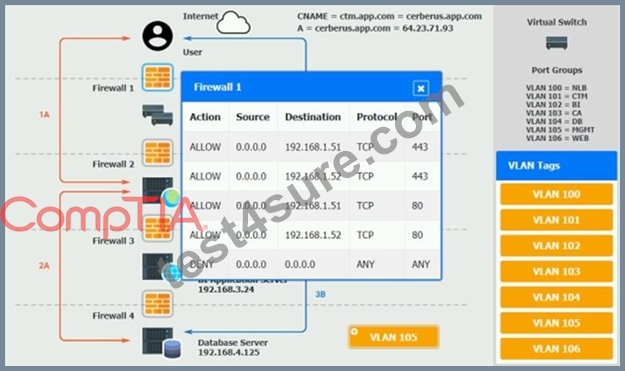


Answer:
Explanation:
See explanation below.
Explanation
On firewall 3, change the DENY 0.0.0.0 entry to rule 3 not rule 1.
NEW QUESTION # 43
During a security incident, an laaS compute instance is detected to send traffic to a host related to cryptocurrency mining. The security analyst handling the incident determines the scope of the incident is limited to that particular instance. Which of the following should the security analyst do NEXT?
- A. Perform a memory acquisition in the affected instance.
- B. Create a snapshot of the volumes attached to the instance.
- C. Replace the instance with another from the baseline.
- D. Isolate the instance from the network into quarantine.
Answer: D
Explanation:
The first step in incident response is to contain the incident activities and attackers, which means preventing them from spreading to other systems or causing more damage. In this case, the security analyst should isolate the instance from the network into quarantine, which means cutting off its communication with other hosts and services. This will stop the cryptocurrency mining activity and prevent the attacker from accessing the instance remotely. Isolating the instance also preserves the evidence for further analysis and investigation.
NEW QUESTION # 44
A VDI administrator is enhancing the existing environment with a feature to allow users to connect devices to virtual workstations. Which of the following types of devices are most likely to be allowed in the upgrade? (Select two).
- A. SATA devices
- B. Printers
- C. PCIe devices
- D. Display monitors
- E. USB devices
- F. PCI devices
Answer: B,E
Explanation:
B) USB devices and F. Printers are most likely to be allowed in the upgrade. USB devices are common peripherals that users may want to connect to their virtual workstations, such as flash drives, keyboards, mice, webcams, etc. Printers are also useful devices that users may need to print documents from their virtual desktops. VDI software can support USB redirection and printer redirection to enable these devices to work with virtual workstations12.
Display monitors, SATA devices, PCIe devices, and PCI devices are less likely to be allowed in the upgrade, as they are either part of the physical hardware of the end device or the server, or they require direct access to the host system. VDI software typically does not support these types of devices, as they are not compatible with the virtualization layer or the remote display protocol34.
NEW QUESTION # 45
Before doing a change on a VM, a systems administrator wants to ensure there is an easy and fast way to rollback if needed. The change and testing should take approximately two hours.
Which of the following is the EASIEST way to meet this requirement?
- A. Make an on-demand, full backup to a secondary location.
- B. Create a snapshot on a remote storage array.
- C. Create a snapshot on the hypervisor.
- D. Make an on-demand, incremental backup to a VTL.
Answer: C
NEW QUESTION # 46
A company has deployed a new cloud solution and is required to meet security compliance.
Which of the following will MOST likely be executed in the cloud solution to meet security requirements?
- A. Usability testing
- B. Performance testing
- C. Vulnerability testing
- D. Regression testing
Answer: C
NEW QUESTION # 47
A cloud solutions architect is working on a private cloud environment in which storage consumption is increasing daily, resulting in high costs. Which of the following can the architect use to provide more space without adding more capacity? (Select two).
- A. Deduplication
- B. NVMe
- C. Flash optimization
- D. Tiering
- E. Compression
- F. RAID provisioning
Answer: A,E
Explanation:
B) Deduplication and D. Compression are the two options that the architect can use to provide more space without adding more capacity. Deduplication is the process of eliminating duplicate copies of data that are stored in different locations, thus reducing the storage consumption and costs1. Compression is the process of reducing the size of data by applying algorithms that remove redundant or unnecessary information, thus saving storage space and bandwidth2. Both deduplication and compression can improve the efficiency and performance of cloud storage solutions12.
NEW QUESTION # 48
A cloud administrator has finished setting up an application that will use RDP to connect. During testing, users experience a connection timeout error.
Which of the following will MOST likely solve the issue?
- A. Configuring QoS rules
- B. Enforcing TLS authentication
- C. Opening TCP port 3389
- D. Checking user passwords
Answer: C
Explanation:
TCP port 3389 is the default port used by Remote Desktop Protocol (RDP) to connect to a remote system or application over a network. Opening TCP port 3389 on the firewall or network device will most likely solve the issue of users experiencing a connection timeout error when trying to use RDP to connect to an application, as it will allow RDP traffic to pass through. If TCP port 3389 is closed or blocked, RDP traffic will be denied or dropped, resulting in a connection timeout error. References: CompTIA Cloud+ Certification Exam Objectives, page 15, section 2.8 Reference: https://docs.microsoft.com/en-us/windows-server/remote/remote-desktop-services/troubleshoot/ rdp-error-general-troubleshooting
NEW QUESTION # 49
A cloud architect is deploying a web application that contains many large images and will be accessed on two containers. Which of the following will MOST improve the user experience while keeping costs low?
- A. Implement web servers in both continents and set up a VPN between the VPCs.
- B. Implement web servers on both continents and peer the VPCs.
- C. Implement a CDN and offload the images to an object storage.
- D. Implement a replica of the entire solution on every continent.
Answer: C
NEW QUESTION # 50
An administrator recently provisioned a file server in the cloud. Based on financial considerations, the administrator has a limited amount of disk space. Which of the following will help control the amount of space that is being used?
- A. User quotas
- B. Network file system
- C. Software-defined storage
- D. Thick provisioning
Answer: A
Explanation:
User quotas are what will help control the amount of space that is being used by a file server in the cloud that has a limited amount of disk space due to financial considerations. User quotas are the limits or restrictions that are imposed on the amount of space that each user can use or consume on a file server or storage device. User quotas can help to control the amount of space that is being used by:
Preventing or reducing wastage or overuse of space by users who may store unnecessary or redundant files or data on the file server or storage device.
Ensuring fair and equal distribution or allocation of space among users who may have different needs or demands for space on the file server or storage device.
Monitoring and managing the usage or consumption of space by users who may need to be notified or alerted when they reach or exceed their quota on the file server or storage device.
NEW QUESTION # 51
A cloud engineer notices on a dashboard that the host is close to reaching maximum capacity for the CPU and memory in the cloud environment, which could cause performance issues. The cloud environment has 100 servers, with 25% of the servers consuming their compute only during peak business hours, 25% consuming half of the allocated resources, and the remaining 50% using the compute during off hours. Which of the following should the engineer perform to optimize the efficiency of the compute usage in the cloud?
- A. Add additional CPUs and RAM to the host that is serving the cloud.
- B. Adjust the cloud workload by migrating resource-intensive applications to different hosts.
- C. Enable automatic scaling in the cloud management tool.
- D. Add additional hosts to the environment using the cloud management tool.
Answer: B
NEW QUESTION # 52
A customer wants a cloud systems administrator to adjust the backup schedule after month-end to ensure the data can be restored as fast as possible while minimizing the time needed to perform the backup. Which of the following backup types should be scheduled?
- A. Synthetic full
- B. Incremental
- C. Differential
- D. Full
Answer: A
NEW QUESTION # 53
A cloud administrator needs to deploy a security virtual appliance in a private cloud environment, but this appliance will not be part of the standard catalog of items for other users to request. Which of the following is the BEST way to accomplish this task?
- A. Acquire the build scripts from the vendor and recreate the appliance using the baseline templates
- B. Convert the virtual appliance to a template and deploy a new VM using the template.
- C. Create an empty VM. import the hard disk of the virtual appliance. and configure the CPU and memory.
- D. Import the virtual appliance into the environment and deploy it as a VM
Answer: D
Explanation:
Explanation
The correct answer is C. Import the virtual appliance into the environment and deploy it as a VM.
A virtual appliance is a pre-packaged and pre-configured software solution that runs on a virtual machine (VM). A virtual appliance typically consists of an operating system, an application, and any required dependencies, and is designed to provide a specific function or service. A virtual appliance can be distributed as a single file or a set of files that can be imported into a virtualization platform, such as VMware, Hyper-V, or KVM .
A cloud administrator can deploy a security virtual appliance in a private cloud environment by importing the virtual appliance into the environment and deploying it as a VM. This is the best way to accomplish this task because it preserves the original configuration and functionality of the virtual appliance, and does not require any additional installation or customization. The cloud administrator can also control the access and visibility of the virtual appliance, and prevent other users from requesting it from the standard catalog of items .
Creating an empty VM, importing the hard disk of the virtual appliance, and configuring the CPU and memory is not the best way to accomplish this task because it involves more steps and complexity than importing the virtual appliance as a whole. It also introduces the risk of losing or corrupting some data or settings during the import process, or misconfiguring the CPU and memory for the virtual appliance.
Acquiring the build scripts from the vendor and recreating the appliance using the baseline templates is not the best way to accomplish this task because it involves more time and effort than importing the virtual appliance directly. It also depends on whether the vendor provides the build scripts or not, and whether they are compatible with the baseline templates or not.
Converting the virtual appliance to a template and deploying a new VM using the template is not the best way to accomplish this task because it adds an unnecessary step of creating a template from the virtual appliance. It also does not prevent other users from accessing or requesting the template from the catalog of items.
NEW QUESTION # 54
A company that requires full administrative control at the OS level is considering the use of public cloud services. Which of the following service models would BEST fit the company's requirements?
- A. laaS
- B. DBaaS
- C. SaaS
- D. PaaS
Answer: A
Explanation:
Explanation
laaS (Infrastructure as a Service) is a public cloud service model that provides access to fundamental compute, network, and storage resources on demand over the public Internet or through dedicated connections.
Customers can provision and configure these resources according to their needs, and they have full administrative control at the OS level. This means that customers can install, update, and manage any software or applications they want on the cloud servers, as well as apply their own security and compliance policies.
laaS is suitable for companies that require high flexibility and customization of their cloud infrastructure, as well as scalability and cost-efficiency.
NEW QUESTION # 55
A company has hired a security firm to perform a vulnerability assessment of its environment. In the first phase, an engineer needs to scan the network services exposed by the hosts. Which of the following will help achieve this with the LEAST privileges?
- A. A credentialed scan
- B. A network-based scan
- C. An application scan
- D. An agent-based scan
Answer: B
Explanation:
Explanation
A network-based scan is a type of vulnerability assessment that scans the network services exposed by the hosts without requiring any credentials or agents. This type of scan will help achieve the objective of scanning the network services with the least privileges, as it does not need any access to the hosts or their internal configurations. A network-based scan can identify open ports, running services, and potential vulnerabilities on the hosts. Reference: CompTIA Cloud+ Certification Exam Objectives, Domain 2.0 Security, Objective 2.4 Given a scenario, implement security automation and orchestration in a cloud environment.
NEW QUESTION # 56
A systems administrator is deploying a VM and would like to minimize storage utilization by ensuring the VM uses only the storage if needs. Which of the following will BEST achieve this goal?
- A. RAID
- B. Thin provisioning
- C. Deduplication
- D. Compression
Answer: B
Explanation:
Reference:
https://docs.vmware.com/en/VMware-vSphere/7.0/com.vmware.vsphere.vm_admin.doc/GUID-4C0F4D73-82F2
This provisioning is the technique that will minimize storage utilization by ensuring the VM uses only the storage it needs. Thin provisioning is a storage allocation method that assigns disk space to a VM on demand, rather than in advance. Thin provisioning can improve storage utilization and efficiency by avoiding overprovisioning and wasting disk space. Thin provisioning can also allow for more flexibility and scalability of storage resources.
NEW QUESTION # 57
......
Get professional help from our CV0-003 Dumps PDF: https://freecert.test4sure.com/CV0-003-exam-materials.html