

Get Started: SC-200 Exam [2022] Dumps Microsoft PDF Questions
SC-200 Premium Exam Engine pdf Download
Certification Topics of Microsoft SC-200 Exam
Mitigate threats using Azure Sentinel (40-45%)
Mitigate threats using Microsoft 365 Defender (25-30%)
Mitigate threats using Azure Defender (25-30%)
NEW QUESTION 33
HOTSPOT
You are informed of an increase in malicious email being received by users.
You need to create an advanced hunting query in Microsoft 365 Defender to identify whether the accounts of the email recipients were compromised. The query must return the most recent 20 sign-ins performed by the recipients within an hour of receiving the known malicious email.
How should you complete the query? To answer, select the appropriate options in the answer area.
NOTE: Each correct selection is worth one point.
Hot Area:
Answer:
Explanation:
Section: [none]
Explanation/Reference:
https://docs.microsoft.com/en-us/microsoft-365/security/defender/advanced-hunting-query-emails-devices?
view=o365-worldwide
NEW QUESTION 34
You implement Safe Attachments policies in Microsoft Defender for Office 365.
Users report that email messages containing attachments take longer than expected to be received.
You need to reduce the amount of time it takes to deliver messages that contain attachments without compromising security. The attachments must be scanned for malware, and any messages that contain malware must be blocked.
What should you configure in the Safe Attachments policies?
- A. Monitor and Enable redirect
- B. Block and Enable redirect
- C. Dynamic Delivery
- D. Replace
Answer: C
Explanation:
Reference:
https://docs.microsoft.com/en-us/microsoft-365/security/office-365-security/safe-attachments?view=o365-world
NEW QUESTION 35
You need to receive a security alert when a user attempts to sign in from a location that was never used by the other users in your organization to sign in.
Which anomaly detection policy should you use?
- A. Malware detection
- B. Activity from infrequent country
- C. Impossible travel
- D. Activity from anonymous IP addresses
Answer: B
Explanation:
Reference:
https://docs.microsoft.com/en-us/cloud-app-security/anomaly-detection-policy
NEW QUESTION 36
You create a new Azure subscription and start collecting logs for Azure Monitor.
You need to configure Azure Security Center to detect possible threats related to sign-ins from suspicious IP addresses to Azure virtual machines. The solution must validate the configuration.
Which three actions should you perform in a sequence? To answer, move the appropriate actions from the list of action to the answer area and arrange them in the correct order.
Answer:
Explanation:
Explanation
Reference:
https://docs.microsoft.com/en-us/azure/security-center/security-center-alert-validation
NEW QUESTION 37
You are informed of a new common vulnerabilities and exposures (CVE) vulnerability that affects your environment.
You need to use Microsoft Defender Security Center to request remediation from the team responsible for the affected systems if there is a documented active exploit available.
Which three actions should you perform in sequence? To answer, move the appropriate actions from the list of actions to the answer area and arrange them in the correct order.
Answer:
Explanation:
1 - From Threat & Vulnerability.......
2 - Select Security recommendations.
3 - Create the remediation request.
Reference:
https://techcommunity.microsoft.com/t5/core-infrastructure-and-security/microsoft-defender-atp-remediate-apps-using-mem/ba-p/1599271
NEW QUESTION 38
The issue for which team can be resolved by using Microsoft Defender for Office 365?
- A. executive
- B. security
- C. marketing
- D. sales
Answer: C
Explanation:
Reference:
https://docs.microsoft.com/en-us/microsoft-365/security/office-365-security/atp-for-spo-odb-and-teams?
view=o365-worldwide
NEW QUESTION 39
Note: This question is part of a series of questions that present the same scenario. Each question in the series contains a unique solution that might meet the stated goals. Some question sets might have more than one correct solution, while others might not have a correct solution.
After you answer a question in this section, you will NOT be able to return to it. As a result, these questions will not appear in the review screen.
You have Linux virtual machines on Amazon Web Services (AWS).
You deploy Azure Defender and enable auto-provisioning.
You need to monitor the virtual machines by using Azure Defender.
Solution: You manually install the Log Analytics agent on the virtual machines.
Does this meet the goal?
- A. Yes
- B. No
Answer: B
Explanation:
Reference:
https://docs.microsoft.com/en-us/azure/defender-for-cloud/quickstart-onboard-machines?pivots=azure-arc
NEW QUESTION 40
You have two Azure subscriptions that use Microsoft Defender for Cloud.
You need to ensure that specific Defender for Cloud security alerts are suppressed at the root management group level. The solution must minimize administrative effort.
What should you do in the Azure portal?
- A. Create an Azure Policy assignment.
- B. Modify the Workload protections settings in Defender for Cloud.
- C. Modify the alert settings in Defender for Cloud.
- D. Create an alert rule in Azure Monitor.
Answer: C
Explanation:
You can use alerts suppression rules to suppress false positives or other unwanted security alerts from Defender for Cloud.
Note: To create a rule directly in the Azure portal:
1. From Defender for Cloud's security alerts page:
Select the specific alert you don't want to see anymore, and from the details pane, select Take action.
Or, select the suppression rules link at the top of the page, and from the suppression rules page select Create new suppression rule:
2. In the new suppression rule pane, enter the details of your new rule.
Your rule can dismiss the alert on all resources so you don't get any alerts like this one in the future.
Your rule can dismiss the alert on specific criteria - when it relates to a specific IP address, process name, user account, Azure resource, or location.
3. Enter details of the rule.
4. Save the rule.
NEW QUESTION 41
You provision Azure Sentinel for a new Azure subscription. You are configuring the Security Events connector.
While creating a new rule from a template in the connector, you decide to generate a new alert for every event.
You create the following rule query.
By which two components can you group alerts into incidents? Each correct answer presents a complete solution.
NOTE: Each correct selection is worth one point.
- A. resource group
- B. user
- C. computer
- D. IP address
Answer: C,D
NEW QUESTION 42
You need to configure DC1 to meet the business requirements.
Which four actions should you perform in sequence? To answer, move the appropriate actions from the list of actions to the answer area and arrange them in the correct order.
Answer:
Explanation:
1 - Provide global administrator credentials to the litware.com Azure AD tenant.
2 - Create an instance of Microsoft Defender for identity.
3 - Provide domain administrator credentials to the litware.com Active Directory domain.
4 - Install the sencor on DC1.
Reference:
https://docs.microsoft.com/en-us/defender-for-identity/install-step1
https://docs.microsoft.com/en-us/defender-for-identity/install-step4
Topic 1, Litware inc.
Existing Environment
Identity Environment
The network contains an Active Directory forest named litware.com that syncs to an Azure Active Directory (Azure AD) tenant named litware.com.
Microsoft 365 Environment
Litware has a Microsoft 365 E5 subscription linked to the litware.com Azure AD tenant. Microsoft Defender for Endpoint is deployed to all computers that run Windows 10. All Microsoft Cloud App Security built-in anomaly detection policies are enabled.
Azure Environment
Litware has an Azure subscription linked to the litware.com Azure AD tenant. The subscription contains resources in the East US Azure region as shown in the following table.
Network Environment
Each Litware office connects directly to the internet and has a site-to-site VPN connection to the virtual networks in the Azure subscription.
On-premises Environment
The on-premises network contains the computers shown in the following table.
Current problems
Cloud App Security frequently generates false positive alerts when users connect to both offices simultaneously.
Planned Changes
Litware plans to implement the following changes:
Create and configure Azure Sentinel in the Azure subscription.
Validate Azure Sentinel functionality by using Azure AD test user accounts.
Business Requirements
Litware identifies the following business requirements:
Azure Information Protection Requirements
All files that have security labels and are stored on the Windows 10 computers must be available from the Azure Information Protection - Data discovery dashboard.
Microsoft Defender for Endpoint Requirements
All Cloud App Security unsanctioned apps must be blocked on the Windows 10 computers by using Microsoft Defender for Endpoint.
Microsoft Cloud App Security Requirements
Cloud App Security must identify whether a user connection is anomalous based on tenant-level data.
Azure Defender Requirements
All servers must send logs to the same Log Analytics workspace.
Azure Sentinel Requirements
Litware must meet the following Azure Sentinel requirements:
Integrate Azure Sentinel and Cloud App Security.
Ensure that a user named admin1 can configure Azure Sentinel playbooks.
Create an Azure Sentinel analytics rule based on a custom query. The rule must automatically initiate the execution of a playbook.
Add notes to events that represent data access from a specific IP address to provide the ability to reference the IP address when navigating through an investigation graph while hunting.
Create a test rule that generates alerts when inbound access to Microsoft Office 365 by the Azure AD test user accounts is detected. Alerts generated by the rule must be grouped into individual incidents, with one incident per test user account.
NEW QUESTION 43
The issue for which team can be resolved by using Microsoft Defender for Office 365?
- A. executive
- B. security
- C. marketing
- D. sales
Answer: C
Explanation:
Section: [none]
Explanation/Reference:
https://docs.microsoft.com/en-us/microsoft-365/security/office-365-security/atp-for-spo-odb-and-teams?
view=o365-worldwide
Testlet 2
Case study
This is a case study. Case studies are not timed separately. You can use as much exam time as you would like to complete each case. However, there may be additional case studies and sections on this exam.
You must manage your time to ensure that you are able to complete all questions included on this exam in the time provided.
To answer the questions included in a case study, you will need to reference information that is provided in the case study. Case studies might contain exhibits and other resources that provide more information about the scenario that is described in the case study. Each question is independent of the other questions in this case study.
At the end of this case study, a review screen will appear. This screen allows you to review your answers and to make changes before you move to the next section of the exam. After you begin a new section, you cannot return to this section.
To start the case study
To display the first question in this case study, click the Next button. Use the buttons in the left pane to explore the content of the case study before you answer the questions. Clicking these buttons displays information such as business requirements, existing environment, and problem statements. If the case study has an All Information tab, note that the information displayed is identical to the information displayed on the subsequent tabs. When you are ready to answer a question, click the Question button to return to the question.
Overview
Litware Inc. is a renewable company.
Litware has offices in Boston and Seattle. Litware also has remote users located across the United States. To access Litware resources, including cloud resources, the remote users establish a VPN connection to either office.
Existing Environment
Identity Environment
The network contains an Active Directory forest named litware.com that syncs to an Azure Active Directory (Azure AD) tenant named litware.com.
Microsoft 365 Environment
Litware has a Microsoft 365 E5 subscription linked to the litware.com Azure AD tenant. Microsoft Defender for Endpoint is deployed to all computers that run Windows 10. All Microsoft Cloud App Security built-in anomaly detection policies are enabled.
Azure Environment
Litware has an Azure subscription linked to the litware.com Azure AD tenant. The subscription contains resources in the East US Azure region as shown in the following table.
Network Environment
Each Litware office connects directly to the internet and has a site-to-site VPN connection to the virtual networks in the Azure subscription.
On-premises Environment
The on-premises network contains the computers shown in the following table.
Current problems
Cloud App Security frequently generates false positive alerts when users connect to both offices simultaneously.
Planned Changes
Litware plans to implement the following changes:
* Create and configure Azure Sentinel in the Azure subscription.
* Validate Azure Sentinel functionality by using Azure AD test user accounts.
Business Requirements
Litware identifies the following business requirements:
* The principle of least privilege must be used whenever possible.
* Costs must be minimized, as long as all other requirements are met.
* Logs collected by Log Analytics must provide a full audit trail of user activities.
* All domain controllers must be protected by using Microsoft Defender for Identity.
Azure Information Protection Requirements
All files that have security labels and are stored on the Windows 10 computers must be available from the Azure Information Protection - Data discovery dashboard.
Microsoft Defender for Endpoint requirements
All Cloud App Security unsanctioned apps must be blocked on the Windows 10 computers by using Microsoft Defender for Endpoint.
Microsoft Cloud App Security requirements
Cloud App Security must identify whether a user connection is anomalous based on tenant-level data.
Azure Defender Requirements
All servers must send logs to the same Log Analytics workspace.
Azure Sentinel Requirements
Litware must meet the following Azure Sentinel requirements:
* Integrate Azure Sentinel and Cloud App Security.
* Ensure that a user named admin1 can configure Azure Sentinel playbooks.
* Create an Azure Sentinel analytics rule based on a custom query. The rule must automatically initiate the execution of a playbook.
* Add notes to events that represent data access from a specific IP address to provide the ability to reference the IP address when navigating through an investigation graph while hunting.
* Create a test rule that generates alerts when inbound access to Microsoft Office 365 by the Azure AD test user accounts is detected. Alerts generated by the rule must be grouped into individual incidents, with one incident per test user account.
NEW QUESTION 44
You are informed of an increase in malicious email being received by users.
You need to create an advanced hunting query in Microsoft 365 Defender to identify whether the accounts of the email recipients were compromised. The query must return the most recent 20 sign-ins performed by the recipients within an hour of receiving the known malicious email.
How should you complete the query? To answer, select the appropriate options in the answer area.
NOTE: Each correct selection is worth one point.
Answer:
Explanation:
Explanation
Graphical user interface, text, application, email Description automatically generated
Reference:
https://docs.microsoft.com/en-us/microsoft-365/security/defender/advanced-hunting-query-emails-devices?view=
NEW QUESTION 45
Your company deploys the following services:
* Microsoft Defender for Identity
* Microsoft Defender for Endpoint
* Microsoft Defender for Office 365
You need to provide a security analyst with the ability to use the Microsoft 365 security center. The analyst must be able to approve and reject pending actions generated by Microsoft Defender for Endpoint. The solution must use the principle of least privilege.
Which two roles should assign to the analyst? Each correct answer presents part of the solution.
NOTE: Each correct selection is worth one point.
- A. the Compliance Data Administrator in Azure Active Directory (Azure AD)
- B. the Security Administrator role in Azure Active Directory (Azure AD)
- C. the Security Reader role in Azure Active Directory (Azure AD)
- D. the Active remediation actions role in Microsoft Defender for Endpoint
Answer: C,D
Explanation:
Reference:
https://docs.microsoft.com/en-us/microsoft-365/security/defender-endpoint/rbac?view=o365-worldwide
NEW QUESTION 46
You have an Azure Sentinel deployment.
You need to query for all suspicious credential access activities.
Which three actions should you perform in sequence? To answer, move the appropriate actions from the list of actions to the answer area and arrange them in the correct order.
Answer:
Explanation:
1 - From Azure Sentinel, select Hunting.
2 - Filture by tactics.
3 - Select Run All Queries.
NEW QUESTION 47
Your company uses Azure Sentinel to manage alerts from more than 10,000 IoT devices.
A security manager at the company reports that tracking security threats is increasingly difficult due to the large number of incidents.
You need to recommend a solution to provide a custom visualization to simplify the investigation of threats and to infer threats by using machine learning.
What should you include in the recommendation?
- A. livestream
- B. notebooks
- C. built-in queries
- D. bookmarks
Answer: B
Explanation:
Section: [none]
Explanation/Reference:
https://docs.microsoft.com/en-us/azure/sentinel/notebooks
NEW QUESTION 48
HOTSPOT
You have a Microsoft 365 E5 subscription that uses Microsoft Defender and an Azure subscription that uses Azure Sentinel.
You need to identify all the devices that contain files in emails sent by a known malicious email sender. The query will be based on the match of the SHA256 hash.
How should you complete the query? To answer, select the appropriate options in the answer area.
NOTE: Each correct selection is worth one point.
Hot Area:
Answer:
Explanation:
Section: [none]
Explanation/Reference:
https://docs.microsoft.com/en-us/microsoft-365/security/defender/advanced-hunting-query-emails-devices?
view=o365-worldwide
Testlet 1
Case study
This is a case study. Case studies are not timed separately. You can use as much exam time as you would like to complete each case. However, there may be additional case studies and sections on this exam.
You must manage your time to ensure that you are able to complete all questions included on this exam in the time provided.
To answer the questions included in a case study, you will need to reference information that is provided in the case study. Case studies might contain exhibits and other resources that provide more information about the scenario that is described in the case study. Each question is independent of the other questions in this case study.
At the end of this case study, a review screen will appear. This screen allows you to review your answers and to make changes before you move to the next section of the exam. After you begin a new section, you cannot return to this section.
To start the case study
To display the first question in this case study, click the Next button. Use the buttons in the left pane to explore the content of the case study before you answer the questions. Clicking these buttons displays information such as business requirements, existing environment, and problem statements. If the case study has an All Information tab, note that the information displayed is identical to the information displayed on the subsequent tabs. When you are ready to answer a question, click the Question button to return to the question.
Overview
Litware Inc. is a renewable company.
Litware has offices in Boston and Seattle. Litware also has remote users located across the United States. To access Litware resources, including cloud resources, the remote users establish a VPN connection to either office.
Existing Environment
Identity Environment
The network contains an Active Directory forest named litware.com that syncs to an Azure Active Directory (Azure AD) tenant named litware.com.
Microsoft 365 Environment
Litware has a Microsoft 365 E5 subscription linked to the litware.com Azure AD tenant. Microsoft Defender for Endpoint is deployed to all computers that run Windows 10. All Microsoft Cloud App Security built-in anomaly detection policies are enabled.
Azure Environment
Litware has an Azure subscription linked to the litware.com Azure AD tenant. The subscription contains resources in the East US Azure region as shown in the following table.
Network Environment
Each Litware office connects directly to the internet and has a site-to-site VPN connection to the virtual networks in the Azure subscription.
On-premises Environment
The on-premises network contains the computers shown in the following table.
Current problems
Cloud App Security frequently generates false positive alerts when users connect to both offices simultaneously.
Planned Changes
Litware plans to implement the following changes:
* Create and configure Azure Sentinel in the Azure subscription.
* Validate Azure Sentinel functionality by using Azure AD test user accounts.
Business Requirements
Litware identifies the following business requirements:
* The principle of least privilege must be used whenever possible.
* Costs must be minimized, as long as all other requirements are met.
* Logs collected by Log Analytics must provide a full audit trail of user activities.
* All domain controllers must be protected by using Microsoft Defender for Identity.
Azure Information Protection Requirements
All files that have security labels and are stored on the Windows 10 computers must be available from the Azure Information Protection - Data discovery dashboard.
Microsoft Defender for Endpoint requirements
All Cloud App Security unsanctioned apps must be blocked on the Windows 10 computers by using Microsoft Defender for Endpoint.
Microsoft Cloud App Security requirements
Cloud App Security must identify whether a user connection is anomalous based on tenant-level data.
Azure Defender Requirements
All servers must send logs to the same Log Analytics workspace.
Azure Sentinel Requirements
Litware must meet the following Azure Sentinel requirements:
* Integrate Azure Sentinel and Cloud App Security.
* Ensure that a user named admin1 can configure Azure Sentinel playbooks.
* Create an Azure Sentinel analytics rule based on a custom query. The rule must automatically initiate the execution of a playbook.
* Add notes to events that represent data access from a specific IP address to provide the ability to reference the IP address when navigating through an investigation graph while hunting.
* Create a test rule that generates alerts when inbound access to Microsoft Office 365 by the Azure AD test user accounts is detected. Alerts generated by the rule must be grouped into individual incidents, with one incident per test user account.
NEW QUESTION 49
You provision Azure Sentinel for a new Azure subscription. You are configuring the Security Events connector.
While creating a new rule from a template in the connector, you decide to generate a new alert for every event. You create the following rule query.
By which two components can you group alerts into incidents? Each correct answer presents a complete
solution.
NOTE: Each correct selection is worth one point.
- A. resource group
- B. user
- C. computer
- D. IP address
Answer: B,C
NEW QUESTION 50
You need to receive a security alert when a user attempts to sign in from a location that was never used by the other users in your organization to sign in.
Which anomaly detection policy should you use?
- A. Malware detection
- B. Activity from infrequent country
- C. Impossible travel
- D. Activity from anonymous IP addresses
Answer: B
Explanation:
Activity from a country/region that could indicate malicious activity. This policy profiles your environment and triggers alerts when activity is detected from a location that was not recently or was never visited by any user in the organization. Activity from the same user in different locations within a time period that is shorter than the expected travel time between the two locations. This can indicate a credential breach, however, it's also possible that the user's actual location is masked, for example, by using a VPN.
Reference:
https://docs.microsoft.com/en-us/cloud-app-security/anomaly-detection-policy
NEW QUESTION 51
You use Azure Sentinel.
You need to receive an immediate alert whenever Azure Storage account keys are enumerated.
Which two actions should you perform? Each correct answer presents part of the solution.
NOTE: Each correct selection is worth one point.
- A. Create a hunting query.
- B. Add a data connector
- C. Create an analytics rule
- D. Create a bookmark.
- E. Create a livestream
Answer: A,B
Explanation:
Explanation/Reference:
https://docs.microsoft.com/en-us/azure/sentinel/livestream
NEW QUESTION 52
Your company deploys Azure Sentinel.
You plan to delegate the administration of Azure Sentinel to various groups.
You need to delegate the following tasks:
Create and run playbooks
Create workbooks and analytic rules.
The solution must use the principle of least privilege.
Which role should you assign for each task? To answer, drag the appropriate roles to the correct tasks. Each role may be used once, more than once, or not at all. You may need to drag the split bar between panes or scroll to view content.
NOTE: Each correct selection is worth one point.
Answer:
Explanation:
Reference:
https://docs.microsoft.com/en-us/azure/sentinel/roles
NEW QUESTION 53
You use Azure Sentinel to monitor irregular Azure activity.
You create custom analytics rules to detect threats as shown in the following exhibit.
You do NOT define any incident settings as part of the rule definition.
Use the drop-down menus to select the answer choice that completes each statement based on the information presented in the graphic.
NOTE: Each correct selection is worth one point.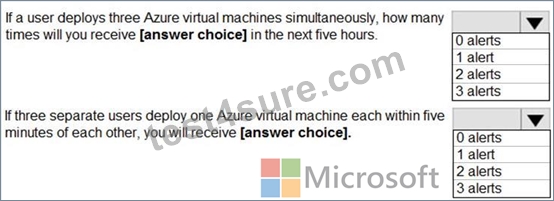
Answer:
Explanation:
Explanation
Graphical user interface, text, application, email Description automatically generated
Reference:
https://docs.microsoft.com/en-us/azure/sentinel/tutorial-detect-threats-custom
NEW QUESTION 54
Your company stores the data for every project in a different Azure subscription. All the subscriptions use the same Azure Active Directory (Azure AD) tenant.
Every project consists of multiple Azure virtual machines that run Windows Server. The Windows events of the virtual machines are stored in a Log Analytics workspace in each machine's respective subscription.
You deploy Azure Sentinel to a new Azure subscription.
You need to perform hunting queries in Azure Sentinel to search across all the Log Analytics workspaces of all the subscriptions.
Which two actions should you perform? Each correct answer presents part of the solution.
NOTE: Each correct selection is worth one point.
- A. Add the Security Events connector to the Azure Sentinel workspace.
- B. Create a query that uses the resourceexpression and the aliasoperator.
- C. Add the Azure Sentinel solution to each workspace.
- D. Use the aliasstatement.
- E. Create a query that uses the workspaceexpression and the unionoperator.
Answer: C,E
Explanation:
Explanation/Reference:
https://docs.microsoft.com/en-us/azure/sentinel/extend-sentinel-across-workspaces-tenants
NEW QUESTION 55
Your company uses Azure Security Center and Azure Defender.
The security operations team at the company informs you that it does NOT receive email notifications for security alerts.
What should you configure in Security Center to enable the email notifications?
- A. Security solutions
- B. Pricing & settings
- C. Azure Defender
- D. Security policy
- E. Security alerts
Answer: B
Explanation:
Reference:
https://docs.microsoft.com/en-us/azure/security-center/security-center-provide-security-contact-details
NEW QUESTION 56
You use Azure Defender.
You have an Azure Storage account that contains sensitive information.
You need to run a PowerShell script if someone accesses the storage account from a suspicious IP address.
Which two actions should you perform? Each correct answer presents part of the solution.
NOTE: Each correct selection is worth one point.
- A. Create an Azure logic app that has an Azure Security Center alert trigger.
- B. Create an Azure logic app that has an HTTP trigger.
- C. From Azure Security Center, enable workflow automation.
- D. Create an Azure logic app that has a manual trigger.
- E. From Azure Active Directory (Azure AD), add an app registration.
Answer: A,C
Explanation:
Section: [none]
Explanation/Reference:
https://docs.microsoft.com/en-us/azure/storage/common/azure-defender-storage-configure?tabs=azure- security-center
https://docs.microsoft.com/en-us/azure/security-center/workflow-automation Testlet 1 Case study This is a case study. Case studies are not timed separately. You can use as much exam time as you would like to complete each case. However, there may be additional case studies and sections on this exam.
You must manage your time to ensure that you are able to complete all questions included on this exam in the time provided.
To answer the questions included in a case study, you will need to reference information that is provided in the case study. Case studies might contain exhibits and other resources that provide more information about the scenario that is described in the case study. Each question is independent of the other questions in this case study.
At the end of this case study, a review screen will appear. This screen allows you to review your answers and to make changes before you move to the next section of the exam. After you begin a new section, you cannot return to this section.
To start the case study
To display the first question in this case study, click the Next button. Use the buttons in the left pane to explore the content of the case study before you answer the questions. Clicking these buttons displays information such as business requirements, existing environment, and problem statements. If the case study has an All Information tab, note that the information displayed is identical to the information displayed on the subsequent tabs. When you are ready to answer a question, click the Question button to return to the question.
Overview
A company named Contoso Ltd. has a main office and five branch offices located throughout North America.
The main office is in Seattle. The branch offices are in Toronto, Miami, Houston, Los Angeles, and Vancouver.
Contoso has a subsidiary named Fabrikam, Ltd. that has offices in New York and San Francisco.
Existing Environment
End-User Environment
All users at Contoso use Windows 10 devices. Each user is licensed for Microsoft 365. In addition, iOS devices are distributed to the members of the sales team at Contoso.
Cloud and Hybrid Infrastructure
All Contoso applications are deployed to Azure.
You enable Microsoft Cloud App Security.
Contoso and Fabrikam have different Azure Active Directory (Azure AD) tenants. Fabrikam recently purchased an Azure subscription and enabled Azure Defender for all supported resource types.
Current Problems
The security team at Contoso receives a large number of cybersecurity alerts. The security team spends too much time identifying which cybersecurity alerts are legitimate threats, and which are not.
The Contoso sales team uses only iOS devices. The sales team members exchange files with customers by using a variety of third-party tools. In the past, the sales team experienced various attacks on their devices.
The marketing team at Contoso has several Microsoft SharePoint Online sites for collaborating with external vendors. The marketing team has had several incidents in which vendors uploaded files that contain malware.
The executive team at Contoso suspects a security breach. The executive team requests that you identify which files had more than five activities during the past 48 hours, including data access, download, or deletion for Microsoft Cloud App Security-protected applications.
Requirements
Planned Changes
Contoso plans to integrate the security operations of both companies and manage all security operations centrally.
Technical Requirements
Contoso identifies the following technical requirements:
* Receive alerts if an Azure virtual machine is under brute force attack.
* Use Azure Sentinel to reduce organizational risk by rapidly remediating active attacks on the environment.
* Implement Azure Sentinel queries that correlate data across the Azure AD tenants of Contoso and Fabrikam.
* Develop a procedure to remediate Azure Defender for Key Vault alerts for Fabrikam in case of external attackers and a potential compromise of its own Azure AD applications.
* Identify all cases of users who failed to sign in to an Azure resource for the first time from a given country. A junior security administrator provides you with the following incomplete query.
BehaviorAnalytics
| where ActivityType == "FailedLogOn"
| where ________ == True
NEW QUESTION 57
......
Pass Your Microsoft Exam with SC-200 Exam Dumps: https://freecert.test4sure.com/SC-200-exam-materials.html