

MuleSoft MCD-Level-2 Certification Exam Dumps with 62 Practice Test Questions
New MCD-Level-2 Exam Dumps with High Passing Rate
NEW QUESTION # 20
Refer to the exhibit.
Based on the code snippet, schema,json file, and payload below, what is the outcome of the given code snippet when a request is sent with the payload?
- A. The Mule flow will execute successfully with status code 204
- B. The Mule flow will throw the exception 'JSON:SCHEMA_NOT_HONOURED
- C. The Mule flow will execute successfully with status code 200, and the response will be the JSON sent in request
- D. The Mule flow will execute successfully with status code 200m and a response will display the message
'' Age in years which must equal to or greater than zero.''
Answer: B
Explanation:
Explanation
Based on the code snippet, schema.json file, and payload below, the outcome of the given code snippet when a request is sent with the payload is that the Mule flow will throw the exception
'JSON:SCHEMA_NOT_HONOURED'. This is because the payload does not conform to the schema.json file, which specifies that age must be a number greater than or equal to zero. The payload has age as a string with a negative value, which violates the schema. Therefore, the validate-schema operation throws an error with type
'JSON:SCHEMA_NOT_HONOURED'. References:
https://docs.mulesoft.com/json-module/1.1/json-validate-schema
NEW QUESTION # 21
A system API that communicates to an underlying MySQL database is deploying to CloudHub. The DevOps team requires a readiness endpoint to monitor all system APIs.
Which strategy should be used to implement this endpoint?
- A. Create a dedicated endpoint that responds with the API status and health of the server
- B. Create a dedicated endpoint that responds with the API status only
- C. Use an existing resource endpoint of the API
- D. Create a dedicated endpoint that responds with the API status and reachability of the underlying systems
Answer: D
Explanation:
Explanation
To implement a readiness endpoint to monitor all system APIs, the developer should create a dedicated endpoint that responds with the API status and reachability of the underlying systems. This way, the DevOps team can check if the system API is ready to receive requests and if it can communicate with its backend systems without errors. References:
https://docs.mulesoft.com/mule-runtime/4.3/deployment-strategies#readiness-probes
NEW QUESTION # 22
A company has been using CI/CD. Its developers use Maven to handle build and deployment activities.
What is the correct sequence of activities that takes place during the Maven build and deployment?
- A. Validate, initialize, compile, package, test, install, verify, verify, deploy
- B. Initialize, validate, compute, test, package, verify, install, deploy
- C. Validate, initialize, compile, test package, verify, install, deploy
- D. Validation, initialize, compile, test, package, install verify, deploy
Answer: C
Explanation:
Explanation
The correct sequence of activities that takes place during the Maven build and deployment is validate, initialize, compile, test package, verify, install, deploy. These are Maven lifecycle phases that define a sequence of goals to execute during a build process. Each phase represents a stage in the build lifecycle and can have zero or more goals bound to it. References:
https://maven.apache.org/guides/introduction/introduction-to-the-lifecycle.html
NEW QUESTION # 23
Which plugin or dependency is required to unit test modules created with XML SDK?
- A. XMLUnit
- B. MUnit Maven plugin
- C. Junit
- D. MUnit Extensions Maven plugin
Answer: D
Explanation:
Explanation
To unit test modules created with XML SDK, the developer needs to use the MUnit Extensions Maven plugin.
This plugin allows testing XML SDK modules using MUnit by adding a dependency to the module under test and using a custom processor tag to invoke it. References:
https://docs.mulesoft.com/mule-sdk/1.1/xml-sdk#testing
NEW QUESTION # 24
Refer to the exhibits.
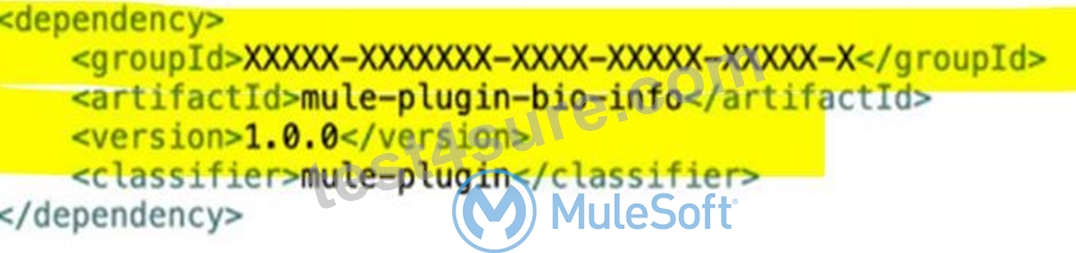
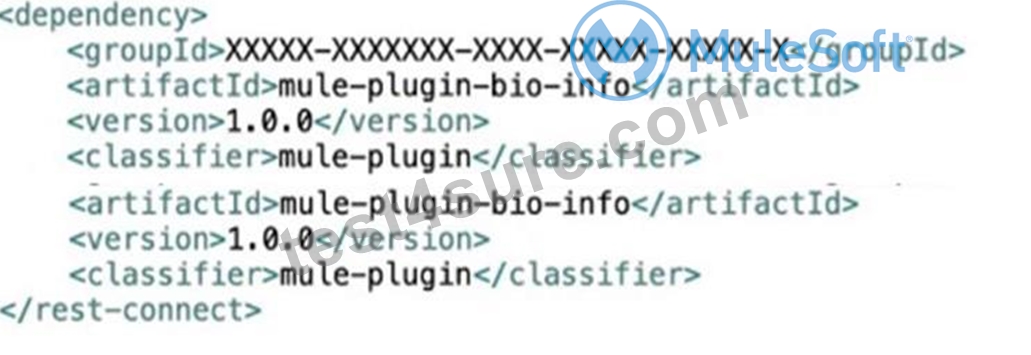
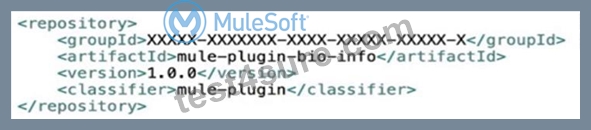
Bioinfo System API is implemented and published to Anypoint Exchange. A developer wants to invoke this API using its REST Connector.
What should be added to the POM?
- A.
- B.

- C.
- D.
- E.

Answer: B
Explanation:
Explanation
To invoke Bioinfo System API using its REST Connector, option E should be added to the pom.xml file. This option adds a dependency for Bioinfo System API REST Connector with its group ID, artifact ID, version, classifier, and type. The classifier specifies that it is a REST Connector (raml-client), and the type specifies that it is a Mule plugin (mule-plugin). References:
https://docs.mulesoft.com/apikit/4.x/apikit-4-generate-from-rest-api-task#add-the-api-dependency-to-the-pom-fil
NEW QUESTION # 25
A company with MuleSoft Titanium develops a Salesforce System API using MuleSoft out-of-the-box Salesforce Connector and deploys the API to CloudHub.
Which steps provide the average number of requests and average response time of the Salesforce Connector?
- A. Change the API Implementation to capture the information in the log.
Retrieve the information from the log file. - B. Access Anypoint Monitoring's built-in dashboard. Select a resource.
Locate the information under the Connectors tab. - C. Access Anypoint Monitoring built-in dashboard.
Select a resource.
Locate the information under Log Manager < Raw Data. - D. Access Anypoint Monitoring's built-in dashboard
Seclect a resource.
Create a custom dashboard to retrieve the information.
Answer: B
Explanation:
Explanation
To get the average number of requests and average response time of the Salesforce Connector, the developer should access Anypoint Monitoring's built-in dashboard, select a resource (such as an application or an API), and locate the information under the Connectors tab. The Connectors tab shows metrics for each connector used by the resource, such as average requests per minute, average response time, and failures. References:
https://docs.mulesoft.com/monitoring/built-in-dashboard-reference
NEW QUESTION # 26
A Mule API receives a JSON payload and updates the target system with the payload. The developer uses JSON schemas to ensure the data is valid.
How can the data be validation before posting to the target system?
- A. Use a DataWeave 2.09 transform operation, and at the log of the DataWeave script, add:
%dw 2.0
Import.json-moduls - B. Using the DataWeave if Else condition test the values of the payload against the examples included in the schema
- C. Add the JSON module dependency and add the validate-schema operation in the flow, configured to reference the schema
- D. Apply the JSON Schema policy in API Manager and reference the correct schema in the policy configuration
Answer: C
Explanation:
Explanation
To validate the data before posting to the target system, the developer should add the JSON module dependency and add the validate-schema operation in the flow, configured to reference the schema. The JSON module provides a validate-schema operation that validates a JSON payload against a JSON schema and throws an error if the payload is invalid. References:
https://docs.mulesoft.com/json-module/1.1/json-validate-schema
NEW QUESTION # 27
The Center for Enablement team published a common application as a reusable module to the central Nexus repository.
How can the common application be included in all API implementations?
- A. Add a Maven dependency in the PCM file with multiple-plugin as <classifier>
- B. Download the common application from Naxus and copy it to the src/main/resources folder in the API
- C. Add a Maven dependency in the POM file with jar as <classifier>
- D. Copy the common application's source XML file and out it in a new flow file in the src/main/mule folder
Answer: C
Explanation:
Explanation
To include a common application as a reusable module in all API implementations, the developer should add a Maven dependency in the POM file with jar as <classifier>. This way, the developer can reuse Mule code from another application by packaging it as a JAR file and adding it as a dependency in the POM file of the API implementation. The classifier element specifies that it is a JAR file. References:
https://docs.mulesoft.com/mule-runtime/4.3/mmp-concept#add-a-maven-dependency-to-the-pom-file
NEW QUESTION # 28
A Mule application defines as SSL/TLS keystore properly 'tis,keystore.keyPassword'' as secure.
How can this property be referenced to access its value within the application?
- A. p{secure::tiskeystore,keyPassowrd}
- B. #{secure::tiskeystore,keyPassowrd}
- C. ${secure::tiskeystore,keyPassowrd}
- D. ${secure::tiskeystore,keyPassowrd}
Answer: D
Explanation:
Explanation
secure::tiskeystore,keyPassowrdShortExplanationofCorrectAnswerOnly:Toreferenceasecurepropertyvaluewithin In this case, the property name is tiskeystore,keyPassword, so the correct syntax is
${secure::tiskeystore,keyPassowrd}. References:
https://docs.mulesoft.com/mule-runtime/4.3/secure-configuration-properties#referencing-secure-properties
NEW QUESTION # 29
Which type of cache invalidation does the Cache scope support without having to write any additional code?
- A. Time to live
- B. Notification-based invalidation
- C. Write-through invalidation
- D. White-behind invalidation
Answer: A
Explanation:
Explanation
The Cache scope supports time to live (TTL) as a cache invalidation strategy without having to write any additional code. TTL specifies how long the cached response is valid before it expires and needs to be refreshed. The Cache scope also supports custom invalidation strategies using MEL or DataWeave expressions. References: https://docs.mulesoft.com/mule-runtime/4.3/cache-scope#cache_invalidation
NEW QUESTION # 30
A Mule application contain two policies Policy A and Policy A has order1, and Policy B has order 2. Policy A Policy B, and a flow are defined by he configuration below.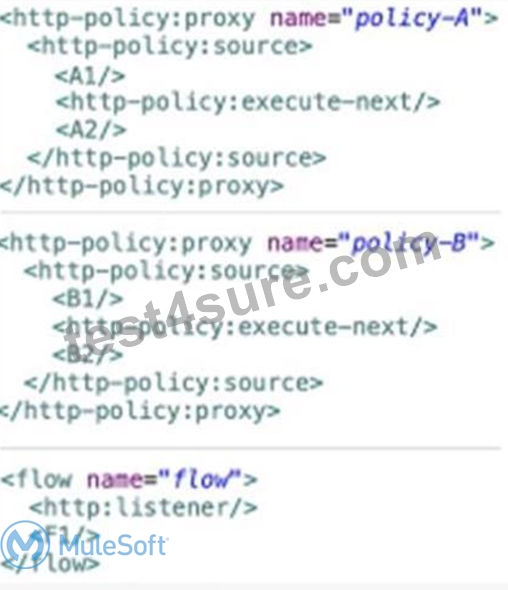
When a HTTP request arrives at the Mule application's endpoint, what will be the execution order?
- A. B1, A1, F1, A2, B2
- B. F1, A1, B1, B2, A2
- C. A1, B1, F1, B2, A2
- D. F1, B1, A1, A2, B2
Answer: C
Explanation:
Explanation
Based on the configuration below, when a HTTP request arrives at the Mule application's endpoint, the execution order will be A1, B1, F1, B2, A2. This is because policies are executed before and after the API implementation flow according to their order attribute. Policy A has order 1, which means it is executed first before Policy B, which has order 2. The flow is executed after both policies are executed before the flow.
Then, Policy B is executed after the flow before Policy A is executed after the flow. References:
https://docs.mulesoft.com/api-manager/2.x/policies-policy-order
NEW QUESTION # 31
A Mule application for processing orders must log the order ID for every log message output.
What is a best practice to enrich every log message with the order ID?
- A. Use flow variables within every logger processor to log the order ID
- B. Set a flow variable and edit the log4/2.xml file to output the variable as part of the message pattern
- C. Create a custom XML SDK component to wrap the logger processor and automatically add the order ID within the connector
- D. Use the Tracing module to set logging variables with a Mapped Diagnostic Context
Answer: D
Explanation:
Explanation
To enrich every log message with the order ID, the developer should use the Tracing module to set logging variables with a Mapped Diagnostic Context (MDC). The Tracing module allows adding custom key-value pairs to log messages using MDC variables. The developer can use Set Logging Variables operation to set the order ID as an MDC variable and then use it in any logger processor within the same thread or event.
References: https://docs.mulesoft.com/tracing-module/1.0/tracing-module-reference#set-logging-variables
NEW QUESTION # 32
A Mule application deployed to multiple Cloudhub 2.0 replicas needs to temporarily persist large files over
10MB between flow executions, and routinely needs to query whether the file data exists on separate executions.
How can this be achieved?
- A. Use an in-memory Object Store
- B. Store the key and full contents of the file, caching the filename and location between requests
- C. Store the key and full contents of the file in an Object Store
- D. Store the contents of the file on separate storage, and store the key and location of the file Object using Object Store v2
Answer: D
Explanation:
Explanation
To temporarily persist large files over 10MB between flow executions, and routinely query whether the file data exists on separate executions, the developer should store the contents of the file on separate storage, and store the key and location of the file object using Object Store v2. This way, the developer can avoid storing large files in memory or exceeding the size limit of Object Store v2 (10MB per object). The developer can also use Object Store v2 operations to query, retrieve, or delete the file object by its key. References:
https://docs.mulesoft.com/object-store/osv2-faq#can-i-store-files-in-object-store-v2
NEW QUESTION # 33
A mule application exposes and API for creating payments. An Operations team wants to ensure that the Payment API is up and running at all times in production.
Which approach should be used to test that the payment API is working in production?
- A. Create a health check endpoint that listens on a separate port and uses a separate HTTP Listener configuration from the API
- B. Create a health check endpoint that reuses the same port number and HTTP Listener configuration as the API itself
- C. Configure the application to send health data to an external system
- D. Monitor the Payment API directly sending real customer payment data
Answer: A
Explanation:
Explanation
To test that the payment API is working in production, the developer should create a health check endpoint that listens on a separate port and uses a separate HTTP Listener configuration from the API. This way, the developer can isolate the health check endpoint from the API traffic and avoid affecting the performance or availability of the API. The health check endpoint should return a simple response that indicates the status of the API, such as OK or ERROR. References:
https://docs.mulesoft.com/api-functional-monitoring/afm-create-monitor#create-a-monitor
NEW QUESTION # 34
When registering a client application with an existing API instance or API Group instance, what is required to manually approve or reject request access?
- A. To only have Exchange Administrator permission
- B. To configure the SLA tier for the application and have the Exchange Administrator permission
- C. To configure the SLA tier for the application
- D. To configure the SLA tier for the application and have the role of Organization Administrator, API Manager Environment Administrator, or the Manage Contacts permission
Answer: D
Explanation:
Explanation
To manually approve or reject request access when registering a client application with an existing API instance or API Group instance, it is required to configure the SLA tier for the application and have one of the following roles or permissions: Organization Administrator, API Manager Environment Administrator, or Manage Contracts permission. These roles or permissions allow managing client applications and contracts in API Manager. References:
https://docs.mulesoft.com/api-manager/2.x/client-applications#managing-client-applications-and-contracts
NEW QUESTION # 35
Which pattern can a web API use to notify its client of state changes as soon as they occur?
- A. Schedule Event Publisher
- B. ETL data load
- C. Shared database trigger
- D. HTTP Webhock
Answer: D
Explanation:
Explanation
A web API can use HTTP Webhook to notify its client of state changes as soon as they occur. A webhook is an HTTP callback that allows an API to send real-time notifications to another system or application when an event happens. The client registers a URL with the API where it wants to receive notifications, and then the API sends an HTTP request to that URL with information about the event. References:
https://docs.mulesoft.com/connectors/webhook/webhook-connector
NEW QUESTION # 36
A company deploys 10 public APIs to CloudHub. Each API has its individual health endpoint defined. The platform operation team wants to configure API Functional Monitoring to monitor the health of the APIs periodically while minimizing operational overhead and cost.
How should API Functional Monitoring be configured?
- A. From one public location with all 10 APIs in a single schedule
- B. From one public location with each API in its own schedule
- C. From one private location with all 10 APIs in a single schedule
- D. From 10 public locations with each API in its own schedule
Answer: A
Explanation:
Explanation
To configure API Functional Monitoring to monitor the health of 10 public APIs periodically while minimizing operational overhead and cost, the developer should use one public location with all 10 APIs in a single schedule. A public location is a worker that runs in a CloudHub shared environment, which is cheaper and easier to maintain than a private location. A single schedule allows running all 10 APIs tests at the same time and frequency, which reduces complexity and resource consumption. References:
https://docs.mulesoft.com/functional-monitoring/fm-create-monitor#create-a-monitor
NEW QUESTION # 37
A developer has created the first version of an API designed for business partners to work commodity prices.
What should developer do to allow more than one major version of the same API to be exposed by the implementation?
- A. In Anypoint Studio, generate scaffolding from the RAML, and then modify the flow names generated by APIKit to include a variable with the major version number
- B. In Design Center, open the RAML and modify each operation to include the major version number
- C. In Design Center, open the RAML and modify baseUn to include a variable that indicates the version number
- D. In Anypoint Studio, generate scaffolding from the RAML, and the modify the <http:listerner> in the generated flows to include a parameter to replace the version number
Answer: C
Explanation:
Explanation
To allow more than one major version of the same API to be exposed by the implementation, the developer should modify the baseUri property in the RAML file to include a variable that indicates the version number.
The baseUri property defines the base URL of the API and can include variables that are replaced with actual values when mocking or deploying the API. By using a variable for the version number, the developer can expose different versions of the API using different base URLs and avoid conflicts or confusion. References:
https://docs.mulesoft.com/api-designer/design-modify-raml-specs#baseuri
https://docs.mulesoft.com/api-manager/2.x/api-versioning
NEW QUESTION # 38
......
Get MCD-Level-2 Braindumps & MCD-Level-2 Real Exam Questions: https://freecert.test4sure.com/MCD-Level-2-exam-materials.html