

Pass Your Exam Easily! L4M5 Real Question Answers Updated on May 24, 2023
Actual Questions Answers Pass With Real L4M5 Exam Dumps
NEW QUESTION # 73
Which type of question should be used to receive affirmation on statement?
- A. Open
- B. Narrow
- C. Leading
- D. Closed
Answer: D
Explanation:
Different questioning styles can be used to elicit desired responses:
Text Description automatically generated
NEW QUESTION # 74
Personal power is only used in distributive approach. Is this statement true?
- A. No, because personal power can be veryhelpful in integrative approach
- B. No, because only organisational power will optimise the negotiation outcomes
- C. Yes, because one party will abuse coercive power to maximise the gain
- D. Yes, because only distributive approach to negotiation requires strong personal power
Answer: A
Explanation:
Explanation
Power, or more precisely perceptions of power,are critically important in understanding the commercial negotiation process. From a commercial negotiation point of view (under any circumstances, either integrative or distributive approach), CIPS is interested in power from both a personal and organisational perspective.
When you are negotiating on behalf of your employer, you bring the power of your organisation (its brand, reputation and purchasing spend) as well your own personal power (6 sources of personal power, based on French and Raven's power base model) to the negotiation.
In both integrative and distributive approaches, personal power plays an important role. It helps both parties push through negotiating barriers and secure commitment and final agreement LO 1, AC 1.3
NEW QUESTION # 75
What letter R in the acronym SMART stands for?
- A. Random
- B. Recommended
- C. Relevant
- D. Risk-free
Answer: C
Explanation:
Explanation
SMART is an acronym that you can use toguide your goal setting. SMART is an acronym that stands for Specific, Measurable, Achievable, Relevant, and Time-bound A student met this question in the L4M5 exam. SMART is mentioned primarily in L4M3 Commercial Contracting.
LO: Unknown, AC: Unknown
NEW QUESTION # 76
JCB is a large manufacturer of heavy machinery. The CPO is going to a negotiation with a Chinese supplier about procuring some major components. He is wondering about balance of power in the negotiation. Which of the following micro factors are most likely to shift the balance of power towards the buying organisation in this commercial negotiation? Select TWO that apply
- A. JCB's switching costs are low
- B. Suppliers are more concentrated than buyer
- C. These components are highly standardised
- D. Eruption of epidemic in supply market
- E. Buyers purchase in small volumes
Answer: A,C
Explanation:
Explanation
There are many factors that can influence the balance of power in a negotiation. These factors are classified into 3 levels:
- Macro level: STEEPLE framework: social, technological, economic, environment, political, legal and ethical
- Micro level: Porter's five forces:
Diagram Description automatically generated
- One-to-one buyer-supplier dynamics.
The question asks about the micro factors that increases buyer's bargaining power. Among 5 answers, only 2 are likely to increase buyer'spower:
- JCB's switching costs are low: Buyer may easily switch its suppliers anytime
- These components are highly standardised: The products are not different any more, buyer may choose to buy from any supplier available.
Other answers cannot be correctbecause:
- Suppliers are more concentrated than buyer: Suppliers are forming oligopoly market, their bargaining power tend to be greater.
- Eruption of epidemic in supply market: this is a macro factor. Eruption of epidemic may cause factories closed and disruptions on supply chain.
- Buyers purchase in small volumes: Buyer will be seen as less potential to suppliers. Buying organisation may have difficulties to deal better price with suppliers.
LO 1, AC 1.3
NEW QUESTION # 77
Can a party gain huge advantages innegotiation from setting room layout?
- A. Yes, because the host can freely manipulate the other party's mind through setting room layout
- B. No, because the advantages gained from manipulating room layout are short-lived
- C. No, because room layout contributes nothing to the negotiation outcomes
- D. Yes, because the other party can capitulate to the host
Answer: B
Explanation:
Essentially, for trained negotiators under most circumstances, the physical locations of negotiations and the room layout should not make much difference to the outcomes of the meeting. It is reasonable to assume that most commercial negotiations are based at least initially on a principled- or pragmatic-type approach. It is arguable also that any advantage gained through intentionally creating an uncomfortable environment to put short-term pressure on TOP is likely to be short-lived as TOP will likely reflect on this later and seek means to get even.
NEW QUESTION # 78
A negotiation is coming to the end. Both parties haven't had any official commitments. Right before leaving the room, the buyer strongly disagrees with supplier's set up prices and requests a discount. The supplier doesn't reply but nods and smiles. Can the buyer consider these actions as an acceptance?
- A. No, because nodding and smiling are not clear signs of neither acceptance nor rejection
- B. Yes, because negotiator should rely on non-verbal communications only
- C. Yes, because smiling shows supplier's readiness in signing the deal off
- D. No, because nodding and smiling are etiquette of polite rejection
Answer: A
Explanation:
Good negotiators are attuned to all stimuli and not just the verbal and written information exchanged. Tone of voice, body language, facial expressions and other clues from TOP are noticed, and with experience and knowledge, interpreted correctly. This interpretation may also involve knowledge of culture norms and values.
A smile, a 'yes' and the type of hospitality received, (in thebusiness context), can mean very different things in different international business cultures.
Trained negotiators will consider non-verbal communication (such as nodding and smiling) and body language as one source of signal from TOP, but will rarely rely wholly on this as a guide to what TOP is thinking or feeling. Furthermore, international and regional cultural considerations must be included here to avoid errors in interpretation. Emotional intelligence also has an important role in forming a more holistic perspective of what TOP may be thinking or feeling.
NEW QUESTION # 79
Jane is planning for a forthcoming negotiation with a key supplier. She has learned what are important to the supplier and what are important to her company from previous contracts between them. In order to avoid negotiation deadlocks, she has set up several concession plans. But Jane has little experience in dealing with suppliers and doesn't know when to trade these concessions. When is the best time in a negotiation to trade concessions?
- A. In the testing phase
- B. In the proposing phase
- C. At bargaining stage
- D. At opening stage
Answer: C
Explanation:
Explanation
The question asks about the point in time when Jane should make concessions with the supplier. These concessions should be traded afterpreliminary stages such as opening, testing and proposing are over and proposals move from being tentative and general to being more definite and specific. This stage is called bargaining phase. The bargaining phase is the 'meat' of the negotiation meeting.
LO 3, AC 3.1
NEW QUESTION # 80
Which of the following is considered a weakness of a 'dealer' style negotiator?
- A. Focuses on the facts and not the people
- B. Very precise
- C. May be too assertive
- D. May shift position quickly
Answer: D
Explanation:
Explanation
A useful and simple shorthand for preferred negotiation styles is summarised by four simple descriptor:
'warm', 'tough', 'logical' and 'dealer', which can beapplied to describe individuals' dominant preferred style in most circumstances.
Warm - a people person
Tough - a hard-nosed negotiator
Logic - a numbers person
Dealer - a trader who loves bargaining
Strengths, weaknesses of dealer style are described below:
Table Description automatically generated
LO 2, AC 2.4
NEW QUESTION # 81
To buying organisation, savings can be achieved from different saving levers or tactics. Which of the following are means that deliver savings through optimising specifications?
- A. Volume pooling
- B. Value engineering
- C. Compare total cost of ownership
- D. Budgetlinkages
- E. Part substitution
Answer: B,E
Explanation:
If driving greater value and efficiency from your supply base is your end, you should remember that there are many ways to do this without seeking to negotiate lowerprices. Below are 7 types of saving levers:
Table Description automatically generated
NEW QUESTION # 82
Stalemate is morelikely to happen if both parties trade more variables in a commercial negotiation. Is this assumption true?
- A. No, because more variables will facilitate more possible negotiated outcomes
- B. No, because the party who offers more variables will have lower bargaining power
- C. Yes, because more variables will cause more conflicts of interest
- D. Yes, because the negotiation will last endlessly if there aretoo many variables
Answer: A
Explanation:
Explanation
Negotiation variables such as price or contract length, etc arethat can be traded with TOP in a negotiation. The more variables you can identify, the better. The more variables you can identify and articulate, the lower the chances of the negotiation reaching deadlock as more possibilities are facilitated regarding more creative solutions.
Below are examples of negotiation tradeables in buying professional services:
Table Description automatically generated
Table Description automatically generated
LO 2, AC 2.3
NEW QUESTION # 83
Win-lose approach is most likely to be associated with which of the following type of relationship?
- A. Strategic alliance
- B. Partnership
- C. Outsourcing
- D. Adversarial
Answer: D
Explanation:
Distributive approach to negotiation used when the interested parties are attempting to divide something up or distribute something of value, also known as zero-sum approach or win-lose. Win-lose approach is useful when the relationship with the other party (TOP) is short-term and once-off.
The question mentions 4 types of relationship:
Adversarial: Both seek to maximize position at the expense of the other. Almost no trust, communication and cooperation. These suppliers will probably provide non-core products or services with the buyer purchasing them on a one-off basis.
Outsourcing relationship: Use competent suppliers to manage non-core businesses previously done in-house.
Require high level of trust and collaboration
Partnership: Both work closely on long term development by sharing information, technology and ideas.High level of trust with the aim to benefit both parties (win-win) Strategic alliance: Both parties identify areas where they could collaborate to create mutual benefits Among these 4 types ofrelationship, only adversarial is once-off. Then it is the correct answer.
NEW QUESTION # 84
A senior buyer analyses the supply market and he realises that his organisation is treated asExploit according to supplier's perspective model. What does he need to do?
- A. Adopt opaque processes
- B. Pay the suppliers on time
- C. Increase the spend value
- D. Raise the transactional costs to do business
Answer: B
Explanation:
Explanation
The supplier's perspective model has two axes: Spend value and Attractiveness:
Chart, table Description automatically generated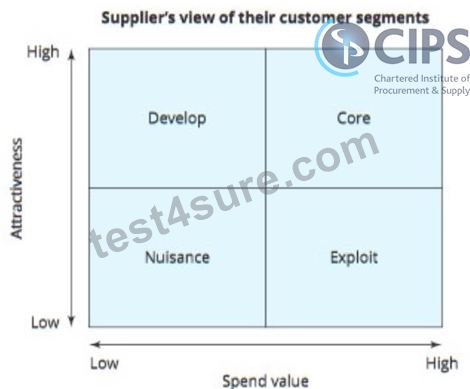
Exploit is the quadrant where the buyer has high spend but low attractiveness. Overarching supplier objective would be: "Milk this customer and charge a high price to compensate for all the painthey put us through".
The buyer should increase its attractiveness to raise the position to Core customer. To do this, a buyer may:
- Simplify procurement processes
- Simplify contracting processes
- Use clear and concise documentation
- Eliminateonerous supplier terms and conditions
- Make the payment on time
- Use transparent processes
- Promote ethical behaviours
LO 1, AC 1.4
NEW QUESTION # 85
In airline industry, suppliers prefer to adopt dynamic pricing in order to constantly monitor and change their fares inresponse to market conditions. Dynamics pricing is based on which costing method?
- A. Absorption costing
- B. Marginal costing
- C. Activity-based costing
- D. Cost plus costing
Answer: B
Explanation:
Dynamic pricing is the practice of dynamically calculating the price of a product or service in order to incorporate real-time market conditions, input costs, and/or competitive perspectives. Dynamic pricing which is based on marginal costing, is used by airlines and many other organisations.
Marginal cost is the cost of producing an additional unit of output. Marginal Costing is a costing technique wherein the marginal cost, i.e. variable cost is charged to units of cost, while the fixed cost for the period is completely written off against the contribution.
NEW QUESTION # 86
Which of the following is the first step in the development of negotiation strategies?
- A. Recognising TOP'sneeds and wants
- B. Defining overarching objectives
- C. Developing scenarios around possible options
- D. Determining your BATNA
Answer: B
Explanation:
Developing specific negotiation strategies in areas where risk or spend is high involves analysing a wide range of objectives and variables within the context of the organisation'sbusiness requirements. The first stage in any negotiation preparation is to define your overall objectives which may be related to a single variable such as price in the case of a standardised requirement, or many variables in the case of capital equipment. Your negotiating strategies and tactics will all be focused on achieving overall objectives.
NEW QUESTION # 87
In addition to organisational power, personal power of each negotiator can influence the outcomes of a negotiation. A good negotiator can leverage different sources of power. Is this statement true?
- A. Yes, because the good negotiator recognises his own power in a negotiation
- B. Yes, because allsources of power have similar effectiveness in every situation
- C. No, because each person has only one superior source of personal power
- D. No, because only organisational power can be leveraged during a negotiation
Answer: A
Explanation:
Explanation
Both organisational and personal power have the ability to influence the outcomes of negotiation. Good negotiators recognises the different sources of relative personal power they possess in a negotiation. There is no one superior source of personal power; they will vary in their effectiveness based on the situation. The more personal sources available the better, even if some not used, these can be used as a fallback.
LO 1, AC 1.3
NEW QUESTION # 88
SBL provides contract bathroom furniture and fittings for a wide variety of domestic and commercial clients.
To some suppliers, SBL spendclaims a large portion of their revenue. But SBL is famous for imposing draconian obligations on these suppliers. Which of the following is most likely to be overarching objective of these suppliers to SBL?
- A. Drop the business with SBL immediately
- B. Charge a higher price to compensate for all the pain SBL has put
- C. Hold on and keep SBL happy but make sure that the business is profitable
- D. Win and keep business with SBL at any costs, even without profits
Answer: B
Explanation:
According to Paul Steele's 'The Seller's Perspective', customer can be classified into 4 categories as below:
Chart, treemap chart Description automatically generated
In this scenario, although SBL's spend claims large portion in suppliers' revenues, their draconian treatment will reduce SBL's attractiveness in supplier's perspective.SBL falls into Exploit quadrant. With exploitable customers, suppliers tend to 'milk' the customer and charge a high price to compensate for all the pain customer put on them.
NEW QUESTION # 89
Which of the following is the internal factor that is taken intoprice of a product?
- A. Exchange rate
- B. Elasticity
- C. Customer tastes
- D. Risk management
Answer: D
Explanation:
Explanation
In order to answer this question, you should better consider each option:
'Exchange rate' is the value of one nation's currency versus thecurrency of another nation or economic zone.
This is a macroeconomic factor.
'Elasticity' refers to the degree to which individuals, consumers or producers change their demand or the amount supplied in response to price or income changes. This is a microeconomic factor Consumer tastes refer to the products and services that consumers consciously choose over others. Consumer tastes are so powerful that they can change how businesses conduct their activity. Like elasticity, this is also a microeconomic factor.
Among 4 options, only risk management is the internal factor. Risk pricing is a strategy applied by many companies in the world. To learn how to price the risk, you can read an article from McKinsey:
https://www.mckinsey.com/business-functions/marketing-and-sales/our-insights/how-to-price-risk-to-win-and-pr This is a question that a student met in her actual exam. The knowledge section is unknown.
LO: Unknown, AC: Unknown
NEW QUESTION # 90
Which of the following statements about oligopoly isincorrect?
- A. One firm's behaviour is a function of what its rivals do
- B. A few firms play an important role in the sale of a product
- C. Oligopolistic firms recognize their interdependence
- D. Prices in oligopoly are predicted to fluctuate widely and frequently
Answer: D
Explanation:
Explanation
An oligopoly exists when there are small number of producers that exert a significant influence in the market.
Oligopoly's main characteristics are discussed as follows:
- Interdependence
The most important feature of oligopolyis the interdependence in decision-making of the few firms which comprise the industry. This is because when the number of competitors is few, any change in price, output, product etc. by a firm will have a direct effect on the fortune of its rivals, which will then retaliate in changing their own prices, output or products as the case may be.
- Importance of advertising and selling costs
A direct effect of interdependence of oligopolists is that the various firms have to employ variousaggressive and defensive marketing weapons to gain a greater share in the market or to prevent a fall in their market share. For this various firms have to incur a good deal of costs on advertising and on other measures of sales promotion. Therefore, thereis a great importance of advertising and selling costs under conditions of market situation characterised by oligopoly
- Group behaviour
Another important feature of oligopoly is that for the proper solution to the problem of determination of price and output under, it analysis of group behaviour is impor-tant.
- Indeterminateness of demand curve facing an oligopolist
In this question, 'Prices in oligopoly are predicted to fluctuate widely and frequently' is an incorrect statement as producers in oligopoly often try to set up price. Prices fluctuate more frequently in perfect competition.
LO 2, AC 2.2
NEW QUESTION # 91
......
New L4M5 Dumps - Real CIPS Exam Questions: https://freecert.test4sure.com/L4M5-exam-materials.html