

The Best AD0-E605 Exam Study Material Premium Files and Preparation Tool (Feb-2026)
Get Instant Access to AD0-E605 Practice Exam Questions
NEW QUESTION # 53
What is an example of on-site personalization using Adobe RT-CDP?
- A. Exporting a customer profile report to an external system.
- B. Running a batch activation workflow for ad platforms.
- C. Sending an email campaign to a segment of customers.
- D. Displaying a personalized homepage banner based on recent browsing behavior.
Answer: D
NEW QUESTION # 54
What is a key guardrail when activating data to destinations?
- A. Data governance policies must be enforced during activation.
- B. Data must always be batch processed before activation.
- C. Only static segments can be activated.
- D. Activation can only occur during predefined time slots.
Answer: A
NEW QUESTION # 55
File-based destinations in Real-Time CDP allow customers to export data to files in various formats (such as CSV or JSON), which can then be used for marketing activation purposes.
Which three types of schedules are available for exporting profiles to file-based destinations in the Adobe Real-Time CDP? (Choose three.)
- A. On-demand (scheduled)
- B. After segment evaluation
- C. On-demand
- D. Incremental
- E. Scheduled
Answer: B,C,E
NEW QUESTION # 56
What are benefits of using the Identity Graph in Adobe RT-CDP? (Select two.)
- A. Prevents unification of structured and unstructured data.
- B. Resolves multiple identifiers into a single customer profile.
- C. Enhances manual identity mapping workflows.
- D. Enables probabilistic and deterministic identity resolution.
Answer: B,D
NEW QUESTION # 57
What are common criteria used to define segments in Adobe RT-CDP? (Select two.)
- A. Behavioral data such as purchase history.
- B. Demographic attributes such as age and gender.
- C. Static batch ingestion rules.
- D. DULE policy enforcement rules.
Answer: A,B
NEW QUESTION # 58
A data architect is tasked with enabling same-page and next-page personalization use cases via Adobe Target to ensure real-time targeting based on customer's interaction on the website.
Which two are prerequisites for activating the audiences to Adobe Target for onsite personalization? (Choose two.)
- A. Grant users access to the default workspace and the Approver role
- B. Activate the Active-On-Edge merge policy to constantly evaluate audiences on the edge
- C. Create a separate workspace in Adobe Target for real-time and next-page personalization
- D. Implement a custom merge policy to evaluate audiences in real-time
Answer: A,B
NEW QUESTION # 59
An Adobe Real-Time CDP (RTCDP) administrator would like to better control how downstream marketers enable segments for activations.
What next steps should the administrator take to better protect the dataset from being misused in activations?
- A. Lean on performance guardrails of the Adobe RTCDP
- B. Establish data usage labels across the Adobe RTCDP
- C. Configure manual review of all activations
- D. Set entity limits across Adobe RTCDP components
Answer: B
NEW QUESTION # 60
The marketer notices some strange behavior in emails that were going out and noticed a Profile that had multiple email identities.
What would the marketer do next to identify the root cause?
- A. Use the Identity graph viewer to retrieve the Identity Map linked to the profile
- B. Use the Identity API to get the details of the Identity Namespace definition
- C. Use Identity graph viewer to retrieve the list of data sources
- D. Use the Identity API to list the Identity Mappings for the email
Answer: C
NEW QUESTION # 61
An engineer has been mandated with ingesting data via the Adobe Edge Network Server API for various data coming from the website. The engineer notices that there seems to be a discrepancy with the Edge profile not qualifying in real-time for various Edge-based personalization use cases.
Upon integration, the engineer finds that mid-stream some of the data appears to be routed to a different Edge likely caused by a customer turning on/off a VPN.
How best would the engineer resolve this issue to ensure all data is always routed to the same Edge in the initiating session?
- A. Enable cross-edge synchronization to resolve discrepancies
- B. Build a middleware service to catch and resolve these issues
- C. Use the Web SDK
- D. Use location hints in their calls
Answer: D
NEW QUESTION # 62
A financial services firm uses Adobe RT-CDP to unify customer data from multiple sources, including credit card activity, email interactions, and website visits. What combination of features is critical for accurate profile assembly?
- A. Real-time activation without identity stitching.
- B. Deterministic identity resolution and the Identity Graph.
- C. Probabilistic identity resolution and edge profiles.
- D. Static schemas and batch ingestion workflows.
Answer: B
NEW QUESTION # 63
What is the primary purpose of governance in Adobe RT-CDP?
- A. Ensuring data compliance and proper usage across services.
- B. Optimizing data ingestion workflows.
- C. Creating static and dynamic segments.
- D. Performing deterministic identity resolution.
Answer: A
NEW QUESTION # 64
What actions can alerts in Adobe RT-CDP trigger? (Select two.)
- A. Warn administrators of quota breaches.
- B. Notify users of data ingestion errors.
- C. Automatically resolve identity conflicts.
- D. Activate segments without approval.
Answer: A,B
NEW QUESTION # 65
What is a common use case for batch data ingestion in Adobe RT-CDP?
- A. Real-time website interaction tracking.
- B. Periodic uploads of customer transaction history.
- C. Identity stitching for cross-device activities.
- D. Low-latency personalization for email campaigns.
Answer: B
NEW QUESTION # 66
What is a key difference between static and dynamic segments?
- A. Static segments are used for batch processing, while dynamic segments cannot be activated.
- B. Static segments support real-time updates, while dynamic segments do not.
- C. Dynamic segments only work with structured data.
- D. Dynamic segments automatically update based on real-time data, while static segments remain fixed.
Answer: D
NEW QUESTION # 67
A marketer has a requirement to enrich the audience which was already created with a few additional attributes from a specific dataset.
Which should a marketer use to create the new enriched audience?
- A. Use "Analyze audience" to add attributes to existing audience definitions
- B. Create Audience with "Compose audience" method
- C. Create Audience with "Build rule" method
- D. Create Audience with "Enrich audience" method
Answer: B
NEW QUESTION # 68
What is the primary purpose of Attribute-Based Access Control (ABAC) in Adobe RT-CDP?
- A. Assigning data access based on specific attributes of the data.
- B. Automating identity resolution processes.
- C. Enabling batch processing for customer profiles.
- D. Restricting data access based on user roles.
Answer: A
NEW QUESTION # 69
A financial institution needs to store customer transaction data along with unstructured notes from customer service interactions.
Which feature of Adobe RT-CDP should they use?
- A. Batch processing workflows.
- B. Deterministic identity resolution.
- C. Hierarchical data modeling in NoSQL schemas.
- D. Schema-on-write with strict normalization.
Answer: C
NEW QUESTION # 70
What are characteristics of hub profiles? (Select two.)
- A. Exclusive use of structured data.
- B. Real-time updates from all data sources.
- C. Support for large-scale batch processing.
- D. Centralized data storage.
Answer: B,D
NEW QUESTION # 71
What are key elements of monitoring capabilities in Adobe RT-CDP? (Select two.)
- A. Tracking ingestion failures and processing delays.
- B. Analyzing profile update errors.
- C. Exporting unified profiles to batch workflows.
- D. Configuring governance policies for data activation.
Answer: A,B
NEW QUESTION # 72
A healthcare organization using Adobe RT-CDP wants to restrict access to sensitive patient data based on geographic location.
What governance feature should they implement?
- A. Role-Based Access Control (RBAC).
- B. Attribute-Based Access Control (ABAC).
- C. Identity resolution guardrails.
- D. Real-time segmentation rules.
Answer: B
NEW QUESTION # 73
A financial institution is using Adobe RT-CDP to activate data to an ad platform. The dataset includes sensitive information such as account balances.
What guardrails should they apply during activation?
- A. Limit the activation to edge-based triggers.
- B. Include all data fields in the activation for completeness.
- C. Perform manual activation workflows.
- D. Use DULE policies to restrict sensitive data from being exported.
Answer: D
NEW QUESTION # 74
What is the primary purpose of monitoring capabilities in Adobe RT-CDP?
- A. Automating data governance policies.
- B. Exporting customer profiles to external systems.
- C. Configuring audience segments.
- D. Tracking data ingestion, profile updates, and activation workflows.
Answer: D
NEW QUESTION # 75
An Adobe Real-Time CDP (RTCDP) customer has 5 million profiles and a 300kb average profile richness license. Their current usage stands at 4 million profiles across multiple identities and
100kb profile richness. The marketing team in the organization is tasked to provide new prospect use cases to be delivered using RTCDP to increase customer acquisition. What key question should the data team ask the marketers to stay within license compliance?
- A. Number of attributes along with cardinality and the overlap with existing set of attributes in data model
- B. Number of identifiers and their respective types such as people identifier or cross-domain
- C. Number of unique prospects, average number of events per prospects, and look back period
- D. Number of customer segments that overlap with existing customer audiences
Answer: C
NEW QUESTION # 76
What is a best practice for designing a Real-Time Customer Profile in Adobe RT-CDP?
- A. Segment data into multiple unrelated schemas.
- B. Avoid enabling datasets for profile use.
- C. Create a unified schema to include all data types and relationships.
- D. Avoid creating identity namespaces for customer data.
Answer: C
NEW QUESTION # 77
An architect is tasked with onboarding e-commerce data into Adobe Experience Platform (AEP).
An ERD of the data is shown below.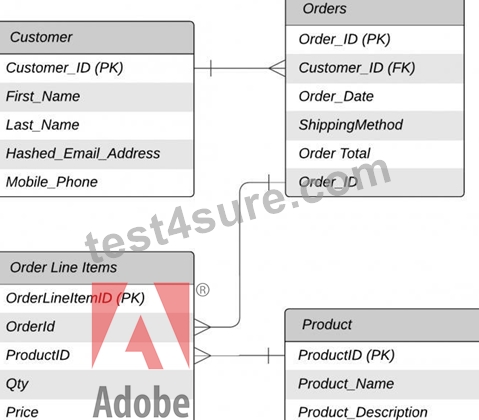
What are the three correct mappings of source entities into AEP classes? (Choose three.)
- A. Create Order Line Items as Experience Event
- B. Create Product as a Custom Class
- C. Create Orders as Experience Event
- D. Create Product and Order Line Items as custom classes
- E. Embed Order Line Items as an object array in orders
Answer: B,C,E
NEW QUESTION # 78
......
Validate your Skills with Updated AD0-E605 Exam Questions & Answers and Test Engine: https://freecert.test4sure.com/AD0-E605-exam-materials.html