

The Ultimate Microsoft AZ-400 Dumps PDF Review
Achieve The Utmost Performance In AZ-400 Exam Pass Guaranteed
NEW QUESTION # 17
You have project in Azure DevOps.
You create the following template named Template1.yml.
You create the following pipeline named File1.yml.
You need to ensure that Template1.yaml runs before File1.yml.
How should you update File1.yml?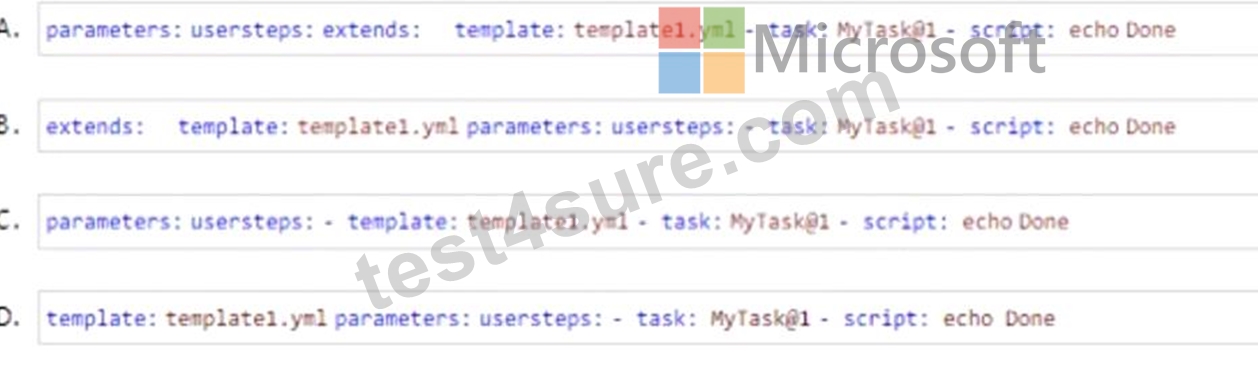
- A. Option B
- B. Option D
- C. Option C
- D. Option A
Answer: A
NEW QUESTION # 18
You have a GitHub repository that contains the source code for an app.
You need to identify all the changes made between versions 1.4.16 and 1.6.12 of the source code.
How should you complete the Git command? To answer, select the appropriate options in the answer area.
NOTE: Each correct selection is worth one point.
Git _________ ____________ | helper-script > changes.txt
Answer:
Explanation:
see the answer below.
Explanation
Answer below
git diff v1.4.16 v1.6.12 | helper-script > changes.txt
This command will compare the changes made between versions 1.4.16 and 1.6.12 of the source code in your GitHub repository, pipe the output through the helper-script and save the result to a file called "changes.txt" Please note that, this command assumes that you have a helper-script that can handle git diff output as an input and processes it further. It is not a default git command.
NEW QUESTION # 19
You are creating a NuGet package.
You plan to distribute the package to your development team privately.
You need to share the package and test that the package can be consumed.
Which four actions should you perform in sequence? To answer, move the appropriate actions from the list of actions to the answer area and arrange them in the correct order.
Answer:
Explanation:
Explanation
Step 1: Configure a self-hosted agent.
The build will run on a Microsoft hosted agent.
Step 2: Create a new Azure Artifacts feed
Microsoft offers an official extension for publishing and managing your private NuGet feeds.
Step 3: Publish the package.
Publish, pack and push the built project to your NuGet feed.
Step 4: Connect to an Azure Artifacts feed.
With the package now available, you can point Visual Studio to the feed, and download the newly published package References:
https://medium.com/@dan.cokely/creating-nuget-packages-in-azure-devops-with-azure-pipelines-and-yaml-d6fa
NEW QUESTION # 20
You have a project in Azure DevOps that contains a release pipeline. The pipeline contains two stages named QA and Prod. QA deploys code to an Azure web app named webapp1. Prod deploys code to an Azure web app named webapp2.
You need to ensure that code deployments to webapp2 are blocked if Azure Application Insights generates Failed requests alerts following the deployment of new code to webapp1.
What should you do for each stage? To answer, select the appropriate options in the answer area.
NOTE: Each correct selection is worth one point.
Answer:
Explanation:
Explanation:
NEW QUESTION # 21
Your company uses a Git source-code repository.
You plan to implement GitFlow as a workflow strategy.
You need to identify which branch types are used for production code and preproduction code in the strategy.
Which branch type should you identify for each code type? To answer, select the appropriate options in the answer area.
NOTE: Each correct selection is worth one point.
Answer:
Explanation:
Reference:
https://medium.com/@patrickporto/4-branching-workflows-for-git-30d0aaee7bf
NEW QUESTION # 22
You need to configure the alert for VM1. The solution must meet the technical requirements.
Which two settings should you configure? To answer, select the appropriate settings in the answer area.
NOTE: Each correct selection is worth one point.
Answer:
Explanation:
Explanation:
Graphical user interface, text, application Description automatically generated
Setting 1: Threshold value
Set to 80 %
Scenario: An Azure Monitor alert for VM1 must be configured to meet the following requirements:
Be triggered when average CPU usage exceeds 80 percent for 15 minutes.
Calculate CPU usage averages once every minute.
Setting 2: Aggregation granularity
Set to 15 minutes.
NEW QUESTION # 23
Your company wants to use Azure Application Insights to understand how user behaviors affect an application.
Which application Insights tool should you use to analyze each behavior? To answer, drag the appropriate tools to the correct behaviors. Each tool may be used once, more than once, or not at all. You may need to drag the split bar between panes or scroll to view content.
NOTE: Each correct selection is worth one point.
Answer:
Explanation:
Explanation
Box 1: User Flows
The User Flows tool visualizes how users navigate between the pages and features of your site. It's great for answering questions like:
How do users navigate away from a page on your site?
What do users click on a page on your site?
Where are the places that users churn most from your site?
Are there places where users repeat the same action over and over?
Box 2: Users
Box 3: Impact
Reference:
https://docs.microsoft.com/en-us/azure/azure-monitor/app/usage-flows
NEW QUESTION # 24
You need to recommend a procedure to implement the build agent for Project1.
Which three actions should you recommend be performed in sequence? To answer, move the appropriate actions from the list of actions to the answer area and arrange them in the correct order.
Answer:
Explanation:
Explanation
Scenario:
Step 1: Sign in to Azure Develops by using an account that is assigned the Administrator service connection security role.
Note: Under Agent Phase, click Deploy Service Fabric Application. Click Docker Settings and then click Configure Docker settings. In Registry Credentials Source, select Azure Resource Manager Service Connection. Then select your Azure subscription.
Step 2: Create a personal access token..
A personal access token or PAT is required so that a machine can join the pool created with the Agent Pools (read, manage) scope.
Step 3: Install and register the Azure Pipelines agent on an Azure virtual machine.
By running a Azure Pipeline agent in the cluster, we make it possible to test any service, regardless of type.
References:
https://docs.microsoft.com/en-us/azure/service-fabric/service-fabric-tutorial-deploy-container-app-with-cicd-vsts
https://mohitgoyal.co/2019/01/10/run-azure-devops-private-agents-in-kubernetes-clusters/
NEW QUESTION # 25
This question is part of a series of questions that present the same scenario. Each question in the series contains a unique solution that might meet the stated goals. Some question sets might have more than one correct solution, while others might not have a correct solution.
After you answer a question in this section, you will NOT be able to return to it. As a result, these questions will not appear in the review screen.
You have an Azure DevOps project.
Your build process creates several artifacts.
You need to deploy the artifacts to on-premises servers.
Solution: You deploy an Azure self-hosted agent to an on-premises server. You add a Copy and Publish Build Artifacts task to the deployment pipeline.
Does this meet the goal?
- A. Yes
- B. No
Answer: A
Explanation:
To build your code or deploy your software using Azure Pipelines, you need at least one agent.
If your on-premises environments do not have connectivity to a Microsoft-hosted agent pool (which is typically the case due to intermediate firewalls), you'll need to manually configure a self-hosted agent on on-premises computer(s). The agents must have connectivity to the target on-premises environments, and access to the Internet to connect to Azure Pipelines or Team Foundation Server.
References:
https://docs.microsoft.com/en-us/azure/devops/pipelines/agents/agents?view=azure-devops
NEW QUESTION # 26
Your company has four projects. The version control requirements for each project are shown in the following table.
You plan to use Azure Repos for all the projects.
Which version control system should you use for each project? To answer, drag the appropriate version control systems to the correct projects. Each version control system may be used once, more than once, or not at all.
You may need to drag the split bar between panes or scroll to view content.
NOTE: Each correct selection is worth one point.
Answer:
Explanation:
1 -> TFVS Refer :
https://docs.microsoft.com/en-us/azure/devops/repos/tfvc/control-access-team-foundation-version-control?view=
2 -> TFVS Refer :
https://docs.microsoft.com/en-us/azure/devops/repos/tfvc/add-check-policies?view=azure-devops
3 -> Git Refer :
https://docs.microsoft.com/en-us/azure/devops/repos/git/share-your-code-in-git-xcode?view=azure-devops
4 -> TFVS Refer
:https://docs.microsoft.com/en-us/azure/devops/organizations/security/permissions?view=azure-devops#tfvc
NEW QUESTION # 27
Your company is building a new web application.
You plan to collect feedback from pilot users on the features being delivered.
All the pilot users have a corporate computer that has Google Chrome and the Microsoft Test & Feedback extension installed. The pilot users will test the application by using Chrome.
You need to identify which access levels are required to ensure that developers can request and gather feedback from the pilot users. The solution must use the principle of least privilege.
Which access levels m Azure DevOps should you identify? To answer, select the appropriate options in the answer area NOTE: Each correct selection is worth one point.
Answer:
Explanation:
Explanation
Box 1: Basic
Assign Basic to users with a TFS CAL, with a Visual Studio Professional subscription, and to users for whom you are paying for Azure Boards & Repos in an organization.
Box 2: Stakeholder
Assign Stakeholders to users with no license or subscriptions who need access to a limited set of features.
Note:
You assign users or groups of users to one of the following access levels:
Basic: provides access to most features
VS Enterprise: provides access to premium features
Stakeholders: provides partial access, can be assigned to unlimited users for free References: https://docs.microsoft.com/en-us/azure/devops/organizations/security/access-levels?view=vsts
NEW QUESTION # 28
You have an Azure DevOps organization named Contoso.
You have 10 Azure virtual machines that run Windows Server 2019. The virtual machines host an application that you build and deploy by using Azure Pipelines. Each virtual machine has the Web Server (IIS) role installed and configured.
You need to ensure that the web server configurations pin the virtual machines is maintained automatically.
The solution must provide centralized management of the configuration settings and minimize management overhead.
Which four actions should you perform in sequence? To answer, move the appropriate actions from the list of actions to the answer area and arrange them in the correct order.
Answer:
Explanation:
Explanation:
Step1: Create an Azure Automation account.
An Azure Automation account is required.
Step 2: Install the custom Desired State Configuration (DSC) extension on the virtual machines Under the hood, and without an administrator having to remote into a VM, the Azure VM Desired State Configuration extension registers the VM with Azure Automation State Configuration.
Step 3: Onboard the virtual machines to the Azure Automation account.
Step 4: Complete the Desired State Configuration (DSC) configuration.
Create a DSC configuration.
Reference:
https://docs.microsoft.com/en-us/azure/automation/automation-dsc-onboarding
NEW QUESTION # 29
You plan to create alerts that will be triggered based on the page load performance of a home page.
You have the Application Insights log query shown in the following exhibit.
Use the drop-down menus to select the answer choice that completes each statement based on the information presented in the graphic.
NOTE: Each correct selection is worth one point.
Answer:
Explanation:
Explanation
Timeline Description automatically generated with low confidence
Box 1: percentile_duration_95
Box 2: success
For example -
requests
| project name, url, success
| where success == "False"
This will return all the failed requests in my App Insights within the specified time range.
Reference:
https://devblogs.microsoft.com/premier-developer/alerts-based-on-analytics-query-using-custom-log-search/
NEW QUESTION # 30
You are configuring Azure Pipelines for three projects in Azure DevOps as shown in the following table.
Which version control system should you recommend for each project? To answer, drag the appropriate version control systems to the correct projects. Each version control system may be used once, more than once, or not at all. You may need to drag the split bar between panes or scroll to view content.
NOTE: Each correct selection is worth one point.
Answer:
Explanation:
Reference:
https://www.azuredevopslabs.com/labs/azuredevops/yaml/
https://enterprise.github.com/faq
NEW QUESTION # 31
You plan to deploy a runbook that will create Azure AD user accounts.
You need to ensure that runbooks can run the Azure PowerShell cmdlets for Azure Active Directory.
To complete this task, sign in to the Microsoft Azure portal.
Answer:
Explanation:
See solution below.
Explanation
Azure Automation now ships with the Azure PowerShell module of version 0.8.6, which introduced the ability to non-interactively authenticate to Azure using OrgId (Azure Active Directory user) credential-based authentication. Using the steps below, you can set up Azure Automation to talk to Azure using this authentication type.
Step 1: Find the Azure Active Directory associated with the Azure subscription to manage:
1. Log in to the Azure portal as the service administrator for the Azure subscription you want to manage using Azure Automation. You can find this user by logging in to the Azure portal as any user with access to this Azure subscription, then clicking Settings, then Administrators.
2. Note the name of the directory associated with the Azure subscription you want to manage. You can find this directory by clicking Settings, then Subscriptions.
Step 2: Create an Azure Active Directory user in the directory associated with the Azure subscription to manage:
You can skip this step if you already have an Azure Active Directory user in this directory. and plan to use this OrgId to manage Azure.
1. In the Azure portal click on Active Directory service.
2. Click the directory name that is associated with this Azure subscription.
3. Click on the Users tab and then click the Add User button.
4. For type of user, select "New user in your organization." Enter a username for the user to create.
5. Fill out the user's profile. For role, pick "User." Don't enable multi-factor authentication. Multi-factor accounts cannot be used with Azure Automation.
6. Click Create.
7. Jot down the full username (including part after @ symbol) and temporary password.
Step 3: Allow this Azure Active Directory user to manage this Azure subscription.
1. Click on Settings (bottom Azure tab under StorSimple)
2. Click Administrators
3. Click the Add button. Type the full user name (including part after @ symbol) of the Azure Active Directory user you want to set up to manage Azure. For subscriptions, choose the Azure subscriptions you want this user to be able to manage. Click the check mark.
Step 4: Configure Azure Automation to use this Azure Active Directory user to manage this Azure subscription Create an Azure Automation credential asset containing the username and password of the Azure Active Directory user that you have just created. You can create a credential asset in Azure Automation by clicking into an Automation Account and then clicking the Assets tab, then the Add Setting button.
Note: Once you have set up the Azure Active Directory credential in Azure and Azure Automation, you can now manage Azure from Azure Automation runbooks using this credential.
References:
https://azure.microsoft.com/sv-se/blog/azure-automation-authenticating-to-azure-using-azure-active-directory/
NEW QUESTION # 32
......
The AZ-400 certification exam is part of Microsoft's role-based certification program, which is designed to validate the candidate's skills and expertise in various job roles. The AZ-400 exam is intended for professionals who are involved in the design, implementation, and management of DevOps solutions using Microsoft Azure technologies. AZ-400 exam is suitable for DevOps engineers, automation engineers, release engineers, and IT professionals who want to enhance their skills and advance their careers in the DevOps field.
For more info visit:
MICROSOFT AZ-400 Exam Reference, and Microsoft Documents
Achive your Success with Latest Microsoft AZ-400 Exam: https://freecert.test4sure.com/AZ-400-exam-materials.html