

XSIAM-Analyst Questions Pass on Your First Attempt Dumps for Security Operations Certified
XSIAM-Analyst Practice Test Pdf Exam Material
NEW QUESTION # 40
Match each incident creation factor with its corresponding mechanism:
Factor
A) Correlation Alert
B) BIOC Detection
C) IOC Match
D) Manual Investigation
Mechanism
1. Multi-source rule logic
2. Endpoint behavior anomalies
3. Static threat intelligence indicator trigger
4. User-initiated case creation
Response:
- A. A-4, B-2, C-3, D-1
- B. A-1, B-2, C-4, D-3
- C. A-1, B-3, C-2, D-4
- D. A-1, B-2, C-3, D-4
Answer: D
NEW QUESTION # 41
SCENARIO:
A security analyst has been assigned a ticket from the help desk stating that users are experiencing errors when attempting to open files on a specific network share. These errors state that the file format cannot be opened. IT has verified that the file server is online and functioning, but that all files have unusual extensions attached to them.
The security analyst reviews alerts within Cortex XSIAM and identifies malicious activity related to a possible ransomware attack on the file server. This incident is then escalated to the incident response team for further investigation.
Upon reviewing the incident, the responders confirm that ransomware was successfully executed on the file server. Other details of the attack are noted below:
* An unpatched vulnerability on an externally facing web server was exploited for initial access
* The attackers successfully used Mimikatz to dump sensitive credentials that were used for privilege escalation
* PowerShell was used on a Windows server for additional discovery, as well as lateral movement to other systems
* The attackers executed SystemBC RAT on multiple systems to maintain remote access
* Ransomware payload was downloaded on the file server via an external site "file io" QUESTION STATEMENT:
Which forensics artifact collected by Cortex XSIAM will help the responders identify what the attackers were looking for during the discovery phase of the attack?
- A. Shell history
- B. WordWheelQuery
- C. PSReadline
- D. User access logging
Answer: A
Explanation:
The correct answer isD - Shell history.
TheShell historyartifact provides a detailed record of commands executed during interactive shell sessions (such as via PowerShell or command prompt) on Windows and Linux systems. Reviewing this artifact enables responders to reconstruct the attacker's activity during thediscovery phase, showing exactly what directories, files, and commands were accessed or run, and what the attackers were searching for.
"The Shell history artifact allows responders to see what commands were executed during the attack, providing insight into attacker intent and discovery activities." Document Reference:XSIAM Analyst ILT Lab Guide.pdf Page:Page 46 (Incident Handling section, Causality and Forensics)
NEW QUESTION # 42
Match each XDM type with the type of data it organizes:
XDM Type
A) xdm.network_traffic
B) xdm.endpoint_alert
C) xdm.process
D) xdm.file_event
Data Organized
1. Communication details between hosts
2. Alert data from XDR agent or third-party systems
3. Executed process and command-line activity
4. File read/write, access, and creation actions
Response:
- A. A-4, B-2, C-3, D-1
- B. A-1, B-4, C-3, D-2
- C. A-1, B-3, C-2, D-4
- D. A-1, B-2, C-3, D-4
Answer: D
NEW QUESTION # 43
You're analyzing a suspicious process chain. Which two XDM datasets would help correlate process behavior with alert generation?
Response:
- A. xdm.file_event
- B. xdm.process
- C. xdm.endpoint_alert
- D. xdm.asset
Answer: B,C
NEW QUESTION # 44
You are hunting for endpoints that have recently executed PowerShell commands. Which two XQL query steps are appropriate?
Response:
- A. Use the xdm.process table
- B. Export user reports from SIEM
- C. Filter events by command-line arguments
- D. Query the xdm.asset table for policy info
Answer: A,C
NEW QUESTION # 45
Which interval is the duration of time before an analytics detector can raise an alert?
- A. Deduplication period
- B. Activation period
- C. Training period
- D. Test period
Answer: C
Explanation:
The correct answer isC - Training period.
Analytics detectors within Cortex XSIAM utilize atraining periodto establish a baseline of normal behavior.
During this interval, the detector learns and identifies patterns and behaviors that are considered normal within the environment. Once the training period is complete, the detector can accurately detect and raise alerts on anomalies.
Other intervals mentioned do not match the definition:
* Activation period:Refers to the time from activation to full functionality.
* Test period:Typically refers to internal or manual testing stages.
* Deduplication period:The time during which similar alerts are suppressed.
"Analytics detectors require an initial training period to learn normal patterns before being able to accurately raise alerts." Document Reference:EDU-270c-10-lab-guide_02.docx (1).pdf Exact Page:Page 28 (Alerting and Detection Processes Section)
NEW QUESTION # 46
Based on the image below, which two determinations can be made from the causality chain? (Choose two.)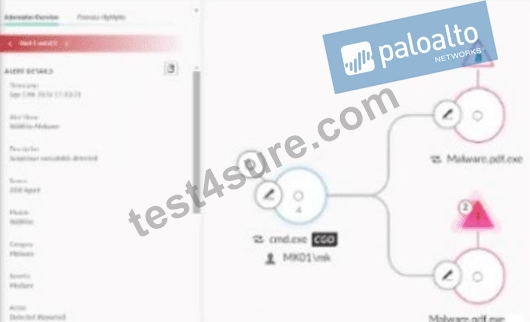
- A. Cortex XDR agent malware profile module applied is set to "Report" mode.
- B. Malware.pdf.exe is responsible for the entire chain of execution resulting in the alerts.
- C. Three alerts in total were generated by the agent on the endpoint.
- D. The process cmd.exe is responsible for the entire chain of execution resulting in the alerts.
Answer: A,D
Explanation:
Comprehensive and Detailed Explanation From Exact Extract:
* D (Correct):The process cmd.exe is marked as theCausality Group Owner (GCO)in the image, meaning it is the root process responsible for spawning or causing the rest of the chain, including the execution of Malware.pdf.exe.
* B (Correct):Thealert iconsshown next to Malware.pdf.exe are typical when the malware profile is set to "Report" mode, which allows detection and alerting on the behavior without actively blocking it (otherwise, the process would not execute fully, and you'd see prevention action).
* A (Incorrect):While Malware.pdf.exe is shown as responsible for generating the alerts, the entire chain starts from cmd.exe, not Malware.pdf.exe.
* C (Incorrect):The image shows two alert icons, not three, so this statement cannot be determined as true from the causality chain.
"The GCO (Causality Group Owner) in the causality chain visual indicates the parent/root process. If a prevention profile is set to Report, the process is logged and not blocked." Document Reference:XSIAM Analyst ILT Lab Guide.pdf, Page 46 (Incident Handling - Causality Investigation)
NEW QUESTION # 47
While analyzing a phishing campaign, you need to validate domains. What steps can assist your analysis?
(Choose two)
Response:
- A. Restart endpoint agent
- B. Modify domain TTL
- C. Look up domain verdicts
- D. Cross-reference with indicator graph
Answer: C,D
NEW QUESTION # 48
Which two methods can be used to create and share queries into the Query Library? (Choose two.)
- A. From the Query Center, locate the query to save to a personal Query Library. Right-click, and select
"Save query to library". Enable the "Share with others" option - B. From XQL Search, locate the query to save to a personal Query Library. Right-click, and select "Save query to library". Enable the "Share with others" option
- C. From XQL Search, in the XQL query field, define the parameters of the query. Save as, and choose the
"Query to Library" option. Enable the "Share with others" option - D. From the Query Center, in the XQL query field, define the parameters of the query. Save as, and choose the "Query to Library" option. Enable the "Share with others" option
Answer: B,C
Explanation:
The correct answers areB and C.
* FromXQL Search, you can save existing queries directly to your personal Query Library and then choose to share them with others by enabling the sharing option.
* You can also build new queries in the XQL Search field, then use "Save as" and select "Query to Library," followed by enabling the "Share with others" option.
"Queries can be created and saved to the Query Library from XQL Search either by saving existing queries or using the 'Save as' feature after building a new query. The 'Share with others' option allows for team collaboration." Document Reference:XSIAM Analyst ILT Lab Guide.pdf Page:Page 25 (Dashboards, Reports, and Widgets section)
NEW QUESTION # 49
An on-demand malware scan of a Windows workstation using the Cortex XDR agent is successful and detects three malicious files. An analyst attempts further investigation of the files by right-clicking on the scan result, selecting "Additional data," then "View related alerts," but no alerts are reported.
What is the reason for this outcome?
- A. The malicious files were false positives and were automatically removed from the scan results
- B. The malicious files are currently in an excluded directory in the Malware Profile
- C. The malicious files were true positives and were automatically quarantined from the scan results
- D. The malware scan action detects malicious files but does not generate alerts for them
Answer: D
Explanation:
The correct answer isB. The malware scan action detects malicious files but does not generate alerts for them.
In Cortex XSIAM and XDR, an on-demand malware scan effectively identifies malicious files on an endpoint. However, such scans typically record their findings directly in the scan results without generating separate alerts. Alerts are generally created through real-time protection mechanisms or detection rules, not through manually triggered scans.
Exact Reference from Official Document:
"The on-demand malware scan capability is designed to detect and identify malicious files but does not automatically generate alerts for those files. Alerts are primarily generated through real-time endpoint protection policies and detection rules." Therefore, the absence of alerts despite successful malware detection is due to the designed behavior of on- demand scans.
NEW QUESTION # 50
Two indicators share a relationship with a command-and-control domain. What can the indicator graph reveal?
(Choose two)
Response:
- A. Whether an endpoint was isolated
- B. How indicators are visually linked
- C. Related file hashes or domains
- D. The causality chain of the indicators
Answer: B,C
NEW QUESTION # 51
An incident context tab shows:
- User = jsmith@corp
- Affected endpoints = 2
- Alerts = file modification, process injection
What can be concluded?
Response:
- A. Alerts are isolated and unrelated
- B. The same user was involved across multiple assets
- C. The incident links multiple alerts and assets to the same identity
- D. This is likely an HR system error
Answer: B,C
NEW QUESTION # 52
For a critical incident, Cortex XSIAM suggests several playbooks which should have been executed automatically.
Why were the playbooks not executed?
- A. Playbook loggers were not configured for those alerts.
- B. Playbook classifier was not configured for the alert type.
- C. Installation of the appropriate content pack was not completed.
- D. Misconfiguration of the connector instance has occurred.
Answer: C
Explanation:
The correct answer is C - Installation of the appropriate content pack was not completed.
If the relevant playbooks are not executed automatically-even though Cortex XSIAM suggests them-it is often due to the required content pack not being installed. Playbooks and their dependencies are delivered through content packs, and unless the content pack is fully installed and enabled, those playbooks cannot run automatically.
"Playbooks may not execute if the required content pack is not installed or enabled in Cortex XSIAM." Document Reference: XSIAM Analyst ILT Lab Guide.pdf Page: Page 38 (Automation and Playbooks section)
NEW QUESTION # 53
During a simulated attack, your sub-playbook fails and causes the parent playbook to stop. How can this behavior be improved?
(Choose two)
Response:
- A. Use retry-on-failure parameters
- B. Set sub-playbook error handling to continue
- C. Replace sub-playbooks with PDFs
- D. Disable logging
Answer: A,B
NEW QUESTION # 54
SCENARIO:
A security analyst has been assigned a ticket from the help desk stating that users are experiencing errors when attempting to open files on a specific network share. These errors state that the file format cannot be opened. IT has verified that the file server is online and functioning, but that all files have unusual extensions attached to them.
The security analyst reviews alerts within Cortex XSIAM and identifies malicious activity related to a possible ransomware attack on the file server. This incident is then escalated to the incident response team for further investigation.
Upon reviewing the incident, the responders confirm that ransomware was successfully executed on the file server. Other details of the attack are noted below:
* An unpatched vulnerability on an externally facing web server was exploited for initial access
* The attackers successfully used Mimikatz to dump sensitive credentials that were used for privilege escalation
* PowerShell was used on a Windows server for additional discovery, as well as lateral movement to other systems
* The attackers executed SystemBC RAT on multiple systems to maintain remote access
* Ransomware payload was downloaded on the file server via an external site "file io" QUESTION STATEMENT:
Which hunt collection category in Cortex XSIAM should the incident responders use to identify all systems where the attackers established persistence during the attack?
- A. Command History
- B. Process Execution
- C. Remote Access
- D. Network Data
Answer: C
Explanation:
The correct answer isA - Remote Access.
TheRemote Accesshunt collection category in Cortex XSIAM is specifically designed to help incident responders identify endpoints where attackers have installed remote access tools (RATs) or backdoors, which are classic methods of attacker persistence. In this scenario, the attackers executedSystemBC RATon multiple systems to maintain remote access, making the "Remote Access" category the most relevant for finding all endpoints where persistence was established.
"Remote Access hunt collections in Cortex XSIAM identify the presence of remote access tools such as RATs and backdoors used by attackers to maintain persistence on endpoints. Analysts should review this collection category after incidents involving tools like SystemBC RAT." Document Reference:XSIAM Analyst ILT Lab Guide.pdf, Page 28 (Alerting and Detection / Threat Intel Management sections)
NEW QUESTION # 55
Which type of alert in Cortex XSIAM is primarily based on endpoint telemetry and behavior?
Response:
- A. BIOC
- B. Correlation
- C. IOC
- D. XDR Agent
Answer: A
NEW QUESTION # 56
What forensic data is most useful for determining malware persistence on a host?
Response:
- A. Network flows
- B. Auto-start registry entries
- C. Parent process tree
- D. DNS queries
Answer: B
NEW QUESTION # 57
A Cortex XSIAM analyst is investigating a security incident involving a workstation after having deployed a Cortex XDR agent for 45 days. The incident details include the Cortex XDR Analytics Alert "Uncommon remote scheduled task creation." Which response will mitigate the threat?
- A. Allow list the processes to reduce alert noise.
- B. Prioritize blocking the source IP address to prevent further login attempts.
- C. Revoke user access and conduct a user audit
- D. Initiate the endpoint isolate action to contain the threat.
Answer: D
Explanation:
The correct answer isA - Initiate the endpoint isolate action to contain the threat.
For incidents indicating possible remote compromise or unauthorized task creation, the most effective initial response isendpoint isolation. This cuts off the endpoint's network access, preventing lateral movement and limiting attacker activity until further investigation and remediation.
"The endpoint isolate action is the primary containment step in incidents involving suspected remote compromise, halting network communication to reduce further risk." Document Reference:XSIAM Analyst ILT Lab Guide.pdf Page:Page 40 (Incident Handling/SOC section)
NEW QUESTION # 58
Based on the artifact details in the image below, what can an analyst infer from the hexagon-shaped object with the exclamation mark (!) at the center?
- A. The WildFire verdict returned is "Low Confidence."
- B. The artifact verdict has changed from a previous state to "Malware."
- C. The malicious artifact was injected.
- D. The malware requires further analysis.
Answer: B
Explanation:
Comprehensive and Detailed Explanation From Exact Extract:
The correct answer isB - The artifact verdict has changed from a previous state to "Malware." Thehexagon-shaped object with an exclamation markin Cortex XSIAM artifact analysis indicates achange or escalation in verdict-typically from "Unknown" or another previous state to "Malware." This symbol is a visual cue for analysts to pay attention to the updated status, as the system has reclassified the file/object to
"Malware" based on new intelligence or analysis.
"The exclamation mark in a hexagon is used to signal that the verdict of the artifact has changed, most commonly to indicate a new classification as 'Malware.'" Document Reference:XSIAM Analyst ILT Lab Guide.pdf Page:Page 37 (Threat Intel Management section, Artifact verdict/status changes)
NEW QUESTION # 59
An alert for malware propagation triggers an incident. The associated playbook isolates the endpoint and notifies the SOC team. What advantages does this approach provide?
(Choose two)
Response:
- A. Allows unrestricted user activity
- B. Prevents SOC teams from seeing alert metadata
- C. Automates critical response actions
- D. Reduces mean time to respond (MTTR)
Answer: C,D
NEW QUESTION # 60
A threat hunter discovers a true negative event from a zero-day exploit that is using privilege escalation to launch "Malware pdf.exe". Which XQL query will always show the correct user context used to launch
"Malware pdf.exe"?
- A. config case_sensitive = false | dataset = xdr_data | filter event_type = ENUM.PROCESS | filter action_process_image_name = "Malware.pdf.exe" | fields actor_process_username
- B. config case_sensitive = false | dataset = xdr_data | filter event_type = ENUM.PROCESS | filter action_process_image_name = "Malware.pdf.exe" | fields causality_actor_effective_username
- C. config case_sensitive = false | datamodel dataset = xdrdata | filter xdm.source.process.name = "Malware.
pdf.exe" | fields xdm.target.user.username - D. config case_sensitive = false | dataset = xdr_data | filter event_type = ENUM.PROCESS | filter action_process_image_name = "Malware.pdf.exe" | fields action_process_username
Answer: B
Explanation:
The correct answer isA- the query using the fieldcausality_actor_effective_username.
When analyzing events where privilege escalation is used, it is essential to identify the original effective user that initiated the causality chain, not merely the process's own running user (as provided by other fields). The fieldcausality_actor_effective_usernamespecifically provides the effective username context of the actor behind the entire chain of actions that resulted in launching the suspicious executable.
Explanation of fields from Official Document:
* causality_actor_effective_username: This field indicates the original effective user who started the entire causality chain.
* actor_process_usernameandaction_process_username: These fields indicate the immediate process username, not necessarily reflecting the correct original context when privilege escalation occurs.
Therefore, to always identify the correct user context in privilege escalation scenarios, optionAis the verified correct answer.
NEW QUESTION # 61
Which two statements apply to IOC rules? (Choose two)
- A. They can be excluded using suppression rules but not alert exclusions.
- B. They can be used to detect a specific registry key.
- C. They can be uploaded using REST API.
- D. They can have an expiration date of up to 180 days.
Answer: B,C
Explanation:
Correct answers areA and D.
* Option A (Correct): IOC rules within Cortex XSIAM can detect specific indicators such as files, registry keys, IP addresses, hashes, and URLs.
* Option D (Correct): IOC rules can indeed be uploaded or updated programmatically using REST APIs, enabling automation and bulk management.
Options B and C are incorrect due to the following reasons:
* Expiration dates for IOC rules vary depending on system settings, and there is no strict 180-day limit explicitly defined in the provided documentation.
* IOC rules are managed through general alert exclusion mechanisms as well as through suppression rules.
"IOC rules can detect specific files, hashes, registry keys, IP addresses, and URLs and can be managed programmatically via REST API." Document Reference:EDU-270c-10-lab-guide_02.docx (1).pdf Exact Page:Page 33 (Alerting and Detection section)
NEW QUESTION # 62
When a sub-playbook loops, which task tab will allow an analyst to determine what data the sub-playbook used in each iteration of the loop?
- A. Outputs
- B. Results
- C. Inputs
- D. Input Results
Answer: D
Explanation:
The correct answer isA - Input Results.
In Cortex XSIAM playbooks, when sub-playbooks are configured to loop, theInput Resultstab within the task view allows analysts to see exactly what input data was provided to the sub-playbook during each iteration of the loop. This is essential for understanding playbook behavior and troubleshooting automation flows.
"The Input Results tab in the playbook task provides visibility into the data supplied to a sub-playbook for every loop iteration, allowing analysts to review how the input changes across executions." Document Reference:XSIAM Analyst ILT Lab Guide.pdf Page:Page 39 (Automation section)
NEW QUESTION # 63
You need to test a custom malware quarantine playbook. Why would you use the Playground?
(Choose two)
Response:
- A. To avoid impacting live environments
- B. To export playbook results to XQL
- C. To trigger alert notifications to users
- D. To simulate and debug response logic
Answer: A,D
NEW QUESTION # 64
......
XSIAM-Analyst [Sep-2025] Newly Released] Exam Questions For You To Pass: https://freecert.test4sure.com/XSIAM-Analyst-exam-materials.html